CarL Reflection Model
The CARL reflective model provides students/practitioners with a simple, quick and usable framework for analysing experiences.
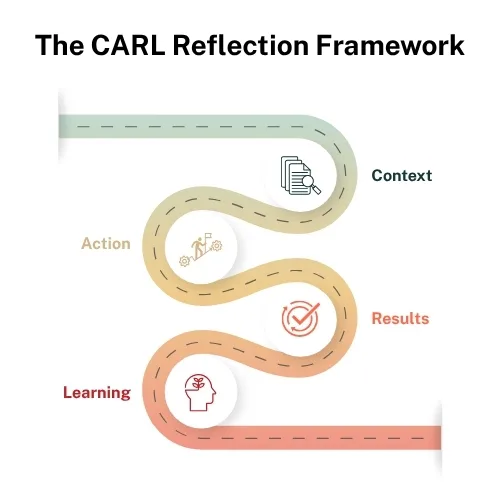
The CARL Reflection Framework
The CARL reflective model provides students/practitioners with a simple, quick and usable framework for analysing experiences. The model was first adapted from frameworks commonly used in job interviews and provides several elements to move from a description simply about an experience, to a meaningful reflection. Frameworks are contextualized by the transition:
Context → Action → Result → Learning.
The CARL framework is very relevant to career-practice reflective work, placement diaries and ’employability’ based
Assessments. However, the framework is highly useful in a variety of other academic disciplines to help foster self-awareness and personal growth (for example, teaching, business, healthcare, management and leadership).
1. Context – Setting the Scene
At this stage, provide an overview of the background or circumstances related to your reflection. You want to describe the context, people in it, what you were doing, and your purpose.
Guiding questions:
Forget the detail that doesn’t matter, describe the important context for your actions and learning.
Example A – Ongoing Skill Development:
As part of my
professional development, I am trying to improve my skill of confidently speaking to groups. I volunteer for a
presentation at an open day at a University, outlining my course and talking about the course material.
Example B – One-Time Experience:
I delivered a 20-minute presentation at a local school for a group of 30 high school students exploring university courses. I could structure the session and content as I wanted.
2. Action - What You Did
This part describes the actions you took during the experience. Besides describing what you did, you should also provide a critical evaluation of the choices you made and to some extent possible actions that were available to you.
Guiding Questions:
Example A – Ongoing Skill Development:
I prepared a primer about our academic programme containing logistical information related to course and assessment structure. I was torn to say yes to a presentation, as I was pressed for time, and I viewed the opportunity as an opportunity to practice planning and executing a public speaking presentation.
Example B – One-Time Experience:
I used a slide deck, with a lot of text to frame my talk on detail admissions criteria and timelines. I generally prefer visual appeal and interacting with audiences, but I accepted it given time and ability to convey clear information.
3. Results - Outcomes and Impact
Think about what happened as a result of your actions and evaluate what the effect was for you and for others. This step lets you really start to think about the impact of your actions.
Guiding Questions:
Example A - Ongoing skill development:
The event gave me some good practice to talk to an unknown audience and helped develop my confidence. I realised, however, that my delivery lacked structure and could have been better and more involving. I learnt that when preparing it is important to not just consider the words; you also have to consider the audience.
Example B – One-Time Experience:
While I felt calm and delivered the session relevantly, the students seemed disconnected and were simply pre-occupied taking notes. They showed no interest at all in what I was saying. All I had done was a one-way talk, which had not engaged them in the topic.
4. Learning – Key Takeaways
In this final phase, you start to pull everything together and think about what you have learned about yourself, your capabilities, and how you want to respond differently in the future.
Guiding Questions:
Example A – Ongoing Skill Development:
I’ve learned that exposure to a public speaking situation regularly, has trained me to reduce my anxiety and improve my fluency. But just confidence is not enough—I am also working on tailoring the structure and the style of the session to the audience. In the future, I will leave time to practice the delivery and design material that engages the audience.
Example B – One-Time Experience:
I have learned the significance of audience engagement as opposed to only providing them information. I have real-time knowledge from the educational theory aspect, recognizing techniques such as open-ended questions and group discussion (Michel et al., 2009) will help the learning outcomes of the co-learning. In future presentations, I will incorporate more two-way communication and visuals/activities that elicit audience involvement.
Benefits of the CARL Framework
Functional, concise and straightforward
At this stage, provide an overview of the background or circumstances related to your reflection
Supports outcome-focused thought and building self-awareness
Can framed to include theory at any stage
Use in interviews, reflections on placements, or academic work.
Reference :
Adapted from:
BlueSteps (2011). The CAR interview technique. Adapted into reflective use in academic and career development contexts.
Table Of the Content