

Four F’s Reflection Model
The Four F’s Model of Reflection provides a straightforward yet powerful framework for critically reflecting on experiences in the real world.
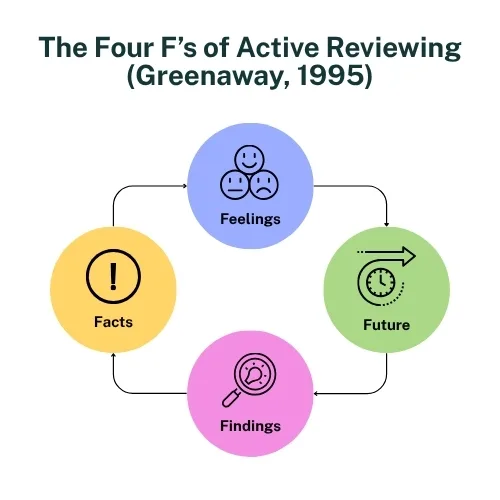
The Four F’s of Active Reviewing (Greenaway, 1995)
The Four F’s Model of Reflection provides a straightforward yet powerful framework for critically reflecting on experiences in the real world. Dr. Roger Greenaway introduced this concept as an effective framework for students and professionals engaged in experiential learning, including those involved in practical placements or work-based dissertations.
It splits the reflection process into four key elements:
Facts – What did really happen?
Feelings – What did it feel like emotionally?
Findings – What did you learn or realize?
Future – What actions can you take in the future?
This model is ideal for reflective writing in nursing, education, business, social science, management etc.
1. Facts – Objective Snapshot
Begin with an objective and neutral account of the situation, without opinion or assumption; so, recount what you observed, did or heard.
Ask yourself:
- What happened? Who was there? Where and when?
- What was unusual, surprising or predictable?
- What was the critical turning point or pivotal moment in the situation?
- What didn't happen that you expected?
Tip: Think like a journalist writing a short article
2. Feelings – Emotional Reactions
This section allows you to explore your emotional experience of the event. Thinking honestly about your emotions may help you better understand your actions and decisions.
Ask yourself:
- What was I feeling during and after the event?
- What were the moments that evoked powerful emotions?
- What were the emotional highs and lows?
- How did I demonstrate or manage my feelings?
Tip: When it comes to this section, the goal is to describe the emotions without being critical of the overall situation yet.
3. Findings – Lessons Learned
This section will allow you to think critically about the situation and get something out of the experience. You want to look at both the good and the bad and consider why it happened the way it did.
Ask yourself:
- What went well or poorly?
- What part did my emotions or assumptions play in this?
- What are the opportunities that I missed?
- What feedback did I get from others?
- What do I understand better now?
Tip: Link this section to personal learning and development of skills.
4. Future – Planning Ahead
Think about what you will do, because of what you’ve learned. When considering next moves, be specific about how you will approach the same situations differently in the future, as well as how you plan to keep track of changes over time.
Ask yourself:
- How will I handle similar future situations?
- What new habits or strategies can I employ?
- What supports/resources do I plan to use to prepare?
- How will I hold myself accountable for my change?
Tip: Your action plan should be reasonable, practical, and measurable.
Sample Use Case (Condensed)
Scenario: A restaurant server made a mistake by forgetting a table’s drinks order during rush hour.
Facts: The server tried to memorize the drinks order, got overwhelmed, and forgot the drinks.
Feelings: Embarrassment, guilt, disappointment.
Findings: The server overestimated their memory abilities; and learned they needed some tools (e.g., notepad to write down drinks).
Future: The server will carry a notepad and deliberately create the habit of taking notes on busy nights.
Why Use the Four F's?
Reference
- Greenaway, R. (1995). The Active Reviewing Cycle. Active Reviewing Guide.