
Driscoll's Reflective Model
The following three questions, aligned with Driscoll’s reflective model, guide learners through the initial stage of reflecting on an experience.What? So What? Now What? — Driscoll's Reflective Model
Driscoll’s Model (1994) is one of the simplest and most useful reflective models available today, based upon the earlier model proposed by Terry Borton, which established the framework for this, and many other models of reflection, with his original proposal in 1970. The following three questions, aligned with Driscoll’s reflective model, guide learners through the initial stage of reflecting on an experience.What? → So What? → Now What?
This framework allows learners to break their experience down into manageable elements in order to consider the significance of aspects of the experience, and then, relating their learning back to action in the future. Driscoll’s model is widely used throughout nursing, healthcare, education, business, and the social sciences – particularly where reflection is required in learning tasks and professional development portfolios.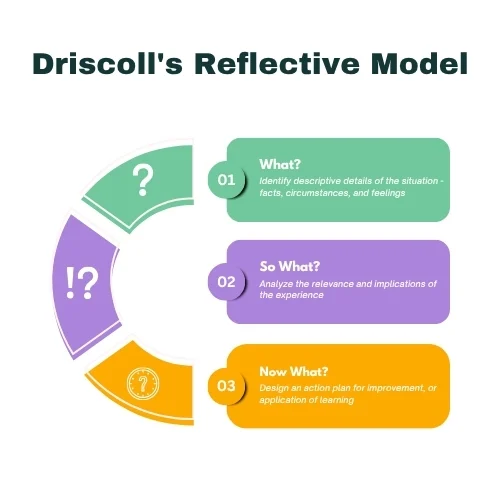
Model Overview
| Stage | Purpose |
| What? | Identify descriptive details of the situation – facts, circumstances, and feelings |
| So What? | Analyze the relevance and implications of the experience |
| Now What? | Design an action plan for improvement, or application of learning |
Stage 1: What?
It is the first stage of analysis, where the experience is literally and emotionally described.Ask yourself:
Example - Assignment Feedback
” I got a terrible, miserable grade on an essay I did in one day. I had an opportunity to get feedback from a peer in class, but I didn’t take advantage of it, due to time pressure. Now I am feeling stressed out and like I regret it.”Example - Workshop Participation
“I did not speak in a group workshop, because I had no confidence. I didn’t know the group and felt like an outsider, so I did not speak up, even though I had ideas.”Step 2: So What?
In the ‘So What’ stage, we explore meaning through causation, behaviours, and outcomes. Tying in theories or other knowledge as applied can support this section.Ask Yourself:
Example – Assignment Feedback
“I learnt I must manage my time better. I missed a chance at feedback, which would have improved my outcome. The stress of the exercise decreased the quality of my writing.”Example – Workshop Participation
“My fear of rejection interfered. I remembered when I was shut down in a previous class, and that stopped me from contributing – I may be stuck in that timeframe. I need to push myself more and take the time to prepare.”Stage 3: Now What ?
This last stage transitions reflection into action. It means setting clear, actionable steps for moving forward and not just ambiguous plans.Ask Yourself:
Example – Assignment Feedback
“I will set my own deadline 4 days prior, build in peer review, and schedule the study time with reminders. This will lessen the pressure of late nights, and allow me to plan revision.”Example – Workshop Participation
“I will review the resources suggested by the tutor and connect with a friend as support. I will make sure to prepare my part before workshop session, and get a peer to prompt me with questions to facilitate engagement.”Why Use This Model?
References
Table Of the Content
Important Revelations

What are the difficulties researchers face while choosing a dissertation topic in business management?
Selection of a suitable PhD dissertation topic is vitally important for any research study.
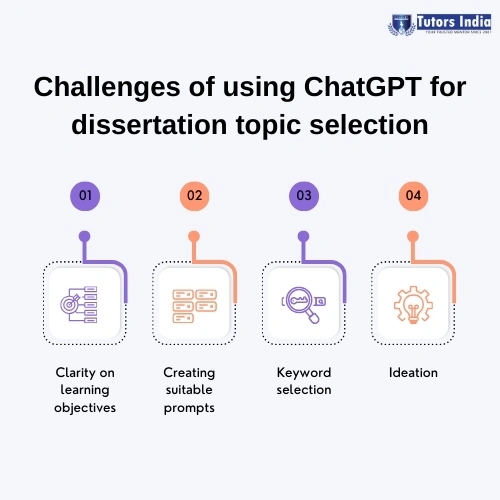
What are the Challenges that you might face while choosing a dissertation topic using ChatGPT?
ChatGPT is a natural language processing tool that was created using a Generative Pre-trained Transformer…
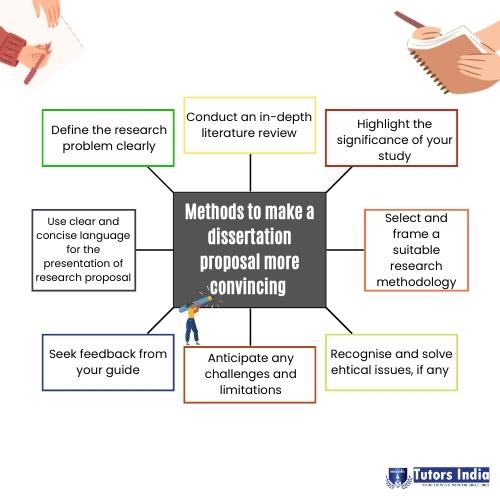
How to ensure that the Research Proposal for the Masters dissertation is convincing enough?
A research proposal could be defined as a written document that describes the intentions of a researcher for conducting a study…