

Why Is Critical Evaluation So Difficult in Malaysian Nursing Literature Review?
- Home
- How To Article
- Why Is Critical Evaluation So Difficult in Malaysian Nursing Literature Review?
Table of Content
- Why Is Critical Evaluation in Nursing Important?
- Factors That Make Critical Evaluation Difficult in Malaysian Nursing Literature Reviews
- Confusing Critical Evaluation with Summary
- Difficulty Comparing Different Research Studies for Critical Appraisal in Nursing
- Weak Methodological Appraisal of Nursing Research
- Difficulty Synthesising Evidence from Multiple Sources
- Weak Academic Writing and Referencing Skills
- Strategies to conduct a critical evaluation
- Conclusion

Why Is Critical Evaluation So Difficult in Malaysian Nursing Literature Review?
Summary
Conducting a literature review for nursing is considered difficult among postgraduate researchers in Malaysia. Although the students may be able to find relevant literature, the difficulty faced by them is in analysing the evidence in a critical manner and not just summarising the literature that has been done earlier. Poor analysis skills, less knowledge regarding research methods and synthesis skills may have an impact on the quality of the literature review being prepared.
A literature review in nursing research is the basis of postgraduate research by critically analysing the available research, highlighting gaps and formulating reasons why research should be conducted. Literature review differs from descriptive writing in that the student must critically analyse the research findings and synthesise them. Postgraduate nursing students in Malaysia find this task very difficult because it involves deep knowledge of research methods, skills of critical analysis and academic writing.
As mentioned by Aveyard et al. (2023), a literature review should not be limited to only summarising past research but also involve critical evaluation of the quality, merits, weaknesses, and significance of available literature to form an argument. Even though students recognise the need for critical evaluation in their reviews, they find it difficult to interpret conflicting results and compare various methods used in conducting research.
The current paper examines the main issues that arise when it comes to conducting critical evaluation in literature reviews in the field of nursing in Malaysia and provides recommendations on how to write and conduct critical analysis in literature reviews in Malaysia. Tutors India provides expert Nursing Literature Review Help to conduct a high-quality critical literature review.
Why Is Critical Evaluation in Nursing Important?
Critical appraisal is very important in a literature review in nursing since it allows nursing students to evaluate the quality, reliability, and validity of published studies instead of merely summarising existing studies. This will enable them to develop solid academic arguments based on their findings in research.
Postgraduate students of nursing in Malaysia require critical appraisal for evidence-based nursing practice and to exhibit higher-order thinking skills. It allows students to synthesise evidence from various studies and write good literature reviews. So, conducting a critical evaluation in nursing literature is essential for master’s research.
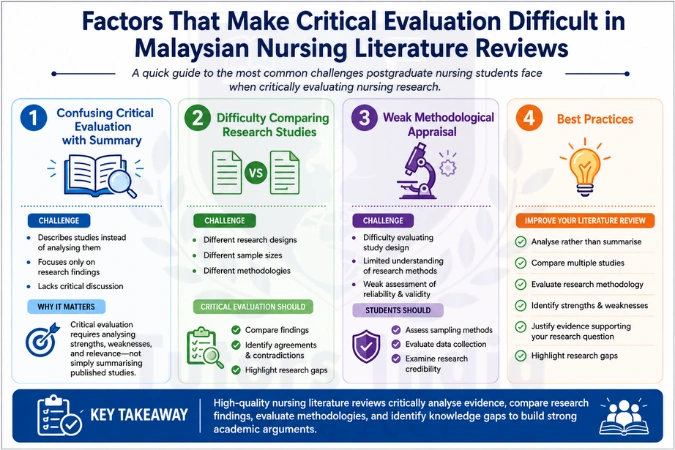
Factors That Make Critical Evaluation Difficult in Malaysian Nursing Literature Reviews
1. Confusing Critical Evaluation with Summary
The most frequent problem that arises in relation to postgraduate nursing students is the confusion between critical analysis and summary of research conducted in the past. Literature reviews tend to include the description of the purpose, methods, and results of studies without evaluating their contribution to the field of nursing.
An evidence-Based Nursing Research needs to compare various studies, to examine the reliability of research methods used in those studies, to identify possible contradictions in the results, and to clarify the connection between the evidence and the research topic.
What Research Shows:
As stated by Aveyard, Sharp & Woolliams (2023), a good literature review should critically assess the published evidence instead of summarising existing research work. Critically assessing any research entails analysing its weaknesses and strengths as well as comparing the results of different studies on the same topic.
Tips:
- Analyse studies instead of simply describing their findings.
- Explain similarities and differences of each research study.
- Assess strengths and weaknesses of each research study and its relevance to the research question.
- Justify the evidence support the research questions.
2. Difficulty Comparing Different Research Studies for Critical Appraisal in Nursing
One other major problem involves the comparison of results obtained from more than one nursing research study. Research varies in terms of methodology, sample sizes, and data collection techniques, among others, which makes it hard for students to establish connections between results. As a result, literature reviews usually describe the different pieces of research individually rather than synthesise them.
It is necessary for critical appraisal in nursing that students can incorporate information from different sources, analyse areas where there are agreements or disagreements, and explain how the information impacts present knowledge in the field of nursing. It makes the review better and more academic in nature.
What Research Shows:
According to Booth, Sutton, and Papaioannou (2021), a literature review should compare results across different research works rather than offer separate summaries of each. The process of discovering what is similar and what is dissimilar in previous studies will allow students to have an overview of the topic and find the justification for further research.
Tips:
- Compare research designs, methodologies, and key findings.
- Identify areas of agreement and conflicting evidence.
- Group related studies under common themes or concepts.
- Highlight research gaps to justify your study.
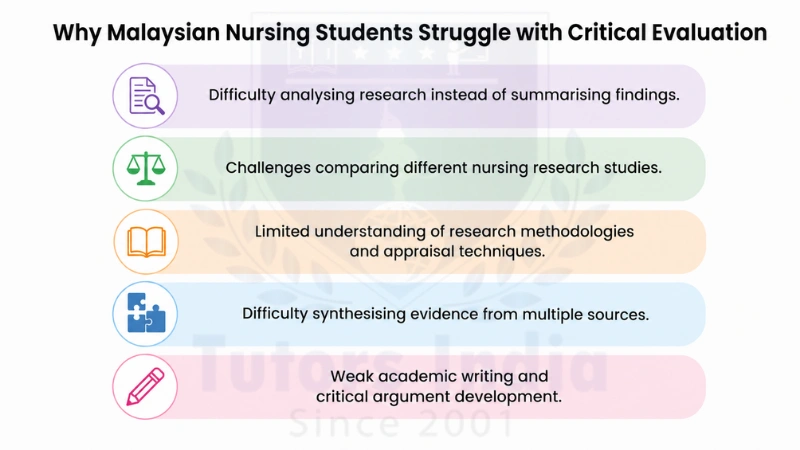
3. Weak Methodological Appraisal of Nursing Research
Limited knowledge of research methodologies is another factor that makes it hard for nursing students to critically evaluate. It has been found that most of the postgraduate students find it difficult to determine whether it would be suitable to use qualitative, quantitative or mixed methods of research to answer a specific research question.
Critical appraisal of the research involves students analysing the design of the research, sampling, data collection procedures, ethics, and data analysis. This knowledge enables students to understand the pros and cons of different scholarly articles and pick out the most relevant sources for their literature review. Several students prefer seeking help from Nursing Literature Review Writing Services in Malaysia for assistance with methodology and writing skills.
What Research Shows:
As stated by Polit and Beck (2021), knowledge of research methodology is necessary to assess the reliability, validity, and relevance of nursing research. Evaluating the methodology involved in the design of a study, its sampling technique, data collection, and data analysis will help students identify credible research and conduct effective literature reviews.
Tips:
- Understand qualitative, quantitative, and mixed-methods research designs.
- Assess the appropriateness of sampling and data collection methods.
- Evaluate the validity, reliability, and credibility of research findings.
- Apply recognised critical appraisal frameworks when reviewing studies.
Enhance your literature review with Manuscript Writing Help in the UK from Tutors India that critically evaluates studies for master’s students
4. Difficulty Synthesising Evidence from Multiple Sources
A very common problem for the literature review is the synthesis of information collected from several research studies into a coherent discussion. In fact, many students just read through each study one after another, without synthesis of findings. The literature review turns out to be merely descriptive in nature and not analytical at all.
The process of synthesising demands that students compare the results from the various pieces of research, classify the research works according to the various themes and explain how the cumulative findings support the research topic. This makes the review more thought-provoking and academically solid.
What Research Shows:
According to Booth, Sutton, and Papaioannou (2021), it is crucial to synthesise results from different research in the literature review to ensure that arguments are backed by evidence. Synthesis of information helps students identify trends, contradictions, and gaps in existing knowledge, and helps students develop a good argument.
Tips:
- Organise studies into relevant themes rather than individual summaries.
- Integrate evidence from multiple sources to support your discussion.
- Identify trends, inconsistencies, and gaps across the literature.
- Link synthesised evidence directly to your research questions.
5. Weak Academic Writing and Referencing Skills
Even in cases where the research is understood by the students, problems with their academic writing skills can negatively impact the quality of their literature review analysis. With unclear argumentation, inconsistent references and a lack of proper organisation, it becomes difficult for the students to put forward a proper discussion of the topic under consideration.
Academic writing should be strong by offering a series of logical arguments, evidence integration, and correct referencing styles. It improves readability and professionalism as well as ensures academic integrity.
What Research Shows:
As Cottrell (2019) states, academic writing is based on critical thinking and communication skills. Effective use of well-reasoned arguments with the use of reliable evidence increases the clarity of the literature review, whereas correct citations ensure academic honesty and increase the reliability of the study.
Tips:
- Make well-supported arguments in your academic paper.
- Use up-to-date nursing research to prove all the claims you make.
- Stick to one academic referencing system throughout your literature review.
- Do not forget to proofread your academic paper.
Strategies to conduct a critical evaluation:
- Critically analyse research papers in nursing rather than summarising them.
- Compare methodologies and results from several papers.
- Judge the validity of the research evidence.
- Employ well-established critical appraisal tools like CASP to evaluate the research.
- Organise the evidence based on thematic issues rather than individually analysing studies.
- Highlight the gaps present in the literature that your study intends to fill.
- Support your points with nursing literature that is both relevant and up-to-date.
- Seek professional assistance to improve your analysis and evidence synthesis skills.
Conclusion
Critical evaluation is an important aspect of a good nursing literature review since it shows the capability of the writer to think analytically and synthesise evidence as well as judge the quality of the scholarly research conducted by other people. Many Malaysian postgraduate nursing students face problems in conducting critical evaluation since it is difficult for them to compare different studies, appraise research methodologies, synthesise evidence, and construct strong academic arguments. With a good command of these three aspects, students will be able to conduct an academic literature review.
Finding it difficult to critically evaluate nursing literature? Connect with our experts for strengthening your literature review through critical appraisal, research synthesis, methodological evaluation, and evidence-based academic writing.
Book a Free Expert Consultation with Tutors India to receive Nursing Research Writing Help and strengthen your literature review.
References
- Aveyard, H., Sharp, P., & Woolliams, M. (2023). A beginner’s guide to evidence-based practice in health and social care (4th ed.). Open University Press. https://www.mheducation.co.uk/a-beginner-s-guide-to-evidence-based-practice-in-health-and-social-care-4e-9780335251964-emea-group
- Booth, A., Sutton, A., & Papaioannou, D. (2021). Systematic approaches to a successful literature review (3rd ed.). Sage Publications. https://www.scirp.org/reference/referencespapers?referenceid=3184401
- Cottrell, S. (2019). The study skills handbook (5th ed.). Red Globe Press. https://api.pageplace.de/preview/DT0400.9781137610898_A42593923/preview-9781137610898_A42593923.pdf
- Polit, D. F., & Beck, C. T. (2021). Nursing research: Generating and assessing evidence for nursing practice (11th ed.). Wolters Kluwer. https://www.scirp.org/reference/referencespapers?referenceid=3798365
FAQs:
1. Why is critical evaluation important in a nursing literature review?
Critical evaluation enables students to assess the quality, credibility, and relevance of published research. It helps develop evidence-based arguments and strengthens the academic quality of a nursing literature review.
2. What is the difference between summarising and critically evaluating research?
Summarising describes the content of a study, whereas critical evaluation analyses its strengths, limitations, methodology, and contribution to existing nursing knowledge.
3. How can I improve critical evaluation in my nursing literature review?
You can improve critical evaluation by comparing multiple studies, assessing research methodologies, synthesising evidence, identifying knowledge gaps, and using recognised critical appraisal frameworks.
4. Which critical appraisal tools are commonly used in nursing research?
Common appraisal tools include the Critical Appraisal Skills Programme (CASP) checklists, Joanna Briggs Institute (JBI) critical appraisal tools, and the Mixed Methods Appraisal Tool (MMAT), depending on the study design.
5. Can Tutors India help with nursing literature review writing in Malaysia?
Yes. Tutors India provides expert support with critical evaluation, evidence synthesis, research methodology assessment, academic writing, editing, and literature review development for postgraduate nursing students in Malaysia.