

Why Biomedical Science Master's Manuscripts Get Rejected Before Journal Submission in the UK
- Home
- How To Article
- Why Biomedical Science Master's Manuscripts Get Rejected Before Journal Submission in the UK
Table of Content
- Why Does Biomedical Science Master's Manuscript Crucial?
- Factors That Lead to Biomedical Science Master's Manuscript Rejection
- Weak Scientific Structure and Organisation
- Inadequate Literature Review and Research Gap
- Poor Data Analysis and Interpretation
- Failure to Follow Journal Guidelines
- Language, Grammar, and Academic Writing Issues
- How to Improve Your Biomedical Science Master's Manuscript?
- Conclusion

Why Biomedical Science Master's Manuscripts Get Rejected Before Journal Submission in the UK
Summary
Preparation of a manuscript in a publishable standard is among the hardest challenges faced by Biomedical Science master’s students in the UK. Many master’s students undertake excellent research, but the articles they prepare are rejected before submission to journals due to various problems, including weak scientific writing, poor data analysis, insufficient literature review, wrong journal formatting, among others. This paper highlights some of the factors responsible for the rejection of these articles, as well as some ways to avoid them.
Introduction
Publication of research is of growing significance for students enrolled in master’s degree programs in Biomedical Science in the United Kingdom. A well-prepared manuscript shows not only that the student has the skills necessary to do research but also improves academic and professional prospects. The problem is that students have difficulty translating their research results into a publishable manuscript. Scientific manuscript writing differs from writing university papers due to certain standards of publication.
As stated by Day and Gastel (2022), scientific writing involves conveying research findings clearly, logically, and precisely while ensuring transparency and reproducibility. Many potentially promising papers are rejected well before being subjected to peer review due to their inability to meet these elementary criteria.
This article provides an overview of the primary causes behind rejection of Biomedical Science master’s manuscripts before submission to journals is provided along with some useful suggestions. Tutor India assists postgraduate students in preparing publication-ready Biomedical Manuscripts through Manuscript Writing Support in UK.
Why Does Biomedical Manuscript Writing Services in UK Crucial?
A quality biomedical manuscript ensures the presentation of scientific results in a standardised structure. It is characterised by scientific thinking and ethical research methods. The aim of the research, the methods applied, statistics used, and the discussions are expected to be clear and evidence-based.
Some postgraduate students conduct top-quality research but find difficulties in scientific writing, the scientific format of the manuscript, critical discussion, and presentation of the results. Professional Biomedical Manuscript Writing Services in UK can assist such students in enhancing their manuscripts before submission to scientific journals.
Factors That Lead to Biomedical Science Master's Manuscript Rejection
1. Weak Scientific Structure and Organisation
One of the most common reasons why biomedical papers fail to get accepted by an editor is disorganisation and improper presentation of the content. Many students carry out good research; however, they fail to present the results in a structured, consistent, and coherent way. As it is the first impression that counts, the organisation of the paper is always the first thing the editor evaluates.
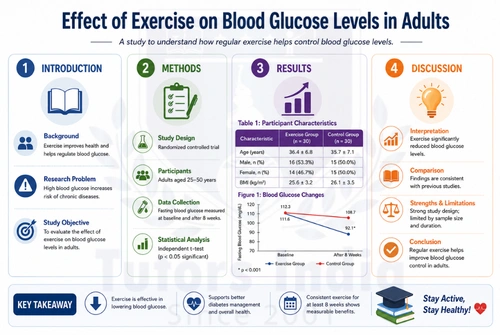
However, usually, all biomedical journals demand the use of IMRaD format (introduction, methods, results, discussion). Inadequate paragraph organisation, repetition, and inappropriate transitions make the comprehension of the whole process difficult.
What Research Shows:
According to Day & Gastel (2022), a properly structured scientific paper improves its readability and enables the reviewer to judge the value, validity, and significance of the study. The authors stress that proper structuring and logical ordering of information contribute to scientific writing and reduce the risk of a paper being rejected by the editor because of poor presentation and structuring.
Tips:
- Follow the IMRaD structure
- Write clear and concise section headings.
- Present results before interpreting them.
- Ensure logical flow between all sections.
Example manuscript structure:
2. Inadequate Literature Review and Research Gap
Another significant reason for rejecting manuscripts is that of inadequate literature review. Master’s level students tend to provide an overview of previous research without proper evaluation and definition of the research gap. Thus, the importance and relevance of the research cannot be clearly seen.
A manuscript must show the authors’ comprehensive knowledge of the current biomedical research along with how the research fills the gap in science. Without a defined research gap, it is hard to explain the importance and relevance of the research.
What Research Shows:
As per Booth et al. (2021), literature reviews do more than just summarise earlier studies; rather, they synthesise data, highlight knowledge gaps, and critique existing research. A good literature review builds a firm base for the research to be conducted and shows why the research is required.
Tips:
- Use recent peer-reviewed biomedical studies.
- Critically compare previous findings.
- Clearly identify the research gap.
- Explain how your study advances current knowledge.
3. Improving Data Analysis and Interpretation with Journal Manuscript Support in UK
However, strong experimental results are not always enough for acceptance into a journal. Many papers have been turned down due to the inappropriate use of statistics, the lack of explanation, or inadequate interpretation of results in terms of science. It is not sufficient just to give numerical results to prove the importance of the study.
The editors ask the authors to explain the meaning of their results in a biological and clinical context and compare them with other similar studies. Many students often get expert Journal Manuscript Support in UK to handle the editors’ comments.
What Research Shows:
“Statistical results as well as their interpretation must be accurately communicated for biomedical science to be done properly,” according to Lang and Altman (2013). This means that the scientist needs to communicate both the result and its implications to ensure good scientific communication.
Tips:
- Select appropriate statistical methods.
- Explain the significance of findings.
- Compare results with previous studies.
- Avoid overstating conclusions.
Enhance your biomedical manuscripts with Tutors India’s expert guidance and Customised Manuscript Writing Help in UK.
4. Failure to Follow Journal Guidelines
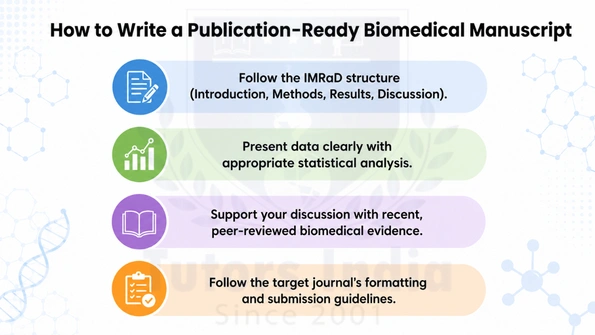
Author instructions are included in every biomedical journal, which detail requirements for the structure of the article, format, citation style, word limit, ethics, illustrations, and tables. Students usually pay less attention to these requirements and think about scientific content only.
Not adhering to journal requirements always leads to rejection by editors without any review process. Strict adherence to journal requirements shows respect and improves chances for your paper to move to the next step.
What Research Shows:
In accordance with the ICMJE, authors are supposed to follow the journal guidelines when submitting the manuscript since it increases the quality of the manuscript, and following the guidelines makes the editing process easier.
Tips:
- Read the journal’s author guidelines carefully.
- Format references correctly.
- Prepare figures and tables according to journal standards.
- Check word count and manuscript style before submission.
5. Language, Grammar, and Academic Writing Issues
Though the scientific work is good enough, it may not be accepted because of grammar errors, unclear sentences, inconsistent terminology, and bad academic writing. Such problems will cause difficulties in understanding the scientific work despite how good it is.
The scientific writing style should help in presenting scientific concepts in a clear and concise manner. This means that well-written manuscripts not only enhance readability but also indicate professionalism.
What Research Shows:
According to Glasman-Deal (2020), clear scientific writing helps in communicating the results of the research and in reviewing the manuscript. Good manuscripts make the scientific writing clear and minimize any ambiguity.
Tips:
- Use clear scientific language.
- Eliminate grammatical and typographical errors.
- Maintain consistent biomedical terminology.
- Proofread thoroughly before submission.
How to Improve Your Biomedical Science Master's Manuscript?
- Identify the right target journal for your study.
- Use the IMRaD format of scientific writing.
- Review the recent biomedical literature thoroughly.
- State your research aims clearly.
- Utilise relevant statistics and analyse findings with care.
- Adhere strictly to journal standards when it comes to formatting and citation.
- Revise your paper several times before submitting.
- Get academic editing help for better editing.
Conclusion
Writing a master’s thesis in Biomedical Science for journal publication involves much more than simply stating the results of the research. Knowledge about critical thinking, science, structuring and journals is required. The issues related to academic writing of research papers include improper structuring, lack of literature review, inadequate analysis of data, improper formatting, and poor language skills. However, one can prepare good papers with professional help for publication in journals.
Looking to improve your Biomedical Science Master’s manuscript? Connect with our experts to get support in biomedical research writing, journal formatting, and academic editing to help students prepare publication-ready manuscripts.
Book a Free Expert Consultation with Tutors India to receive Manuscript Development Services in UK and strengthen your manuscript before journal submission.
References
- Booth, A., Sutton, A., & Papaioannou, D. (2021). Systematic approaches to a successful literature review (3rd ed.). Sage Publications. https://www.researchgate.net/profile/Andrew-Booth-2/publication/235930866_Systematic_Approaches_to_a_Successful_Literature_Review/links/5da06c7f45851553ff8705fa/Systematic-Approaches-to-a-Successful-Literature-Review.pdf
- Day, R. A., & Gastel, B. (2022). How to write and publish a scientific paper (9th ed.). Cambridge University Press. https://comegic.org.mx/wp-content/uploads/2023/06/Como-escribir-articulo-cientifico.pdf
- Glasman-Deal, H. (2020). Science research writing for native and non-native speakers of English (2nd ed.). World Scientific Publishing. https://redacaocientifica.weebly.com/uploads/6/0/2/2/60226751/science_writing_for_non-native_engish_speakers.pdf
- International Committee of Medical Journal Editors. (2024). Recommendations for the conduct, reporting, editing, and publication of scholarly work in medical journals. https://www.icmje.org/icmje-recommendations.pdf
- Lang, T. A., & Altman, D. G. (2015). Basic statistical reporting for articles published in biomedical journals: The SAMPL guidelines. In D. G. Altman, K. F. Schulz, D. Moher, et al. (Eds.), Guidelines for reporting health research: A user’s manual (pp. 213–226). Wiley-Blackwell. https://pubmed.ncbi.nlm.nih.gov/25441757/
- Moher, D., Hopewell, S., Schulz, K. F., Montori, V., Gøtzsche, P. C., Devereaux, P. J., Elbourne, D., Egger, M., & Altman, D. G. (2010). CONSORT 2010 explanation and elaboration: Updated guidelines for reporting parallel group randomised trials. BMJ, 340, c869. https://doi.org/10.1136/bmj.c869
- Equator Network. (2024). Enhancing the QUAlity and Transparency Of health Research (EQUATOR) Network. https://www.equator-network.org
FAQs:
- Why are Biomedical Science master’s manuscripts rejected before journal submission?
Common reasons include poor manuscript structure, inadequate literature review, weak data analysis, failure to follow journal guidelines, and language or grammar issues. - What is the IMRaD format in biomedical research?
IMRaD stands for Introduction, Methods, Results, and Discussion. It is the standard structure used by most biomedical journals to present research clearly and logically. - How can I improve my Biomedical Science manuscript?
Follow the target journal’s author guidelines, conduct a thorough literature review, use appropriate statistical analysis, present findings clearly, and revise the manuscript carefully before submission. - Why is following journal guidelines important?
Adhering to journal requirements for formatting, referencing, word count, figures, and ethical statements improves the chances of your manuscript progressing to peer review. - Can professional manuscript editing improve publication chances?
Yes. Professional editing helps improve scientific writing, grammar, structure, clarity, and compliance with journal standards, making the manuscript more suitable for submission.