

Why UK Healthcare Master's Students Struggle to Write a Critical Literature Review
- Home
- How To Article
- Why UK Healthcare Master's Students Struggle to Write a Critical Literature Review
Table of Content
- Why Critical Literature Review Support UK Matters for Healthcare Dissertations
- Common Challenges That Affect Healthcare Literature Reviews
- Summarising Studies Instead of Critically Evaluating Evidence
- Difficulty Identifying Research Gaps in a Healthcare Literature Review UK
- Poor Organisation and Thematic Structure
- Using Outdated or Low-Quality Healthcare Evidence
- Insufficient Attention to Reliability, Validity, and Research Ethics
- Strategies to Minimise Dissertation Revisions
- Conclusion

Why UK Healthcare Master's Students Struggle to Write a Critical Literature Review
Summary
A critical literature review is described as one of the most difficult parts of a master’s dissertation in health care. It is very hard for many students to critically analyse data, find any gaps in the existing research and combine results of various health care studies. This paper will discuss problems that arise in the process of writing a master’s thesis and suggest solutions.
Introduction
A critical review of literature is one of the most difficult parts of writing a master’s dissertation in the field of health care in the UK. It is challenging for many students to go from merely summarising the literature to critically analysing it, comparing methods, and finding out what needs to be researched further.
As stated by Aromataris and Munn (2020), critical evaluation of evidence plays a crucial role in evidence-based health care research and the formulation of sound academic findings. Students often struggle to justify the research and academic contribution if they lack critical analysis of the literature.
This article will help UK healthcare master’s students in addressing the problems they encounter while doing a critical literature review and give tips on how to deal with the problems encountered while undertaking critical analysis and evidence synthesis in academic writing. Tutors India offers Literature Review Writing Support in UK that assists students in conducting critical analysis to identify the research gap and support their dissertation.
Why Critical Literature Review Support UK Matters for Healthcare Dissertations
A critical literature review offers an essential academic framework for conducting healthcare research by analysing available literature, identifying research gaps and formulating the theoretical framework of the proposed study. It is not enough just to give summaries of the earlier studies. Instead, it is important to contrast research methodologies and assess the quality of evidence.
The development of such evaluative skills is difficult for most postgraduate students. Getting Critical Literature Review Support UK helps improve your ability to synthesise information and formulate arguments as well as write a literature review that will comply with the requirements of UK universities. A quality literature review also reflects your critical thinking and justifies your research.
Common Challenges That Affect Healthcare Literature Reviews
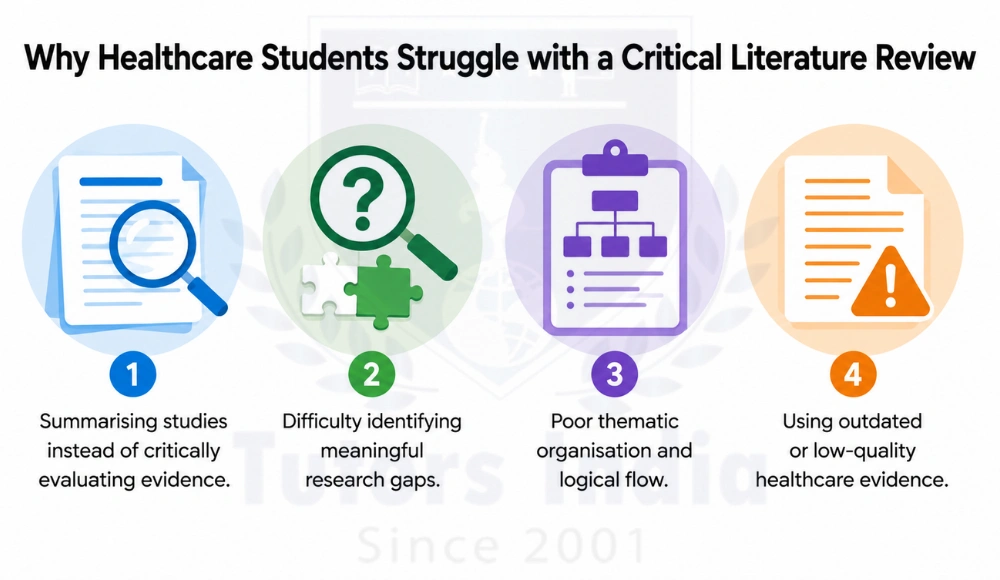
1. Summarising Studies Instead of Critically Evaluating Evidence
One of the main problems faced by master’s students majoring in health care is providing descriptions of earlier research studies without critically assessing them or the results that were found. In literature reviews, one research paper is often analysed without any comparison regarding the strengths and weaknesses of methodologies and data available.
In critical appraisal, it is expected of students to analyse the research design, sample characteristics, methodology, statistics used, and applicability of results to healthcare practice. Only when they learn to do this will the students be able to make stronger arguments in academia and conduct further research.
What Research Shows:
According to Aromataris and Munn (2020), critical appraisal allows researchers to establish the credibility, relevance, and methodological quality of existing evidence within the healthcare field.
Tips:
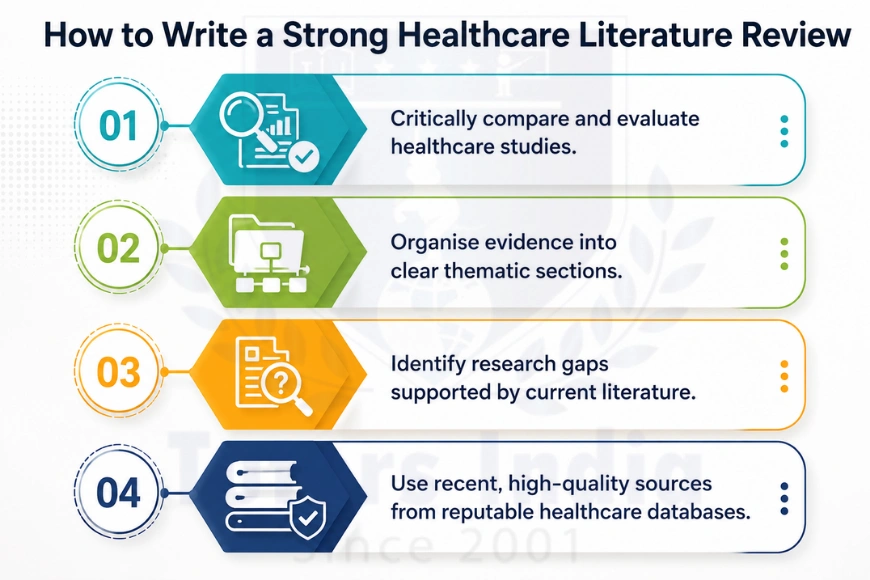
- Compare findings across multiple healthcare studies.
- Evaluate methodological strengths and limitations.
- Analyse conflicting evidence objectively.
- Support arguments using peer-reviewed research.
2. Difficulty Identifying Research Gaps in a Healthcare Literature Review UK
Many students conduct plenty of literature searches but fail to identify any research gaps. Instead of highlighting areas that have not been discovered yet, they only present the areas that have been discovered, without demonstrating how their study will be useful for health care.
A research gap can emerge due to contradiction, weakness, under-representation, advancement of technology, and modification of clinical guidelines. Identifying gaps in the study increases the novelty of the research. An ideal Healthcare Literature Review UK must bring out a valid research gap that contributes to scientific knowledge.
What Research Shows:
According to The Cochrane Handbook for Systematic Reviews of Interventions (2023), it is important to identify the gaps by performing a systematic review of the available evidence base.
Tips:
- Compare conclusions from multiple systematic reviews.
- Identify limitations in previous healthcare studies.
- Highlight under-researched patient populations.
- Link research gaps directly to study objectives.
- Connect the theory with the research gaps.
3. Poor Organisation and Thematic Structure
A further difficulty often faced by students involves structuring the literature review into a coherent academic format. It is not uncommon for students to organise their literature review in chronological order rather than thematically, in terms of evidence related to theories, healthcare interventions or methodology. This makes the process of writing the literature review less coherent.
Thematic structure allows researchers to make comparisons and linkages between evidence from different areas of healthcare research. A theme could be something as simple as evidence related to patient outcomes, clinical interventions, healthcare technology or evidence-based practice.
What Research Shows:
According to Hart (2018), a properly structured literature review is supposed to integrate information from previous research into themes because presenting information on each study in isolation does not provide enough critical analysis.
Tips:
- Group studies into clear thematic categories.
- Use headings to improve logical flow.
- Link each theme to research objectives.
- Maintain consistency throughout the review.
Get the pricing details for the master’s critical literature review service at Tutors India, designed to assist students in crafting a master’s dissertation.
4. Using Outdated or Low-Quality Healthcare Evidence
The field of health sciences research is changing rapidly due to new evidence-based clinical guidelines, systematic reviews, and recommendations. Most master’s students make use of old articles or articles that do not critically evaluate the quality and clinical significance of the sources used in the literature review.
It will be better for the students to concentrate more on accessing up-to-date articles from respectable journals, as well as systematic reviews and national guidelines, in databases that include PubMed, CINAHL, Cochrane Library, Scopus, and Web of Science.
What Research Shows:
As per Page et al. (2021), the PRISMA 2020 Statement stresses the significance of transparent reporting and systematic identification of high-quality evidence to increase the robustness of healthcare research synthesis.
Tips:
- Search literature using recognised healthcare databases.
- Prioritise recent systematic reviews and meta-analyses.
- Critically appraise study quality before inclusion.
- Use current clinical guidelines where appropriate.
5. Insufficient Attention to Reliability, Validity, and Research Ethics
A good literature review brings evidence from various papers to present an academic argument. However, many master’s students in healthcare talk about every paper separately and do not synthesise information between papers. By taking this descriptive approach, the students cannot demonstrate critical thinking and make their research meaningful.
In the critical synthesis, researchers should analyze the patterns, contradictions, methodology, and rationale of why the earlier research is important to the current research. The creation of a well-thought-out argument adds credibility and originality to the thesis.
What Research Shows:
As suggested by Booth et al. (2021), a successful literature review is one where the researcher can synthesise information, critique various viewpoints, and make connections between existing information and future research.
Tips:
- Synthesise findings across multiple studies.
- Compare methodological strengths and weaknesses.
- Integrate evidence into a coherent argument.
- Support conclusions with high-quality healthcare evidence.
Strategies to Improve a Critical Literature Review
- Start searching for literature from the beginning through healthcare databases.
- Group the studies according to thematic areas.
- Compare the methodologies and results of the studies critically.
- Ensure that there is a link between themes and research questions.
- Consider Dissertation Literature Review Services UK for assistance in improving academic writing.
- Identify research gaps using recent results.
- Systematic reviews and clinical guidelines should be considered first.
- Utilise the existing critical appraisal techniques when required.
Conclusion
A critical literature review is crucial when it comes to writing a good health care master’s dissertation in the UK. There are many problems faced by most students, such as critically assessing evidence, research gap identification, thematic arrangement of literature, and synthesising research findings to create an academic argument.
Through systematic approaches in critical evaluation of health care evidence and thematising studies, students can develop literature reviews that showcase critical thinking and provide support to evidence-based research. Asking for assistance from academics will help enhance critical analysis skills and improve dissertations.
If you need support with conducting a systematic literature review or analysing wearable sensor data, Tutors India offers expert Master’s Literature Review Help UK to help you strengthen your research and complete a high-quality dissertation with confidence.
Book a Free Expert Consultation with Tutors India to get support on your master’s dissertation.
References
- Aromataris, E., & Munn, Z. (Eds.). (2020). JBI Manual for Evidence Synthesis. JBI. https://doi.org/10.46658/JBIMES-20-01
- Booth, A., Sutton, A., Clowes, M., & Martyn-St James, M. (2021). Systematic approaches to a successful literature review (3rd ed.). Sage Publications. https://www.scirp.org/reference/referencespapers?referenceid=3184401
- Hart, C. (2018). Doing a literature review: Releasing the research imagination (2nd ed.). Sage Publications. https://sk.sagepub.com/book/mono/doing-a-literature-review-2e/toc
- Page, M. J., McKenzie, J. E., Bossuyt, P. M., Boutron, I., Hoffmann, T. C., Mulrow, C. D., Shamseer, L., Tetzlaff, J. M., Akl, E. A., Brennan, S. E., Chou, R., Glanville, J., Grimshaw, J. M., Hróbjartsson, A., Lalu, M. M., Li, T., Loder, E. W., Mayo-Wilson, E., McDonald, S., … Moher, D. (2021). The PRISMA 2020 statement: An updated guideline for reporting systematic reviews. BMJ, 372, n71. https://doi.org/10.1136/bmj.n71
- Cochrane handbook for systematic reviews of interventions (Version 6.4). Cochrane. https://training.cochrane.org/handbook
FAQs:
1. What are some challenges students face when conducting a literature review?
Students often struggle with critically evaluating studies instead of summarising them, identifying research gaps, organising the review thematically, selecting high-quality evidence, and synthesising findings into a coherent academic argument.
2. What are the 5 C’s of literature review?
The five C’s commonly used in literature reviews are Cite, Compare, Contrast, Critique, and Connect. These principles help students analyse existing research, evaluate evidence, identify gaps, and demonstrate how previous studies relate to their own research.
3. How to write a literature review in healthcare?
Define your research question, search reputable healthcare databases, critically evaluate the evidence, organise studies into themes, and synthesise findings to support your research.
4. What are the 7 steps in writing a literature review??
The main steps are defining the research question, searching and selecting studies, evaluating evidence, organising themes, synthesising findings, identifying research gaps, and writing the review.
5. What is the funnel approach to literature review?
The funnel approach starts with a broad overview of the topic and gradually narrows to specific themes, research gaps, and the study’s research question.