

Why UK Computer Science Master's Students Struggle to Choose a Research Topic
- Home
- How To Article
- Why UK Computer Science Master's Students Struggle to Choose a Research Topic
Table of Content
- Why Dissertation Topic Selection Service in UK Matters for Computer Science Dissertations
- Common Challenges That Affect Research Topic Selection
- Difficulty Identifying a Research Gap
- Choosing a Topic That Is Too Broad or Too Narrow
- Limited Awareness of Emerging Computer Science Research Trends
- Evaluating Dataset Availability and Research Feasibility with Computer Science Topic Selection Support in UK
- Choosing a Topic That Does Not Align with Academic and Career Goals
- How to Choose a Strong Research Topic?
- Conclusion

Why UK Computer Science Master's Students Struggle to Choose a Research Topic
Summary
Topic selection poses a significant challenge for Master’s degree Computer Science students in the UK. The current paper examines some of the problems that include finding a research gap, setting the right scope, evaluating feasibility, and staying updated with new technology. Moreover, useful ways are suggested to assist the students in choosing their topics.
Introduction
Selecting a topic to study in a master’s dissertation in Computer Science can be considered one of the key steps in this kind of academic work, but at the same time it proves to be one of the most difficult steps for the majority of students who are completing their dissertations in British universities. A clearly defined research topic serves as a basis for all aspects of a dissertation because it sets research goals and methods of research.
Due to the fast development of such disciplines as Artificial Intelligence, Machine Learning, Cybersecurity, Cloud Computing, Blockchain, IoT, and Data Science, the choice of an interesting topic for research has become rather difficult. According to Kitchenham et al. (2009), systematic literature reviews allow researchers to discover research gaps and to justify the necessity for conducting new research. Nevertheless, many students find it difficult to detect research gaps, assess existing data sets, and recognise research trends.
This article discusses the issues faced by UK Computer Science master’s students when selecting a research topic and suggests ways to make the task easier. Tutors India provides Dissertation Topic Selection Support in UK that will guide students to find an innovative topic, set research objectives, and write a high-quality master’s dissertation.
Why Dissertation Topic Selection Service in UK Matters for Computer Science Dissertations
Topic selection is the very first step that must be done to write an excellent Computer Science dissertation. The selected topic reflects the scientific interests of the author and defines originality, feasibility, and other aspects of research. In UK universities, master’s dissertations are expected to show independent and critical thinking as well as contribute to existing knowledge. Hence, choosing a research topic is all about finding a research problem backed up by relevant literature.
Most of the postgraduate students face challenges due to the selection of inappropriate topics that are too wide, have not been explored well enough by previous scholars, and cannot be covered adequately in the given timeframe. The Dissertation Topic Selection Service in UK will help you analyse research trends, identify research gaps, formulate a research question and make sure that the dissertation meets all the requirements of your university.
Common Challenges That Affect Research Topic Selection
1. Difficulty Identifying a Research Gap
Some of the most significant problems that the Master of Computer Science students face is finding a research gap. Some students go through a lot of journals but still cannot find areas that need to be explored further. They end up choosing areas that have been researched a lot in the past. Research gaps can emerge due to the limitations of technology, changing industry needs, conflicting results, or new applications of old technologies.
For instance, while AI has been widely adopted in fields like healthcare, finance, and cybersecurity, there is still room for research in the areas of explainable AI, ethics of AI, and efficient machine learning. The same applies to Blockchain technology as it keeps evolving via various applications including decentralised identity management systems, IoT systems security, and sustainable blockchains.
What Research Shows:
According to Webster and Watson (2020), finding the research gap is only possible through reviewing the current literature to understand the problems that are still unexplored, conflicting results, and areas for further research. The properly identified research gap will serve as the foundation of an academic contribution.
Tips:
- Conduct a structured literature review using recent journal articles.
- Compare findings from multiple research studies.
- Identify limitations and recommendations provided by previous researchers.
- Focus on emerging technologies where research is still developing.
2. Choosing a Topic That Is Too Broad or Too Narrow
The second prevalent problem in choosing research topics is selecting an inappropriate topic scope. Students often choose topics that are too large or very narrow, which makes it hard for them to cover the topic comprehensively within the required period and the number of pages for a master’s thesis. For example, the following topics: “Artificial Intelligence in Healthcare” and “Cybersecurity in Cloud Computing” may be viewed as too broad topics.
The chosen topic should be specific, doable, and have enough academic background. The topic needs to state a research problem and its objectives clearly and be manageable through the available means. Narrowing down an idea into a research question helps students develop well-structured academic papers.
What Research Shows:
As per Booth, Sutton, & Papaioannou (2021), there is a need to have a well-formulated research question since it will provide guidance in formulating a literature review, choosing an appropriate methodological approach, and managing the research effectively.
Tips:
- Narrow broad research areas into a specific problem or application.
- Ensure sufficient recent literature and datasets are available.
- Define clear research objectives before finalising the topic.
- Discuss the scope with your supervisor before starting the dissertation.
3. Limited Awareness of Emerging Computer Science Research Trends
Most postgraduates face problems in dealing with the dynamic environment of Computer Science. Mostly, they pick up traditional research topics and ignore the new advances in realms such as Artificial Intelligence, Quantum Computing, Edge Computing, Explainable AI, Blockchain, and Cybersecurity. Thus, the student’s project may not be innovative or even relevant anymore.
Choosing dissertation topics relevant to recent trends of research is important to facilitate innovation and applicability of your paper. Analysis of the latest articles published in journals and conference proceedings will assist you in finding promising challenges or technologies worth exploring in your dissertation.
What Research Shows:
As noted by Dwivedi et al. (2023), the fast growth of artificial intelligence and digital technologies offers new possibilities for research in various fields, which is why choosing research topics based on recent technological advancements is important.
Tips:
- Review recent publications in leading Computer Science journals.
- Follow emerging technologies and industry developments.
- Check the latest conference proceedings to find out about the current trends in research.
- Choose a topic that has both theoretical and practical significance.
Select a novel research topic in computer science with Tutors India’s expert guidance through critical research gap analysis.
4. Evaluating Dataset Availability and Research Feasibility with Computer Science Topic Selection Support in UK
Another problem is choosing a topic for research without considering the availability of data sets, tools, and technologies to use during research. Many students select unique topics and realise that gathering relevant data or developing the suggested solution is challenging within the time frame of the dissertation research.
Before making a final decision about the topic, students need to evaluate if there are sufficient data sets, platforms, and ways of testing developed solutions. A structured Computer Science Topic Selection Support in UK can evaluate the data availability and research feasibility for students. Considering the feasibility of research will make sure that it is possible to research the selected topic.
What Research Shows:
Kitchenham et al. (2009) note that assessing the accessibility and quality of existing evidence and sources of research is very important to plan feasible and methodologically valid research. Evaluation of these aspects will help the researcher choose suitable topics and avoid any problems during the process of research, thus completing the project.
Tips
- Verify the availability of datasets before selecting a topic.
- Assess the software tools and technical resources required.
- Choose a topic that is achievable within the dissertation timeline.
- Discuss the feasibility of the research with your supervisor.
5. Choosing a Topic That Does Not Align with Academic and Career Goals
Students usually choose their research topic not from an area of interest or in line with their career goals, but from popular topics. Even though technology is exciting and interesting, choosing a topic without considering personal abilities and suitability to the career goals may result in a lack of motivation and problems during the process of research.
A good topic for research must be one that corresponds with the abilities of the student along with his strengths and career goals. Choosing a research topic in the domains of Artificial Intelligence, Data Science, Cybersecurity, and Software Engineering provides opportunities for students to gain expertise in a specific field and become more job-ready.
What Research Shows:
According to Felder and Brent (2016), the quality of students’ research work is higher if their research topic coincides with their personal interests, existing knowledge base, and academic or professional plans.
Tips:
- Assess the availability of data sets and research resources.
- Ensure that the chosen research topic can be accomplished during the period of writing the thesis.
- Select a topic with practical relevance to current industry needs.
- Seek guidance from your supervisor before finalising the research topic.
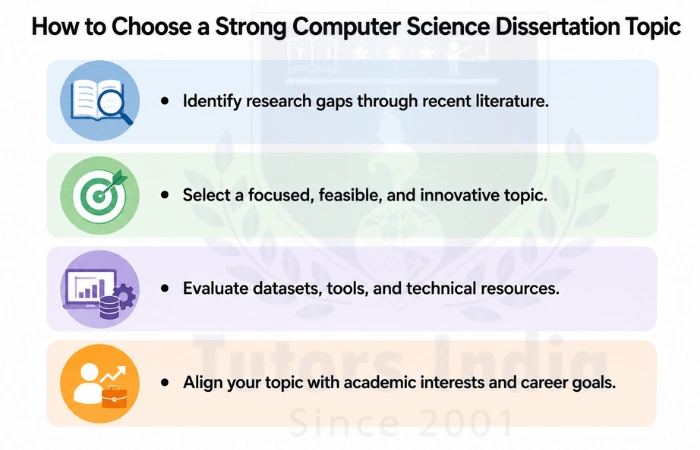
How to Choose a Strong Research Topic?
- Specify your areas of research interest and future career aspirations.
- Examine current journal articles and conference proceedings.
- Discover research gaps through systematic literature review.
- Select an innovative and achievable research topic.
- Select a topic that suits both your academic and professional interests.
- Think about how the research process will improve your skills.
- Formulate your research aims and research questions.
- Seek guidance from your supervisor before finalising the topic.
Conclusion
Choosing a research area for the Computer Science master’s dissertation is undoubtedly the most challenging but crucial step in the process. The problem with which students usually face issues during the selection process are finding research gaps, defining the right research scope, staying updated on the latest technology, assessing the feasibility of research, and choosing suitable topics to align with personal academic and career objectives.
With proper guidance and structure, students can easily choose research topics that add value to existing knowledge and comply with the requirements set by UK universities. Students often consult the Master’s Topic Selection Service in UK to select a research topic that is narrow, achievable, and innovative.
Need help selecting your dissertation topic? Find the right Computer Science research topic with expert guidance in Artificial Intelligence, Machine Learning, Data Science, Cybersecurity, Blockchain, Cloud Computing, IoT, and Explainable AI.
Book a Free Expert Consultation with Tutors India to get support on your master’s research topic selection.
References
- Booth, A., Sutton, A., & Papaioannou, D. (2021). Systematic Approaches to a Successful Literature Review (3rd ed.). Sage Publications. https://www.scirp.org/reference/referencespapers?referenceid=3184401
- Dwivedi, Y. K., Hughes, L., Baabdullah, A. M., Ribeiro-Navarrete, S., Giannakis, M., Al-Debei, M. M., et al. (2023). So what if ChatGPT wrote it? Multidisciplinary perspectives on opportunities, challenges and implications of generative conversational AI for research, practice and policy. International Journal of Information Management, 71, 102642. https://www.researchgate.net/publication/369170284_So_what_if_ChatGPT_wrote_it_Multidisciplinary_perspectives
- Felder, R. M., & Brent, R. (2016). Teaching and Learning STEM: A Practical Guide. Jossey-Bass. https://www.researchgate.net/publication/301232345_Teaching_and_Learning_STEM_A_Practical_Guide
- Kitchenham, B., Brereton, O. P., Budgen, D., Turner, M., Bailey, J., & Linkman, S. (2009). Systematic literature reviews in software engineering – A systematic literature review. Information and Software Technology, 51(1), 7–15. https://www.sciencedirect.com/science/article/abs/pii/S0950584908001390
- Webster, J., & Watson, R. T. (2002). Analyzing the past to prepare for the future: Writing a literature review. MIS Quarterly, 26(2), xiii–xxiii. https://www.jstor.org/stable/4132319
FAQs:
1. What are the biggest challenges in choosing a Computer Science dissertation topic?
Students often struggle to identify research gaps, define a focused research scope, keep up with emerging technologies, evaluate project feasibility, and select a topic that aligns with their academic interests and career goals.
2. How do I choose a good Computer Science dissertation topic?
Start by identifying your research interests, reviewing recent journal articles and conference papers, exploring current technology trends, identifying research gaps, and selecting a topic that is innovative, feasible, and supported by sufficient academic literature.
3. What are the best research areas for a Computer Science master’s dissertation?
Popular research areas include Artificial Intelligence, Machine Learning, Cybersecurity, Data Science, Cloud Computing, Blockchain, Internet of Things (IoT), Explainable AI, Quantum Computing, and Software Engineering.
4. How can I identify a research gap for my dissertation?
Conduct a systematic review of recent academic literature to identify unexplored problems, conflicting findings, technological limitations, or emerging applications. Analysing current research trends can help you define an original and valuable research topic.
5. How do I know if my dissertation topic is feasible?
Evaluate whether relevant datasets, software tools, technical resources, and recent literature are available. Your topic should also be manageable within the dissertation timeline and meet your university’s academic requirements.