
Economics & Finance
Assignment Writing
Academic Law writing
Economic trends in key markets
Consumption and Service sectors
Macroeconomic aspects of nutrition policy
Four factors affecting the business cycle
Three broad areas of financial decision making
Inventory Audit Or Leverage & Profitability Or FDI
UK Banking Industry- A Competition Commission’s Banking Report
Supply chain Resilience
Supply chain resilience is defined as the capability of a supply chain to resist disruptions and also to recover its operational capability after interruptions occur. Resilience contains two critical components: resistance and recovery capacity. 1. Resistance capacity: It is the system’s capability to reduce the impact of an interruption by entirely evading it or by reducing the time between the onset of the disruption and initiation of recovery from disruption. 2. Recovery capacity: It is the system’s capability to return back to functionality after a disruption occurs.
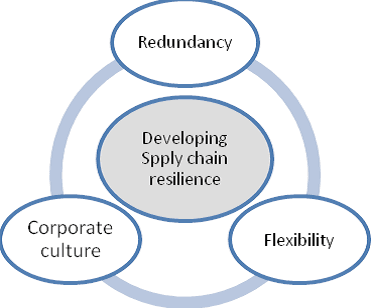
Developing a resilient supply chain
Generating and increasing redundancies during the supply chain.
Creating flexibility: A resilient supply chain resists disruptions and responds to fluctuations in demand.
Changing corporate culture: corporate culture helps to recover rapidly and even beneficially after a disruption

Source:https://www.researchgate.net/figure/Developing-a-resilient-supply-chain_fig1_277597871
Pillars of Supply Chain Resilience
Visibility is the ability to track and monitor the events and patterns of the supply chain as they happen.
Flexibility is the ability to rapidly adapt in response to issues without increasing operational expenses.

Source:https://www2.deloitte.com/ie/en/pages/deloitte-private/articles/improving-supply-chain-resilience.html
Collaboration is the capability to efficiently work with supply chain associates to evade disruptions and attain common goals.
Control is the ability to have robust policies, examining, and control methods to ensure the appropriate procedures and methods are followed.