
Pseudocode
Pseudocode is a method used to outline a computer program’s logical steps or algorithm without adhering to specific programming syntax. It’s a way to represent the logic of a program in a more human-readable and understandable format. Pseudocode is often used during the initial stages of program development to plan and design the program’s structure before actual coding occurs.
Pseudocode uses simple English-like statements, and its purpose is to communicate the algorithm’s logic clearly, without being tied to any specific programming language. Below is an example of a simple pseudocode algorithm to find the sum of two numbers:
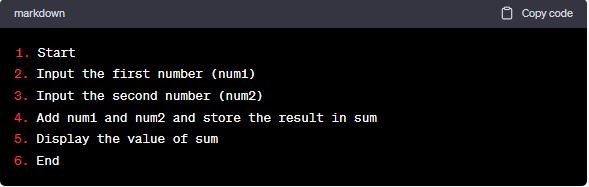
In this pseudocode example, the algorithm starts with a “Start” statement and ends with an “End” statement. It takes two inputs (num1 and num2), adds them together, and stores the result in the variable “sum.” Finally, it displays the value of “sum.”
Pseudocode can also include conditional statements (if-else), loops (for, while), and other programming constructs to represent more complex algorithms. Here’s an example of a pseudocode algorithm to find the factorial of a number using a loop:
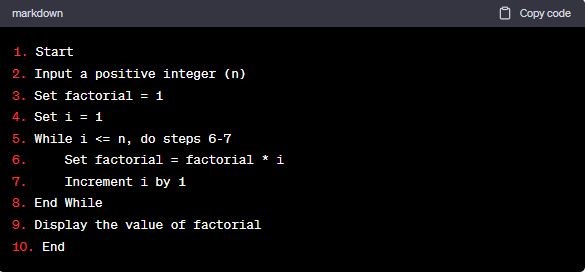
In this example, the algorithm calculates the factorial of a positive integer “n” using a while loop. It initializes the “factorial” variable to 1 and uses a loop to multiply “factorial” by each integer from 1 to “n.”
Pseudocode is a valuable tool for planning and discussing algorithms, making understanding the program’s logic easier before writing actual code in a specific programming language. It allows programmers to focus on problem-solving without getting bogged down in language-specific syntax details. Once the pseudocode is complete and well-tested, it can be translated into https://alicelwaltonfoundation.org/ the chosen programming language.