
Integrated Reflective Cycle
The Integrated Reflective Cycle is a simple but powerful model for students and professionals to engage in a meaningful reflective process on their practical experiences.The Integrated Reflective Cycle (Bassot, 2013)
The Integrated Reflective Cycle is a simple but powerful model for students and professionals to engage in a meaningful reflective process on their practical experiences. Barbara Bassot created the Integrated Reflective Cycle by drawing on aspects of established reflective models, such as those by Gibbs and Schön, and structured them into a four-stage framework.The four stages are
Experience → Reflection → Theory → Preparation This model is useful for students in the areas of professions allied to medicine, health, education, and social work, or for anyone with a professional-development, reflective, or placement assignment.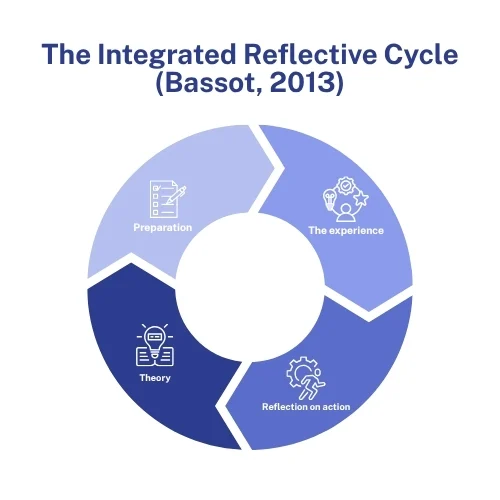
What is the Integrated Reflective Cycle?
This model helps you reflect deeper by combining emotional understanding, critical thinking, and application/ownership of learning. Each stage has questions that prompt you to ask not just what happened, but also why, what it means, and how to take further steps to improve in the future.| Stage | Purpose |
| Experience | Clearly describe the situation and context |
| Reflection on Action | Assess what worked well, What went wrong, what were the assumptions and emotions |
| Theory | Link the experience to academic models and professional knowledge |
| Preparation | Prepare a plan for how to apply this learning to your future practice |
1. Description
This is where you describe the circumstance you have chosen for reflection. Explain the context, who the participants involved were, what happened, and why the situation was important.Guiding Questions:
Tip: Make your description clear enough that someone outside your work context would understand the situation.2. Reflection on Action
At this stage, you will evaluate your thoughts, actions and responses. Reflection on action is where emotional intelligence and honest assessment comes into play.Guiding Questions:
Tip: Tip: This phase looks at feelings, assessment and outcomes in an analytical way all in one.3. Theory
In this stage of reflection, you will use scholarly literature or professional frameworks to make sense of the experience. This stage is extremely important in changing a personal experience into a an academic or profession learning experience.Guiding Questions:
Tip: Connect your actions to any established frameworks (e.g., communication models, codes of ethics, theories on management).4. Preparation
The final stage allows you to establish explicit, realistic objectives on how to adopt your approach in comparable situations in the future.Guiding Questions:
Tip: You need to be precise – general goals like “do better” are less helpful than saying, “I will practice core messages prior to the presentation.”