

Summary
Statistical Data Analysis is one of the most difficult tasks for Public Health Master's students. They often face difficulties with biostatistics, choosing the right statistical test, data preparation, statistical packages, and interpretation of the results. This blog describes the problems faced by students and offers solutions to increase the quality of research.
Introduction
Research in public health is very important for developing the health care systems, preventive measures for diseases, and the health of people in Qatar. Due to the introduction of Qatar National Vision 2030 and health care research in Qatar, the universities in Qatar require their Master’s students to conduct evidence-based research related to public health.
For a student to write a successful public health dissertation, it is not enough to simply collect data from surveys or clinical studies. They must conduct proper analysis of their data, use correct statistics and interpret the results appropriately. Unfortunately, many students undertaking Master's level research often have problems in analysing their data statistically.
The process of data analysis requires a balance between methodological expertise, statistical understanding, and computer skill. When lacking such expertise, students frequently find themselves unable to choose the appropriate statistical test, to analyse the output, or to explain the outcome in reference to their research goals. Tutors India offers Statistical Analysis Help in Qatar to Master's students in public health research, ensuring rigour and credibility in the results and outcomes.
Why Is Health Statistical Analysis Help in Qatar Important for Master's Research?
Unlike other fields of study, quantitative data plays a very critical role in public health studies to measure health status, detect disease patterns, assess intervention efforts, and make sound policy decisions. In Qatar, universities require Master's level students to show proficiency in analysing data through proper statistical methods.
A strong statistical analysis should include:
- Data cleaning and preparation
- Selection of appropriate statistical tests
- Analysis using statistical software
- Interpretation of statistical outputs
- Presentation of tables and figures
- Discussion of findings based on research objectives
An accurate statistical analysis increases the credibility of research and helps students make meaningful conclusions that add to the evidence base of public health practice. Students often get support from an expert Health Statistical Analysis Help in Qatar to strengthen their research outcome through effective data analysis.

Why Does Public Health Master's Research in Qatar Get Stuck at Statistical Data Analysis?
1. Limited Understanding of Biostatistics and Statistical Concepts
The most frequent reason for delay in the master’s research project is a lack of the researcher’s knowledge in biostatistics. Though many researchers have adequate knowledge of concepts and issues related to public health and research methods, they do not have proper knowledge of statistical concepts such as hypothesis testing, probability distributions, confidence intervals, p-values, and regression analysis.
This problem becomes clearer when the student starts analysing the data he has collected. Due to a lack of knowledge of statistical concepts, the researcher might find himself in trouble deciding how he will analyse the data and how he will interpret the statistical results.
What research shows:
According to Brearley et al. (2023), there have been challenges encountered in the comprehension and interpretation of statistical information from published articles amongst many graduate students undertaking public health studies. There is a need for a biostatistical literacy course for the development of hypothesis testing, confidence intervals, regression analysis and interpretation of statistical information.
Tips:
- Review fundamental biostatistics concepts before beginning analysis.
- Understand the assumptions behind commonly used statistical tests.
- Attend university workshops on quantitative
2. Difficulty Selecting Appropriate Statistical Tests
Identifying the right statistical test is yet another challenge facing Public Health Master’s students. Different designs, variables, and objectives need different kinds of analysis. Determining when it is appropriate to perform parametric and non-parametric tests, or using Chi-square, t-test, ANOVA, correlation, or regression is a challenge that students face.
Using the wrong statistical test will lead to erroneous results and undermine the validity of the study. Another challenge students have is checking whether their data satisfy the assumptions of the statistical test.
Example:
According to an analysis conducted by Enders et al. (2021), the skills needed for statistical competency in clinical and translational sciences included knowing when and how to apply different statistical methods. Nevertheless, many advanced analytics skills were found lacking among graduate learners, especially those pursuing a Master’s degree program.
Tips:
- Identify whether your variables are categorical or continuous.
- Check assumptions before selecting statistical tests.
- Match each research objective with an appropriate statistical method.
- Consult a statistician when analysing complex datasets.
3. Addressing Poor Data Preparation and Management with Dissertation Statistical Analysis Help in Qatar
Many Master’s students do not realise the significance of preparing data before conducting a statistical analysis since the dataset will usually include missing values, duplicate data, coding mistakes, inconsistent names of variables, and even outliers.
The failure to perform data cleaning leads to many difficulties in data entry in statistical software or interpretation of results of data analysis. Poor data handling can further affect the validity of the research conclusions by necessitating repeated analysis of the data, thus delaying submission of the dissertation.
Data preparation entails organising variables, examining data quality, coding responses, handling missing data, and verifying data correctness before running statistical procedures. Students can prefer a structured Dissertation Statistical Analysis Help in Qatar to ensure these elements in statistical analysis.
Example:
According to the World Health Organisation (2021), it is important to have good data management for effective public health research because this entails data cleaning, validation, standardisation, and quality assurance. Poorly managed datasets will create challenges like errors in analysis, unreliable data, and evidence-based decision-making in health research.
Tips:
- Check datasets for missing or duplicate values.
- Code variables consistently before analysis.
- Identify and manage outliers appropriately.
- Validate data before importing it into statistical software.
Get the Statistical Analysis Services in Qatar from Tutors India to conduct an effective data analysis for your public health master’s studies.
4. Limited Proficiency in Statistical Software (SPSS, R, or Stata)
Statistical software is crucial for conducting research in public health, but many Master’s students in Qatar lack sufficient practical skills to work with software such as SPSS, R, Stata, or SAS. Universities usually include these software packages in their curricula; however, students might lack enough practice to use them independently.
During research, students face difficulty in importing data sets, coding variables, conducting statistical tests, and analyzing the output from the software program used. Mistakes such as incorrect variable coding and the use of the wrong command could result in incorrect findings, necessitating the whole procedure to be done all over again.
Example:
According to a study conducted by Luo et al. (2023), most graduate students are not confident in their capabilities to utilise statistical software due to the low level of practical training they obtain in managing and analysing research data. Therefore, gaining practical skills through software applications helps improve these abilities in the process.
Tips:
- Learn one statistical software thoroughly before beginning data analysis.
- Practise analysing sample public health datasets.
- Follow university tutorials and online training resources.
- Seek expert guidance when performing advanced statistical
5. Weak Academic Writing and Proposal Structure
Conducting statistical analysis constitutes only a portion of quantitative research. The interpretation of the statistical output and explaining the outcomes with respect to the research aim is an issue faced by many Master’s degree students. It is common that they conduct the analysis properly yet have difficulty understanding its implications.
For instance, most students present the value of p and other statistical measures without giving any practical meaning to the results and comparing them with existing literature. Some students misread confidence intervals, regression coefficients, and correlation. Poor interpretation affects the general quality of the thesis.
Example:
According to Hedlund (2024), statistical reporting in the nursing literature has been reviewed, and it was observed that many published papers lacked proper statistical software and statistical methods used in their analyses. This indicates the need for accurate interpretation and proper reporting of statistical analysis in health sciences.
Tips:
- Interpret results in relation to your research objectives.
- Explain the practical significance of statistical findings.
- Compare your findings with previous public
How to Improve Statistical Data Analysis in Public Health Master's Research?
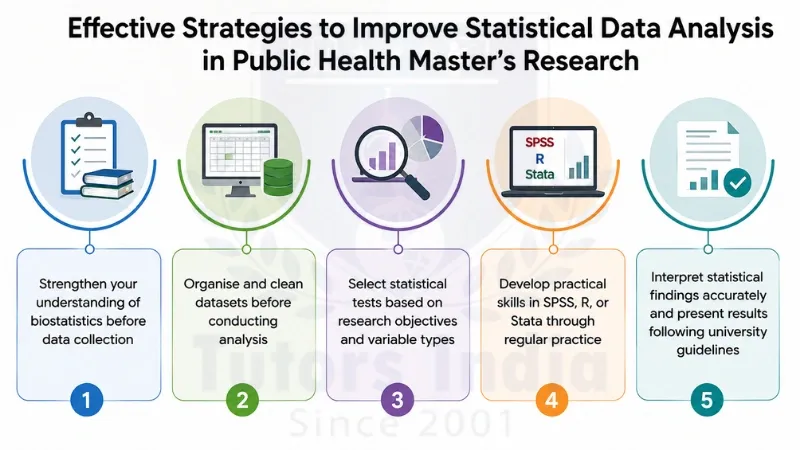
- Strengthen your understanding of biostatistics before collecting data.
- Organise and clean your dataset before analysis.
- Select statistical tests based on your research objectives and variable types.
- Develop practical skills in SPSS, R, or Stata through regular practice.
- Verify that your data meet the assumptions of statistical tests.
- Interpret findings within the context of public health research.
Conclusion:
Data analysis is among the most difficult parts of a Public Health Master’s thesis in Qatar. Most students manage to collect the required data but fail to conduct quantitative data analysis due to a lack of biostatistics knowledge, wrong statistical test selection, insufficient data preparation, computer skills, and statistical results interpretation.
Recognition of these difficulties and addressing them in advance could contribute to enhancing the quality of research work as well as avoiding delays in dissertation writing. Building up skills in statistics, applying software techniques, ensuring data quality and consulting experts when needed could assist in conducting evidence-based research in public health.
Looking to strengthen your Public Health Master's research in Qatar? Talk to our experts for personalised support with statistical data analysis, result interpretation, academic writing, and dissertation refinement to help you achieve academic success
Book a Free Expert Consultation with Tutors India and receive structured Master's Statistical Analysis Help in Qatar
References:
- Brearley, A. M., Rott, K. W., & Le, L. J. (2023). A biostatistical literacy course: Teaching medical and public health professionals to read and interpret statistics in the published literature. Journal of Statistics and Data Science Education, 31(3), 286–294. https://doi.org/10.1080/26939169.2023.2165987
- Enders, F. T., Kim, H., Klinkmeier, A., et al. (2021). Learning gaps among statistical competencies for clinical and translational science learners. Journal of Clinical and Translational Science, 5(1), e12. https://pmc.ncbi.nlm.nih.gov/articles/PMC8057376/
- World Health Organization. (2021). WHO guideline on health data quality and health information systems. World Health Organization. https://www.who.int/publications/who-guidelines
- Luo, L., Kim, J., & Emery, K. (2023). Research data management needs assessment for social sciences graduate students: A mixed methods study. PLOS ONE, 18(3), e0282152 https://journals.plos.org/plosone/article?id=10.1371/journal.pone.0282152
- Hedlund, M. (2024). A matter of research integrity: The reporting of statistical software used in studies published in nursing journals in 2023. Learned Publishing, 37(4). https://onlinelibrary.wiley.com/doi/full/10.1002/leap.1622