

Summary
Undertaking an AI dissertation in the Netherlands requires a lot of effort from the student since they must find a way to coordinate all the aspects of their Master’s program format, research, thesis timeline, academic guidance, data privacy considerations, and university guidelines. A student needs to plan effectively to complete a quality dissertation on time.
Introduction
The field of Artificial Intelligence (AI) has gained prominence as a subject of post-graduate studies in the Netherlands, with courses offered on topics such as machine learning, data science, natural language processing, computer vision, robotics, and responsible AI. The universities in the Netherlands provide research-based courses for students who are required to put their technical knowledge into research practice.
The writing process for an AI Master’s Dissertation at the University of the Netherlands requires more than just developing an artificial intelligence system. There is a need to formulate an adequate question, carry out literature reviews, and analyse data sets. It also involves selecting appropriate AI methodologies, evaluating results, and presenting findings in accordance with the rules laid down by the university. Such research should be able to fit into the EC program structure.
Thus, students may encounter problems due to their overly wide research scope, data processing taking more time than planned, or insufficient time being left for analysis and academic writing after model development. In addition, GDPR, research ethics, responsible AI, and Dutch research integrity requirements can pose additional requirements, especially in cases where personal or sensitive data is being used.
Dissertation Writing Services in Netherlands from Tutors India have the expertise to help students in their Master's programs enhance their methodologies, apply AI models, analyse outcomes, and finish high-calibre dissertations.
Why Is an AI Dissertation Important in a Dutch Master's Programme?
An AI dissertation is a significant part of many Master’s programs in the Netherlands since it allows students to showcase their ability to conduct independent research. As compared to the common application of knowledge gained through course studies, a student is supposed to do research on a particular issue and draw conclusions based on findings.
A high-quality AI dissertation enables students to:
- Apply machine learning, programming and data-analysis skills to a real research problem.
- Demonstrate independent research and critical thinking.
- Design and evaluate suitable AI models and methodologies.
- Work responsibly with datasets while considering privacy and research ethics.
- Present findings according to their Dutch university's thesis and assessment requirements.
- Contribute meaningful insights to an existing area of AI or Data Science research.
Dutch students must choose a realistic research topic since the thesis is a large portion of the entire Master's work. It is necessary to find a compromise between one's research ambitions and the amount of the EC workload, the programme schedule, supervision and availability of adequate data and computing power. It is vital to define a clear research question right from the start.
Why Do Master's Students in the Netherlands Struggle to Complete Their AI Dissertation on Time?
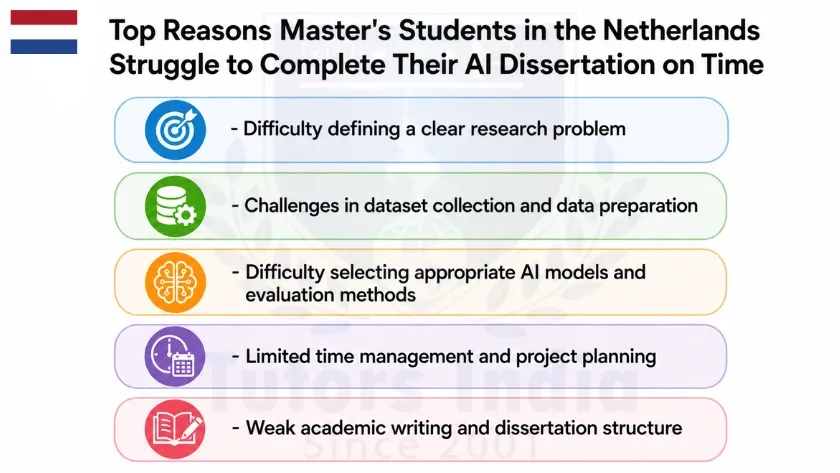
1. Difficulty Defining a Research Problem Within the Dutch Master's Programme
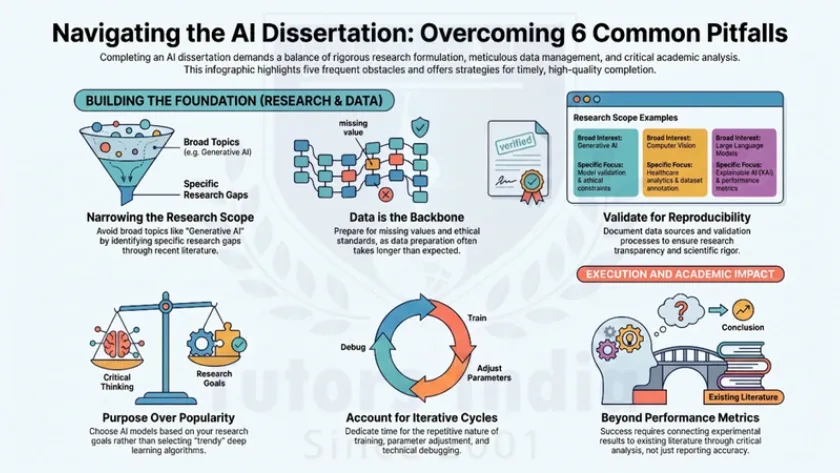
The first challenge that many AI Master's students encounter in the Netherlands is making sure that their chosen field of interest becomes specific enough to form a research problem to be done during the time allotted for their Master's thesis.
Fields like generative AI, large language models, computer vision, healthcare AI, and explainable AI can easily get too broad to be done as one Master's project.
The research requirements of a Master's programme in the Netherlands usually include a certain number of ECs. For instance, the MSc Artificial Intelligence programme at Utrecht University contains an extensive research element, but there are others as well at different universities in the Netherlands. As a result, students need to realise the research feasibility within the allotted timeframe.
What research shows:
Even though AI technologies can help creativity and help with literature review, as pointed out by Castillo-Martínez et al. (2024), any scientific research must be based on well-formulated research questions and critical thinking.
What students should do:
- Check the thesis and EC requirements of their Dutch university before choosing a topic.
- Narrow broad AI areas into a research question suitable for a Master's thesis.
- Review recent research from Dutch AI/Data Science research groups.
- Discuss the research scope and feasibility with the thesis supervisor.
- Align research objectives with the programme's assessment criteria.
2. Challenges With Dataset Collection, Preparation and Dutch Data-Privacy Requirements
Data preparation may turn out to be one of the major causes of delay in an AI dissertation. Students might assume at first that they can use the available dataset right away for training purposes. They may find that the dataset lacks some data, contains duplicates, has issues with variable consistency, class imbalance, and a lack of observations.
When the research includes sensitive personal data, this becomes increasingly relevant. Researchers working in the Netherlands should consider both the GDPR and their own university’s research ethics guidelines.
For instance, the Dutch Data Protection Authority states that the retention of personal information should be limited to the extent that is necessary, and universities stress the importance of conducting research responsibly and scientifically.
It implies that students must give more attention to privacy and ethics before data collection and processing instead of viewing it as an administrative problem while writing a dissertation.
Example:
UvA – AI for Healthcare Decision-Making
The University of Amsterdam (UvA) is involved in a priority research area of Artificial Intelligence for Health Decision Making, which has brought together researchers from the areas of computer science, medicine, law, and humanities, whose work relates to AI application in healthcare and takes into consideration quality, safety, and ethics.
What students should do:
- Check their university's data-management and research-ethics requirements before collecting data.
- Consider GDPR requirements when working with personal or sensitive data.
- Verify whether datasets can legally and ethically be used for academic research.
- Document data collection, cleaning and preprocessing procedures.
- Follow the university's requirements for secure data storage and retention.
3. Difficulty Selecting an Appropriate AI Model and Evaluation Method
The Dutch courses in AI and Data Science offer a diverse selection of analysis techniques such as machine learning, deep learning, statistics, and computational techniques. This makes choosing a suitable model difficult.
Transformers, language models, and deep learning techniques are sometimes chosen by the students since they represent a very modern technique. However, a Master’s thesis should not employ an advanced model just for the innovation.
The chosen model should be suited to the research question, data set, available computing power, and goals of the evaluation process. A student involved in a classification task, for instance, might have to compare simple techniques to more advanced ones before determining whether additional complexity is worth the effort.
Example:
Utrecht University & TU Delft – National Police Lab AI
National Police Lab AI (NPAI) is a joint venture by the Dutch Police, Utrecht University and TU Delft. The topics of research at NPAI include intelligent dialogue, legal argumentation, crime scenarios, evidence-based policing and responsible & transparent AI..
What students should do:
- Select AI methods based on the research question rather than current trends.
- Consider approaches commonly used within their Dutch programme or research group.
- Establish baseline models before applying more complex techniques.
- Justify model selection and evaluation metrics in the methodology.
- Discuss model limitations, reliability and potential bias.
Get structured academic support from Tutors India to write a strong dissertation for your AI research.
4. Difficulty Managing the Thesis Timeline and EC Workload
Time management becomes very crucial in this regard as a thesis from a Dutch Master’s programme forms an integral part of the entire programme structure.
There can be various aspects that require completion by the student before proceeding towards thesis writing. Some programmes even have certain prerequisites that must be met prior to conducting the research work.
For instance, VU Amsterdam notes that students need to accumulate 60 ECs before starting the Master Project AI. The course element in Utrecht University’s program in AI is separated from the substantial research element in the second year.
In other words, students should not consider the deadline for their thesis as just another writing deadline. This project should be worked backward from based on the submission date.
What students should do:
- Check the official thesis timeline and prerequisites of their Master's programme.
- Plan research activities around the programme's EC workload and submission deadline.
- Set milestones for literature review, data preparation, modelling, analysis and writing.
- Allow sufficient time for supervisor feedback and required revisions.
5. Academic Supervision and Communication Challenges
Supervision of the academic research is yet another crucial component in the Master’s thesis process in the Netherlands.
This may be conducted by the university supervisor, daily supervisor, fellow researcher in the group or even an outside organisation depending on the programme and the project.
For instance, the university has observed that those carrying out their final project in an outside company or institution can have supervision from both the outside organisation and the AI teaching staff supervisor. Similarly, the AI project at VU Amsterdam has certain formal criteria regarding the same.
This implies that students should understand who is going to be supervising them, the guidance that will be provided and how the thesis will finally be evaluated.
Some delays may arise when students delay asking questions or do not reach a consensus about milestones or make some major changes to methodology without consulting their supervisors.
What students should do:
- Understand the supervisor and assessment arrangements within their university.
- Agree on research milestones and meeting schedules at the beginning of the project.
- Discuss changes to the research question or methodology with the supervisor.
- Use supervisor feedback throughout the research rather than only before submission.
6. Research Ethics, Data Privacy and Responsible AI
There are ethical issues that will arise out of AI research that would not necessarily be seen in a normal programming assignment.
The data set involved in a thesis could contain personal, health, behavioural, automated decision-making, facial images, internet user information or other forms of sensitive data. As such, there are times when students must consider not only the availability of the data, but its appropriateness for use.
Scientific integrity and good research practices are very important in Dutch universities. In the Netherlands, there is an emphasis placed on compliance with the Dutch Code of Conduct for Research Integrity.
Example:
UvA – AI, Fairness and Inclusive Healthcare:
The UvA-led AI ELSA Lab was funded by NWO to explore how AI can be developed within healthcare. The lab combines data science, ethics, psychology, healthcare, and law, with partners such as UvA, VU Amsterdam, Utrecht University, and Amsterdam UMC.
For AI students, responsible research can include:
- Protecting personal information.
- Clearly documenting data sources.
- Avoiding fabrication or manipulation of results.
- Reporting limitations honestly.
- Considering bias and fairness.
- Explaining the limitations of AI models.
7. Weak Academic Writing and Dutch University Thesis Expectations
Technical skill itself is not enough to write an excellent AI Masters Thesis in the Netherlands. The universities, including Delft University of Technology (TU Delft), University of Amsterdam (UvA), Utrecht University, and Vrije Universiteit Amsterdam (VU Amsterdam), require Master's candidates to show independent research work, a proper research question, the right methodology, and solid conclusions.
For instance, in the AI Master's programs offered at Utrecht University and VU Amsterdam, there are expectations on individual research. The students must explain reasons for choosing certain data sets, AI models and methods of evaluation rather than stating only the accuracy of the model used. A good thesis connects all parts of the work while showing the student's thinking.
The students are also required to adhere to the thesis manual, evaluation criteria, and research norms of their respective universities. This may vary from one institution to another, like TU Delft, UvA, Utrecht University, and VU Amsterdam, among others, especially in terms of structure, evaluation, supervision, research integrity, and data management.
What students should do:
- Follow the university-specific thesis manual and rubric of universities like TU Delft, UvA, Utrecht University or VU Amsterdam.
- Show independent research and analysis, and not just results from AI models.
- Clearly justify all methodological choices and modelling choices.
- Make a coherent connection between literature, research questions, methodology, results, and discussion.
Quick Self-Check
1. Have I defined a clear and focused AI research problem?
2. Have I selected reliable datasets and documented my data preparation process?
3. Have I justified my choice of AI models and evaluation methods?
4. Have I planned sufficient time for experimentation, writing, and revisions?
Conclusion:
A successful completion of an AI Master’s dissertation in the Netherlands within the deadline entails more than just having the technical expertise. The individual will have to balance EC load, set a research question, handle data in an ethical manner, choose proper AI methodologies, and satisfy all research requirements of their institution. It would be helpful for an individual to comprehend the demands of the Dutch university right from the beginning.
Strengthen every stage of your AI dissertation with Tutors India. From defining research objectives and preparing datasets to validating AI models and presenting research findings, our experts support Master's students in the Netherlands throughout their dissertation journey.
Book a Free Expert Consultation with Tutors India and receive structured AI Dissertation Writing Services in Netherlands.
References:
- University of Amsterdam. (n.d.). Artificial Intelligence for Health Decision-Making. UvA Research Priority Area. University of Amsterdam (UvA
- Utrecht University. (n.d.). Making the Netherlands safer with artificial intelligence. Utrecht University. Over het Nationaal Politielab AI - Nationaal Politielab AI - Universiteit Utrecht
- Robeer, M., Bron, M., Herrewijnen, E., Hoeseni, R., & Bex, F. (2024). The Explabox: Model-Agnostic Machine Learning Transparency & Analysis. arXiv. https://arxiv.org/abs/2411.15257
- Castillo-Martínez IM, Flores-Bueno D, Gómez-Puente SM and Vite-León VO (2024) AI in higher education: a systematic literature review. Front. Educ. 9:1391485. doi: 10.3389/feduc.2024.1391485 Frontiers | AI in higher education: a systematic literature review
FAQs:
1. How long does an AI thesis take in the Netherlands?
Most AI Master's theses take 6–10 months, depending on the programme. At Utrecht University, for example, the research phase alone runs about 17–18 weeks full-time. Always check your specific programme's timeline.
2. What is EC workload, and why does it matter for an AI thesis?
EC (European Credits) measures study load, with 1 EC equal to roughly 28 hours of work. A thesis often makes up 30–45 EC of a 120 EC programme, so it demands real time planning. Most programmes also require a set number of EC completed before you can start.
3. Do I need to complete all my coursework before starting my AI thesis?
Not always all of it, but most programmes set a threshold. VU Amsterdam requires 60 ECTS completed first, and Utrecht largely finishes coursework (76 EC) before the research phase begins. Check your own programme's specific requirements.
4. What makes an AI dissertation topic too broad for a Master's timeline?
Fields like "generative AI" or "computer vision" are research areas, not research questions. A workable topic narrows this to one specific, answerable question. Discuss scope with your supervisor early to avoid this trap.
5. Do AI theses in the Netherlands need GDPR or ethics approval?
If you're using personal, health, or sensitive data, yes — you'll likely need a Data Protection Impact Assessment (DPIA) and ethics review. Confirm data-handling rules with your supervisor before collecting any data.
6. Can I use a pre-existing dataset, or do I need to collect my own?
Both are common. Public datasets save time but often have quality issues; self-collected data needs more privacy and ethics planning. Either way, document your source and cleaning process clearly.