
Why UK Medicine Master’s Assignment Grades Drop Despite Strong Clinical Knowledge
Summary:
This blog identifies the reasons for which many UK medical master’s students score low marks in their assignments despite being knowledgeable about clinical practice. This blog will identify some common mistakes made by students while writing academic papers, including lack of critical thinking, lack of evidence-based practice, poor structure, inappropriate referencing, and bad time management skills.
Most postgraduate students seeking careers in medicine in the UK have adequate medical knowledge and considerable experience in health care. Despite having in-depth knowledge in their subjects, most of them get poor grades on their assignments. The explanation is that UK institutions consider other factors besides medical knowledge when marking the assignments.
UK healthcare programs require students to possess advanced learning skills through the synthesis of current clinical evidence, evaluation of research, and theoretical knowledge in clinical settings. Students often struggle to write in an analytical format in clinical writing.
This blog highlights the most critical reasons for UK medicine master’s students getting poor grades on their assignments despite having a thorough knowledge of medicine. At Tutors India, our professionals offer customised Assignment Writing Support in UK to help master’s students write academic assignments.
Importance of Structured Assignment Writing Services in UK
In the United Kingdom, master’s courses in medicine not only consider the clinical skills of the students, but they also judge them on their capability to demonstrate their evidence-based knowledge in the form of academic writing.
The assignments given to the students test their skills of analysing clinical evidence, justifying decisions, applying healthcare theories, and reflecting upon their professional practice. Thus, just having good clinical knowledge is not enough to achieve good grades.
In addition to this, UK universities lay much stress on academic integrity, coherent logic, scientific precision, and proper citation. Good academic writing allows students to prove their knowledge while satisfying all the requirements of marking rubrics. Those students who are weak in academic writing skills usually go for professional Assignment Writing Services in UK to enhance the standard of their assignments.
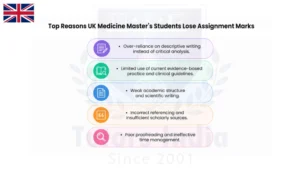
Why UK Medicine Master’s Students Lose Assignment Marks?
1. Over-Reliance on Descriptive Writing Instead of Critical Analysis
The most prevalent reason for a deduction in marks for medicine master’s students is the fact that they tend to discuss clinical problems rather than analysing them. Most students have great clinical exposure and skilled in patient management. However, postgraduate coursework needs analysis rather than discussion.
Critically analysing entails evaluating different possible courses of action, comparing current clinical practice guidelines, assessing pros and cons of available evidence, and defending their clinical decisions based on recent research findings. They are supposed to challenge available evidence rather than regurgitating information found in textbooks.
An example of this is not to provide information on the treatment of sepsis but instead compare what different clinical practice guidelines have recommended and assess the impact of evidence on implementing an early intervention strategy.
2. Addressing Weak Integration of Evidence-Based Practice with Assignment Writing Help in UK
Evidence-based practice is the backbone of contemporary healthcare education in the UK. The evidence should be up-to-date and scientifically valid to back every important point made in the assignments on the Medicine master’s course.
Most students refer to old studies, have a small number of references, or do not justify the impact of research results on the clinical decision-making process. Many students paraphrase articles but do not assess their value. Students often consult Assignment Writing Help in UK to integrate evidence-based practice into their clinical assignments.
In higher-level assessment tasks, you will be required to critically appraise systematic reviews, meta-analyses, randomised controlled trials, and national clinical guidelines. While undertaking assessment, you need to consider: Quality of evidence, Limitations of evidence, Relevance to the impact of evidence-based practice
3. Poor Academic Structure and Scientific Writing
The absence of good organisation, even in the case where students have all the required clinical knowledge, leads to poor grades in the assignments. UK postgraduate institutions require students to adhere to academic guidelines, where the arguments must be made in an orderly way.
Poor grades result from the lack of a topic sentence in the paragraphs, poor linking of ideas, and repetition. Poor writing style and overuse of abbreviations also lead to poor performance.
Objective, clear, and empirical style is necessary for scientific writing. Every paragraph must convey only one main point, and this point must be supported with evidence from literature and connected with the general flow of arguments. The introduction, transitions, and conclusion must be clear.
Get the pricing details for the master’s dissertation methodology service at Tutors India, designed to assist students in developing an appropriate research methodology.
4. Inaccurate Referencing and Limited Use of Scholarly Sources
One of the reasons for avoidable losses of marks in assignment work in Master of Medicine is incorrect references. A proper bibliography or reference list format, as required by the University, must be produced by the student, which must evidence your critical review of academic resources.
Students rely too often on textbooks, lecture notes and websites rather than peer-reviewed literature. In other instances, there is use of old material or citations not consistent with required referencing styles.
A top quality assignment includes recent publications in highly regarded medical journals, well-conducted systematic reviews, and guidelines. The references must also be evaluated as to their quality, currency and fit for the topic.
5. Inadequate Proofreading and Time Management
Many students lose marks by writing assignments close to deadlines, without the time to check over them and edit out careless errors, which often include: grammatical inaccuracies, irregular formatting and, to the detriment of their argument and their mark, poor quality and inattention to references.
Proofreading isn’t just about checking spelling – the logical progression, integrity of arguments, quality of use of evidence, construction of paragraphs, citations and the student’s adherence to the university guidelines on their marking criteria all come under the remit of effective proofreading.
By structuring an achievable writing schedule, you will have time for your research, writing, proofreading and editing. You should also get your supervisor or academic writing services to read through it before handing your work in.
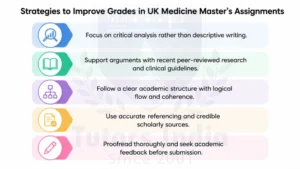
Strategies to Improve Grades in UK Medicine Master’s Assignments
- Read the assignment brief and marking criteria carefully.
- Use accurate referencing and credible scholarly sources.
- Proofread thoroughly and manage your time effectively.
- Seek academic feedback to improve assignment quality.
- Write about critical analysis, not description.
- Use recent peer-reviewed research and clinical guidelines to back up your arguments.
- Get academic Healthcare Assignment Support in UK for master’s research
Conclusion:
Clinical knowledge is no doubt very important for success in studying a UK medicine master’s degree; however, this is just one of many facets of evaluation. Another facet includes the evaluation of a student’s capacity for critical thinking, application of evidence-based practice, argument building, scientific writing, and accurate referencing of academic literature.
Students struggling in assignment writing can utilise customised Master’s Assignment Services in UK, which assist in improving their critical analysis skills, incorporation of evidence, structuring of their assignments, and referencing at the same time.
Book a Free Expert Consultation with Tutors India to write a well-structured assignment that aligns with university requirements.
References:
- Boice, R. (1990). Professors as writers: A self-help guide to productive writing. New Forums Press.
- Kim, S., Yang, J. W., Lim, J., Lee, S., Ihm, J., & Park, J. (2021). The impact of writing on academic performance for medical students. BMC medical education, 21(1), 61. https://doi.org/10.1186/s12909-021-02485-2
- Melnyk, Bernadette Mazurek, B. M., Gallagher-Ford, L., Fineout-Overholt, E., & Stillwell, S. B. (2023). Evidence-based practice in nursing & healthcare: A guide to best practice (5th ed.). Wolters Kluwer.
- International Committee of Medical Journal Editors. (2024). Recommendations for the conduct, reporting, editing, and publication of scholarly work in medical journals.
- Silvia, Paul J.. (2019). How to write a lot: A practical guide to productive academic writing (2nd ed.). American Psychological Association.
 Previous Post