
Medical & Healthcare
Research Methodology
Medical & Healthcare
Continued growth of Telehealth and Privacy concerns
Difference between direct primary care and concierge medicine
Multiple Chronic Condition Research Network
Wearables Support Bedside Care and Remote Patient Monitoring
Telehealth Platform Enable Secure Connections from Anywhere
Mobile Workstations offer more Seamless Care
Decentralized Approach to Care Management
New Insights into Complex Role of Mitochondria in Parkinson’s disease
Wearables Support Bedside Care and Remote Patient Monitoring
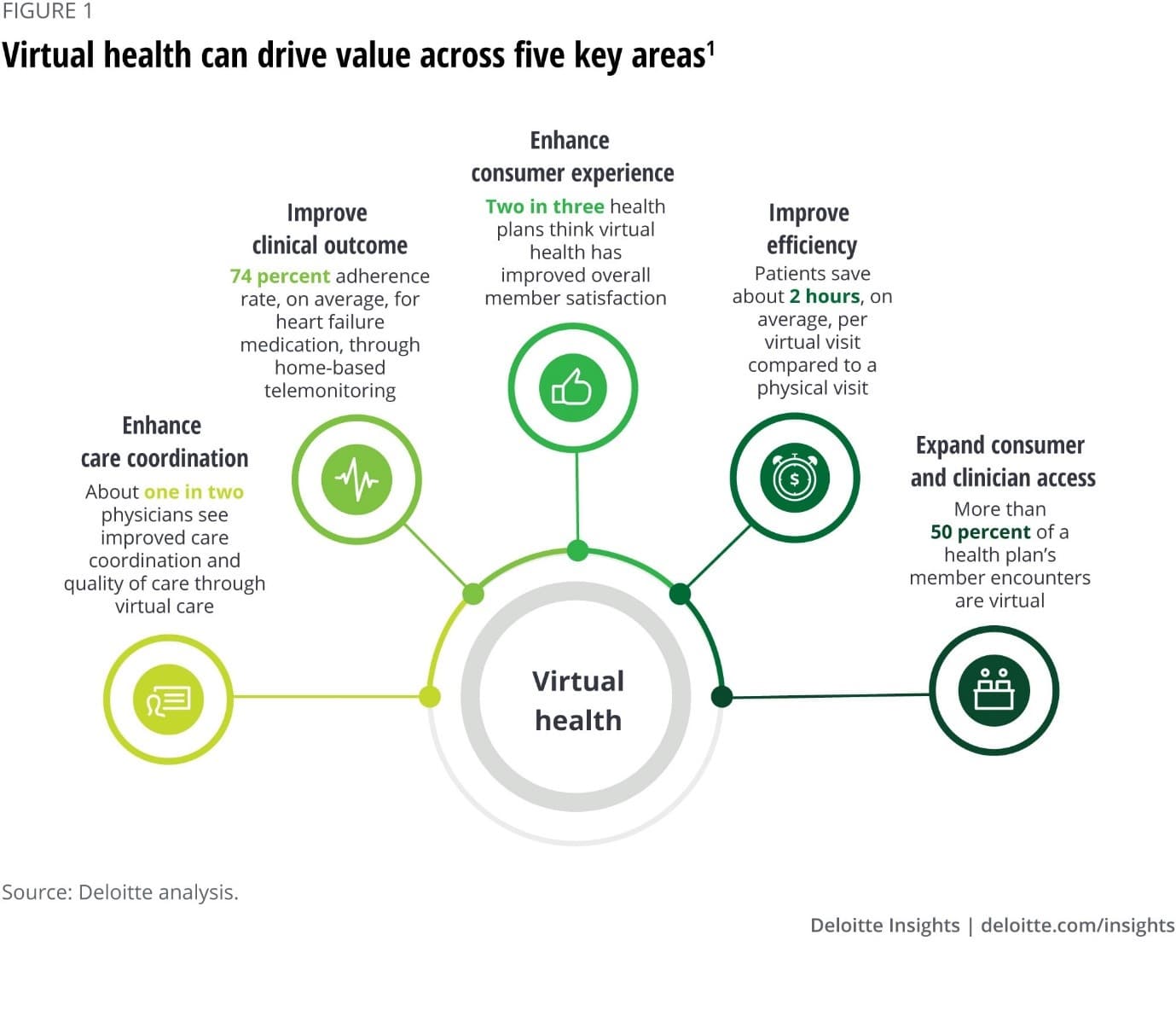
Remote patient monitoring devices take the stress and scramble out of healthcare for a wide range of patients, and can help all kinds of specialists do their job more effectively and efficiently—and ultimately, more joyfully. This form of telehealth can also provide comfort and reassurance for the families of patients who are at a higher risk of falls or accidents using sensors that send alerts to both family members and medical providers.

Fig.1. The Future of Virtual Health (Deloitte.com)
Remote patient monitoring devices tap digital technology to send communications between patients and providers. Patients monitor themselves to collect data about their health at various points throughout the day, then electronically transmit secure data in messages to their clinicians or technicians. Then, medical professionals in their primary care offices, hospitals, intensive care units, nursing facilities, or off-site monitoring centers assess that information in order to make daily—or sometimes, even hourly—recommendations. By continuously tweaking each treatment protocol, they can also provide much-needed reassurance that treatment is working, immediate alerts to alter prescriptions, or direction to head to the ER if necessary.
After a patient is released from the ER or from a care facility, RPM devices allow providers to continue monitoring and treatment tweaks—often preventing the need to leave home again. When clinicians can monitor weight, vital signs, blood pressure, blood sugar, blood oxygen, heart rate, and electrocardiograms from any point of care, they collect data more often and more consistently than they ever could at traditional in-office patient appointments. For patients with high-risk pregnancies, serious heart conditions, or dementia, this rapid, real-time information exchange could be an utter lifesaver.