
Medical & Healthcare
Research Methodology
Medical& Healthcare
Continued growth of Telehealth and Privacy concerns
Difference between direct primary care and concierge medicine
Multiple Chronic Condition Research Network
Wearables Support Bedside Care and Remote Patient Monitoring
Telehealth Platform Enable Secure Connections from Anywhere
Mobile Workstations offer more Seamless Care
Decentralized Approach to Care Management
New Insights into Complex Role of Mitochondria in Parkinson’s disease
Stem Cell Technology
Stem cell research is a rapidly developing field that combines the study of cell biologists, geneticists, and physicians to provide hope for the potential care of a variety of cancers and non-cancerous diseases. Stem cells are totipotent progenitor cells that have the ability to self-renew and differentiate into a variety of age lines. Since stem cells survive and differentiate reliably in culture, they are ideal candidates for in vitro stimulation.
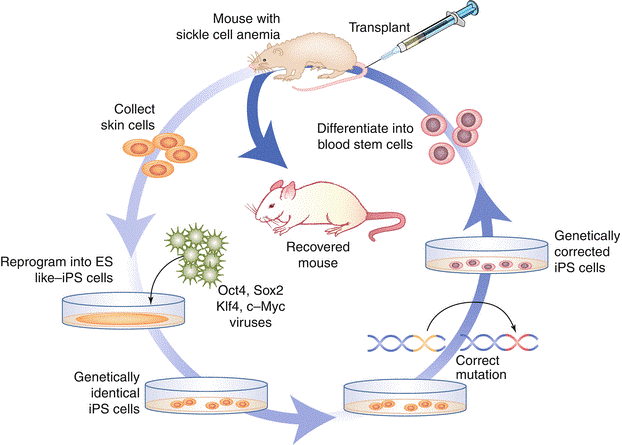
Although the focus of early study was on haematopoietic stem cells, stem cells have since been found in a number of places. Study on strong tissue stem cells has not advanced as rapidly as research on haematopoietic stem cells[1]. This is because replicating the same three-dimensional structures and similar cell-cell and cell-extracellular matrix relations found in solid organs is difficult. Because of their ability to move into tissue cyto-architecture under the control of the host microenvironment and developmental signals, tissue stem cells are appropriate for cell replacement therapy. Medical applications of manipulated stem cells combine advancements in transplantation and gene therapy, and stem cell biology is progressing as a result of a collaborative effort. Stem cells originating from solid tissue can be able to restore tissue. Stem cells originating from solid tissue can be able to restore tissue. Somatic gene therapy, or the introduction of new genetic material into stem cells, is being created, and it could lead to the cure of a number of hereditary diseases[2].

Fig4: Stem Cell Technology[1]
References
[1] https://slideplayer.com/slide/16187184/