

Summary
In UK universities, many master’s research proposals have been turned down due to poor research problem definition, poorly written literature review, wrong methodology used, and poor theoretical justification. There are various reasons why many research proposals get rejected, and this article provides some of the methods to help you create an effective research proposal.
Introduction
The research proposal for a master’s is one of the most important academic documents that must be submitted by students pursuing higher education in the UK. The submission of the research proposal takes place before embarking on the dissertation. The proposal should prove the importance of the research question and provide the methodology and contribution of the study.
UK universities uphold high standards and require proposals to be original, critical, and methodologically sound. While many students are knowledgeable in their subjects, they face problems in organising their research ideas in academic proposals. This results in frequent rejections or revisions of proposals before proceeding with dissertation research.
Professional Master’s Research Proposal Writing Service in UK by Tutors India assists students in preparing well-written proposals that meet the requirements of the university and form a base for their dissertation research.
Research Proposal Writing Support in UK: Building a Strong Foundation for Your Dissertation
A research proposal is not simply an abbreviated version of your dissertation. It’s like a research plan, which explains the research, its significance, original contributions to knowledge, as well as the academic rationale of your study. UK universities will want to see that your proposed research is both meaningful and has some aspect of research ability, and there’s room for more research within the field.
Finally, they evaluate the methodology to determine if it’s ethically acceptable, suitable, and likely to yield valid research results each time. Besides maximising the chances of your dissertation getting approved, a good proposal offers you an actionable guideline in conducting high-quality, systematic research throughout your master’s degree. A professional Research Proposal Writing Support in UK can significantly improve the quality of the master’s research proposal.
A well-developed research proposal enables students to:
Clearly define a focused and researchable problem.
Demonstrate the significance and originality of the proposed study.
Justify appropriate research methodology and theoretical framework.
Develop a realistic and feasible research plan.
Increase the likelihood of proposal approval and successful dissertation completion.
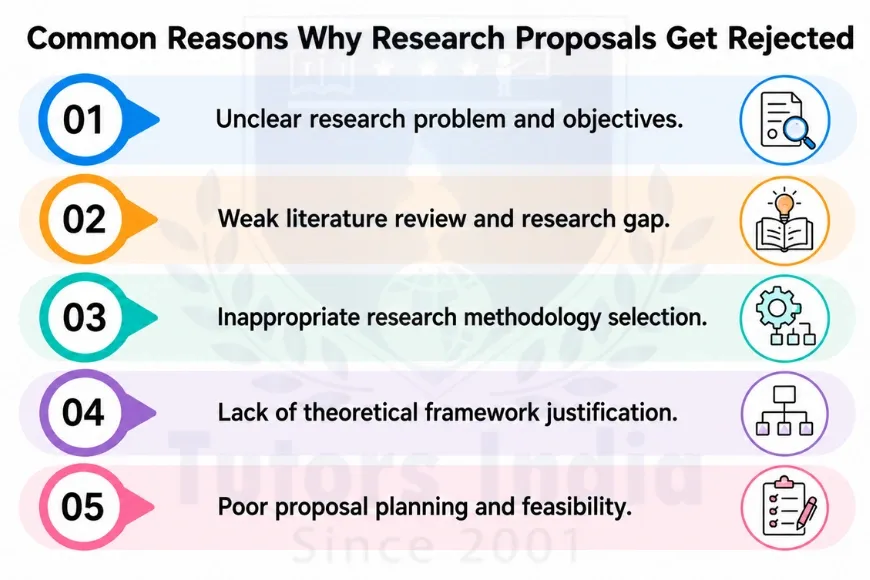
Why Your UK Research Proposal Keeps Getting Rejected?
1. Unclear research problems and objectives
The most common cause of a proposal refusal is the lack of a stated research problem. Some students choose general topics rather than a specific issue that warrants research. This will inevitably result in an imprecise formulation of the research objectives, thus greatly complicating the reviewers’ task in understanding the motivation behind the research.
The proposals must identify the problem under investigation and its relevance to justify its solution through the planned research process.
What research shows:
“The use of a well-formulated problem statement provides a rationale for methodology, for development of research questions and will inform the generation of useful social, behavioural, and educational knowledge and practice” (Creswell & Creswell, 2023).
Tips:
Define one specific research problem.
Develop measurable research objectives.
Ensure objectives align with research questions.
Clearly explain the significance of the study.
2. Weak Literature Review and Research Gap Identification
One of the most common reasons why research proposal applications fail in British institutions of higher education is the existence of an ineffective literature review. Most learners find themselves in the position of presenting only the summary of existing studies without proper analysis.
A good literature review should contain a comparative analysis of findings, a discussion of methods applied to carry out the research, and identification of gaps and inconsistencies.
If the research proposal lacks originality or fails to find any gap, then the review may feel that the research is a mere replication of previous findings and not a generation of new knowledge. A sound literature review will build up the academic base of the research proposal.
What research shows:
According to Snyder (2019), literature reviews are supposed to synthesise previous knowledge but highlight gaps that need further research. Through a systematic and critical review, researchers are able to identify research gaps and come up with research questions.
Tips:
Use recent peer-reviewed journal articles.
Compare different research findings.
Identify theoretical and methodological gaps.
Clearly explain how your study extends existing knowledge.
3. Choosing an appropriate Research Methodology with Dissertation Proposal Writing Service in UK
The common reason that proposals may fail is a lack of proper methodology justification. Students often choose one of the qualitative, quantitative or mixed research methodologies without providing any justification as to why this or that particular methodology is appropriate for solving the research problem and answering the research questions.
In many instances, there is no explanation provided for the choice of research design, sample, methodology of data collection and analysis. Every single aspect of the methodology has to be justified in relation to the research problem. Students can consult a structured Dissertation Proposal Writing Service in UK, which selects the appropriate research methodology for their objectives and justifies it with the problem statement.
What research shows:
Research methodology must be chosen according to the problem, goals, and nature of evidence needed to solve research questions, as explained by Creswell and Creswell (2023). Justified methodology improves the validity and quality of scholarly research.
Tips:
Select a methodology appropriate for your objectives.
Justify every methodological decision.
Explain sampling and data collection procedures.
Describe planned analytical techniques clearly.
Get the pricing details for the Master’s proposal writing service at Tutors India, designed to assist students in getting approval ready proposals.
4. Lack of Theoretical Foundation
However, many research proposals at the master’s level are unsuccessful since they do not formulate an adequate theoretical base for the research. In most cases, students identify the problem area of their study, but they are unable to state what theories are relevant in their study.
Absence of a theoretical basis makes it impossible to illustrate interconnections between variables and explain hypotheses of future results. A well-formulated theoretical framework guides the whole research process by connecting theories and research.
What research shows:
According to Saunders, Lewis and Thornhill (2023), theoretical perspectives offer an intellectual basis to research design and help ensure that the questions, methodology and analysis remain consistent with each other. Selecting a suitable theory enhances the academic rigour of the proposal.
Tips:
Select theories relevant to your topic.
Explain why the theory fits your study.
Connect theory with research objectives.
Use the framework consistently throughout the proposal.
5. Poor Feasibility, Timeline, and Proposal Structure
Even an excellent idea for research can be turned down if the reviewers feel that the work is not feasible considering the time, resources, and academic criteria. A lack of realistic time frames, proper planning, bad organisation of proposals and ignoring the ethical considerations are among the common factors contributing to the poor quality of a proposal.
In addition, an ideal proposal must show that the work is feasible and realistic by means of an appropriate work plan. It is expected by the universities that students consider data availability and ethics before conducting the work.
What research shows:
Booth, Sutton & Papaioannou (2021) observe that through effective research planning, projects become feasible and research can be conducted in an organised manner while ensuring academic excellence. Effective research plans are more prone to success as well as being approved, thus making way for the dissertation phase.
Tips:
Prepare a realistic research schedule.
Demonstrate access to required data.
Address ethical approval requirements.
Follow your university’s proposal structure carefully.
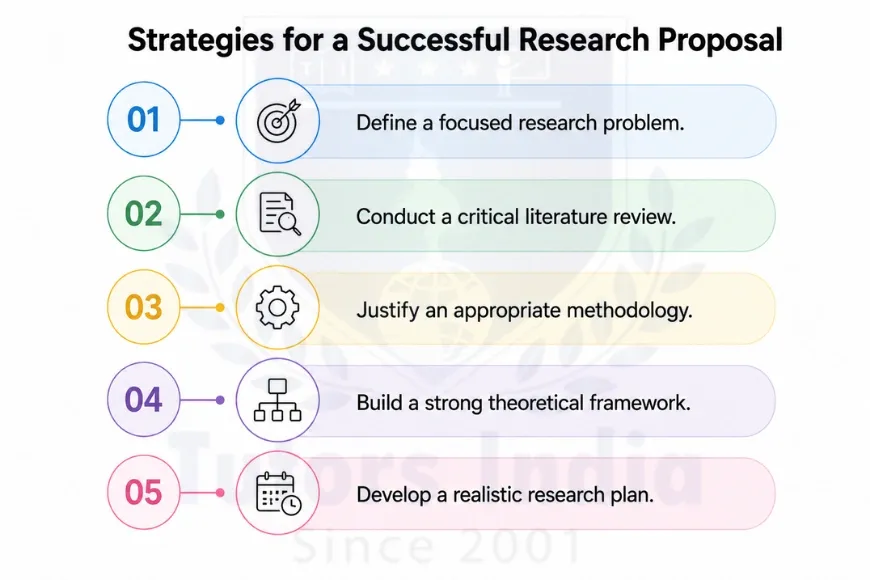
How to Improve Your Research Proposal
Select a focused and researchable topic.
Conduct a critical literature review using high-quality databases.
Clearly identify the research gap.
Justify every methodological decision.
Seek expert Master’s Proposal Writing Help in UK to strengthen proposal quality.
Build your proposal around an appropriate theoretical framework.
Develop realistic timelines and research plans.
Review university proposal guidelines before submission.
Conclusion
A good research proposal is very important for the dissertation to get approval in British universities. The rejection of most proposals happens due to poor research questions, ineffective literature review, ineffective methodology, insufficient theoretical base, and unrealistic research planning, instead of academic incompetence.
By employing an effective research method and meeting the standards set by universities, students will be able to enhance the quality of their proposal and receive fewer requests for revisions. Professional academic assistance also helps students develop well-organised research proposals based on evidence.
Tutors India offers Data Science Proposal Service in UK for helping students refine topics, develop literature reviews, choose methodologies, and construct theoretical frameworks, increasing the chances of dissertation acceptance.
Book a Free Expert Consultationwith Tutors India to craft a research proposal that communicates your research idea perfectly to your university and supervisors.
Booth, A., Sutton, A., Clowes, M., & Martyn-St James, M. (2021). Systematic approaches to a successful literature review (3rd ed.). Sage. https://www.scirp.org/reference/referencespapers?referenceid=3184401
Creswell, J. W., & Creswell, J. D. (2023). Research design: Qualitative, quantitative, and mixed methods approaches (6th ed.). Sage. https://www.scirp.org/reference/referencespapers?referenceid=3784840
Saunders, M. N. K., Lewis, P., & Thornhill, A. (2023). Research methods for business students (9th ed.). Pearson. https://www.researchgate.net/publication/240218229_Research_Methods_for_Business_Students
Snyder, H. (2019). Literature review as a research methodology: An overview and guidelines. Journal of Business Research, 104, 333–339. https://doi.org/10.1016/j.jbusres.2019.07.039
Zimmerman, B. J. (2002). Becoming a self-regulated learner: An overview. Theory Into Practice, 41(2), 64–70. https://doi.org/10.1207/S15430421TIP4102_2