
Designing Problem-Driven and Methodologically Transparent Research Proposals for master’s Research in the Netherlands
Designing Problem-Driven and Methodologically Transparent Research Proposals for master’s Research in the Netherlands
- Home
- How To Article
- Designing Problem-Driven and Methodologically Transparent Research Proposals for master’s Research in the Netherlands
Table of Content
- Problem-Driven Research: Concept and Importance
- Structuring Research Questions and Objectives
- Methodological Transparency in Dutch Master’s Research
- Research Design and Methods
- Ethical Considerations in master’s Research Proposals
- Feasibility and Planning
- Academic Writing and Referencing Standards
- Conclusion

Designing Problem-Driven and Methodologically Transparent Research Proposals for master’s Research in the Netherlands
Creating an effective research proposal for master’s research is essential to be granted entry into a master’s programme at a Dutch university (often referred to as higher education institutions). A great deal of focus is placed on these types of projects at universities in the Netherlands, particularly in relation to research methodology Netherlands standards. Universities in the Netherlands have made a commitment to conducting scientific research that meets evidence-based criteria for producing knowledge (academically) while also achieving societal impact.[1]
A well-written research proposal conveys not only the ability of an academic to successfully carry out research, but also the academic’s capacity for academic writing, critical thinking, and ethical reasoning. It demonstrates a clear understanding of proposal structure and the expectations outlined in dissertation proposal requirements Netherlands. In this article, we examine the key principles necessary to create a strong, problem-oriented, and methodologically transparent original research proposal, with specific reference to expectations at Dutch higher education institutions.[2]
1. Problem-Driven Research: Concept and Importance
Research that is problem-driven sets out to answer a well-defined research question based on real-world experiences or deficiencies in theory. In the Netherlands, research problems should have at least one of three elements: societal relevance; policy importance; and/or contribution to scientific knowledge.[3]
The following are characteristics of a properly constructed research question:
- Clearly and concisely defined
- Based on current literature in academic research
- Relevant to issues of social, economic, political, and/or technological nature
- Ability to be accomplished within the constraints of a master’s level program of study
By adopting a problem-driven approach, a research proposal for master’s research moves beyond abstraction and aligns with the applied and scholarly objectives valued in Dutch academia.
2. Structuring Research Questions and Objectives
Research questions form the foundation of the proposal and are central to effective proposal structure. Dutch universities emphasize coherence and alignment between the research problem, research questions, objectives, and methodology. [4]
Component | Description |
Research Problem | Limited understanding of policy implementation outcomes |
Research Question | How does local governance affect policy implementation effectiveness? |
Research Objective | To analyse governance mechanisms influencing policy outcomes |
Clear alignment signals analytical rigor and improves the proposal’s credibility.
3. Methodological Transparency
Methodological transparency is a core expectation in research methodology Netherlands frameworks. Reviewers assess whether the proposed methods are appropriate, ethical, and replicable. [5]
The components included in an explanation of how a research study will be conducted are:
- Type of research design (qualitative, quantitative, or mixed)
- Type of data used (primary vs. secondary)
- Methods of data collection
- Methods of data analysis
- Ethical considerations
By being transparent about methodology, the reviewer will be able to evaluate the study for validity, reliability, and feasibility.
4. Research Design and Methods
The research design you choose should reflect to your outlined Research Question. [6]
Research Design
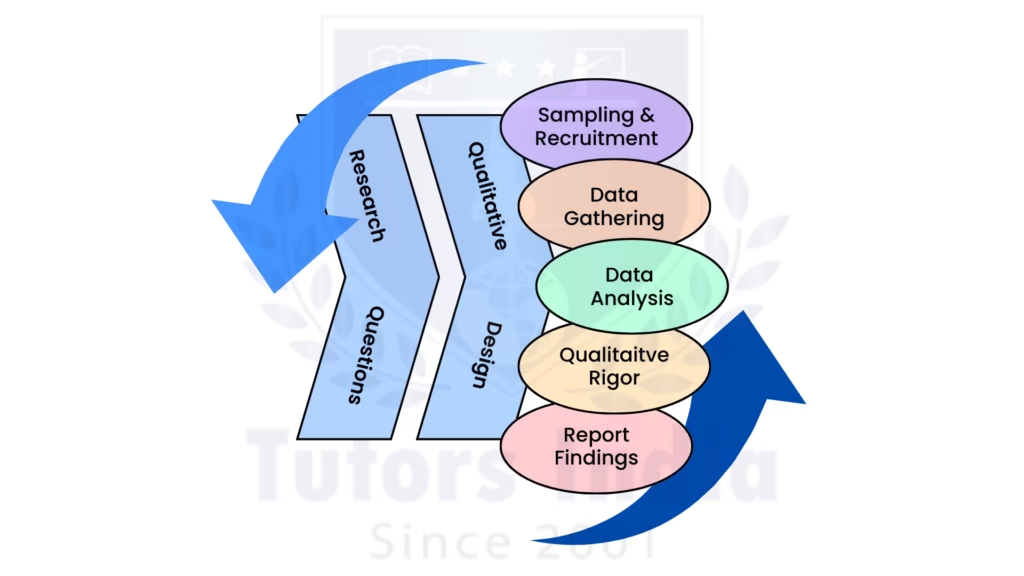
Such structured presentation enhances transparency and readability.
5. Ethical Considerations
One of the key components of research culture in the Netherlands is ethical awareness. Master’s thesis proposals must deal with potential ethical risks or eventualities as well as comply with the guidelines established by their respective institutions.[7]
Some of the most common ethical problems are listed below.
- Obtaining informed con sent from participants
- Data protection and anonymity
- The use of power by the researcher over the participants
- Storing data securely
Addressing these issues strengthens the integrity of the original research proposal and ensures compliance with Dutch and EU ethical standards.
6. Feasibility and Planning
A proposal should show that the research is feasible within the Master’s time limit of generally, 6–12 months, and include items such as the following in a feasibility checklist:
- Access to Data Sources
- A Feasible Sample Size
- Existing Language Skills
- There are Time Constraints
Including a brief timeline reinforces the practicality of the research proposal for master’s research and reassures supervisors of its achievability.
7. Academic Writing and Referencing Standards
Dutch universities expect a high standard of academic writing, characterized by clarity, coherence, and logical argumentation. Scholarly sources must be accurately cited using accepted styles such as APA or Chicago to demonstrate academic integrity and methodological competence.
Conclusion
A problem-oriented and methodologically transparent approach is essential for a successful research proposal for master’s research in the Netherlands. Clearly defining the research problem, aligning research questions with appropriate methodology, and demonstrating ethical and methodological transparency are central to meeting dissertation proposal requirements Netherlands. A well-structured proposal not only satisfies institutional expectations but also lays a strong foundation for credible and impactful scholarly work.
Designing Problem-Driven and Methodologically Transparent Research Proposals for master’s Research in the Netherlands [Get Ethical Dissertation Support] or [Schedule a Free Consultation]
References
- Gopalakrishna, G., Wicherts, J. M., Vink, G., Stoop, I., van den Akker, O. R., Ter Riet, G., & Bouter, L. M. (2022). Prevalence of responsible research practices among academics in The Netherlands. F1000Research, 11, 471. https://doi.org/10.12688/f1000research.110664.2
- Tobi, H., Kampen, J.K. Research design: the methodology for interdisciplinary research framework. Qual Quant52, 1209–1225 (2018). https://doi.org/10.1007/s11135-017-0513-8
- Mårtensson, P., Fors, U., Wallin, S.-B., Zander, U., & Nilsson, G. H. (2016). Evaluating research: A multidisciplinary approach to assessing research practice and quality. Research Policy, 45(3), 593–603. https://doi.org/10.1016/j.respol.2015.11.009
- Praharaj, S. K., & Ameen, S. (2025). Aim, research questions, objectives, and hypotheses- which one and how to write in a manuscript? Kerala Journal of Psychiatry, 38(1). https://doi.org/10.30834/kjp.38.1.2025.549
- van den Akker, O. R., Thibault, R. T., Ioannidis, J. P. A., Schorr, S. G., & Strech, D. (2025). Transparency in the secondary use of health data: assessing the status quo of guidance and best practices. Royal Society open science, 12(3), 241364. https://doi.org/10.1098/rsos.241364
- Tuffrey-Wijne I, Giatras N, Goulding L, et al. Identifying the factors affecting the implementation of strategies to promote a safer environment for patients with learning disabilities in NHS hospitals: a mixed-methods study. Southampton (UK): NIHR Journals Library; 2013 Dec. (Health Services and Delivery Research, No. 1.13.) Chapter 3, Research design and methods. Available from: https://www.ncbi.nlm.nih.gov/books/NBK259496/
- Guiding principles for ethical research. (n.d.). National Institutes of Health (NIH). Retrieved February 6, 2026, from https://www.nih.gov/health-information/nih-clinical-research-trials-you/guiding-principles-ethical-research