
From Description to Critique: Advancing Analytical Skills in Master’s Assignments
From Description to Critique: Advancing Analytical Skills in Master’s Assignments
- Home
- How To Article
- From Description to Critique: Advancing Analytical Skills in Master’s Assignments
Table of Content
- Understanding the Shift: Description vs Critique
- Why master’s Students Struggle with Critical Writing
- Developing Analytical Skills: Practical Strategies
- Descriptive vs Critical Paragraph Structure
- Model Structure for Critical Paragraphs
- Integrating Critical Skills Across Assignment Sections
- Conclusion

From Description to Critique: Advancing Analytical Skills in Master’s Assignments
In most UK universities, master’s level assignments require students to provide more than just reports or descriptions. The assignments demand that students critically engage, integrate theory, and provide depth to analysis. Developing analytical skills for UK master’s assignments is therefore essential for success in master’s academic assignments. Many students demonstrate a solid understanding of their area of study but struggle to progress beyond simply summarising literature to evaluating the arguments made, synthesising their views and developing their own independent insights. As such, moving from descriptive writing to critical analysis is an important academic progression for postgraduate students and is often highlighted in master’s assignment example UK guidance and master’s assignment samples.[1]
This article contains an explanation of the differences between descriptive and analytical writing, practical strategies for improving critical thinking skills, and structured assistance with improving master’s assignments, including guidance often provided through master’s assignment writing help and master’s assignment help.
1. Understanding the Shift: Description vs Critique
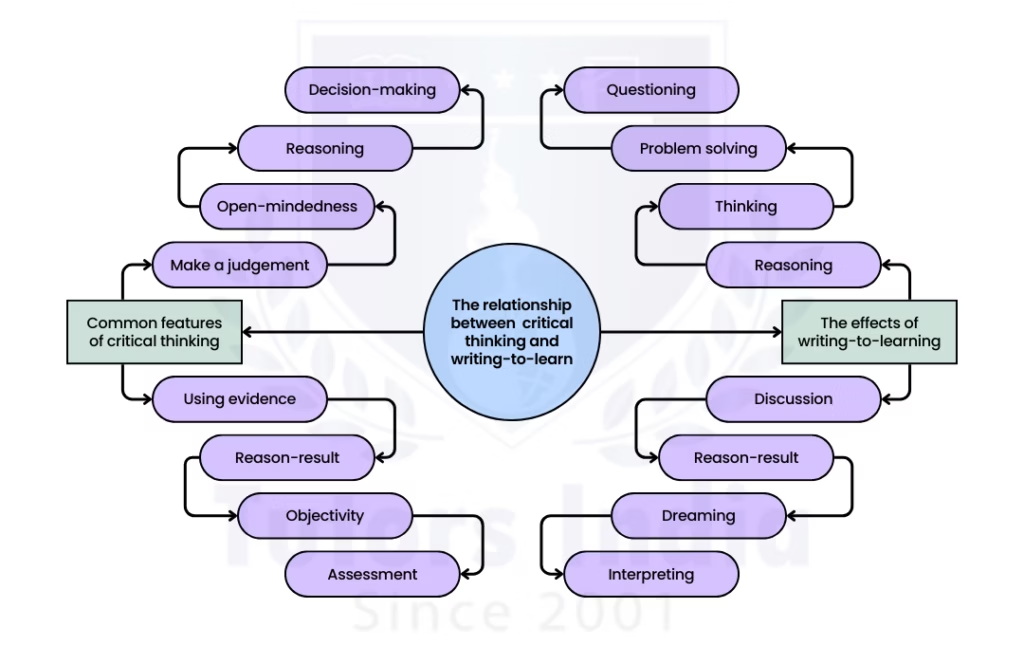
In master’s level studies, the expectations put on students will reflect more advanced thinking such as analysing, evaluating and synthesising; for example, describing is merely stating what something is, while critiquing seeks to determine why that item exists, how it came to be, and with what consequences.[2]
Descriptive Writing will generally | Critical Writing will therefore |
|
|
The movement from descriptive to critical writing is indicative of the student’s growth as an intellectual and a thorough understanding of their field of study. These differences are often illustrated through analytical skills examples in postgraduate writing workshops.
2. Why master’s Students Struggle with Critical Writing
There are many reasons that postgraduate students continue to be descriptive:
They rely too heavily on summarising sources. They fear to ‘criticise’ established scholars. They have limited experience with critical academic models. They are unsure of how to structure evaluative paragraphs. Their time pressures limit the opportunity for them to engage in depth. To students, critique may suggest negativity; however, the purpose of critique is to provide a balanced evaluation that is based on evidence.[3]
3. Developing Analytical Skills: Practical Strategies
3.1. Actively Engage with Literature
Instead of asking an author what he/she has said, ask yourself:
- What are the underlying assumptions of this argument?
- Which of the evidence presented supports the claims being made?
- Does the author have limitations in their application of methods?
- This reflective questioning is a key step in learning how to write a critical analysis
3.2. Utilise Comparison
In most cases, if you write analytically, then you will need to compare.
- Theory A asserts that X, whereas Theory B supports Y.
- Study 1 cites X as evidence; Study 2 finds the opposite. A comparison between studies provides a basis for evaluation.
3.3. Utilise Theoretical Frameworks
To complete a master’s degree, you will demonstrate your ability to:
- Apply your concepts through case studies.
- Critique the application of theories.
- Demonstrate the limitations of the context surrounding theories.
You will use theory to create an analysis that is above surface-level reporting. Many students seek master’s assignment writing help or professional critical analysis writing service support to strengthen this skill.
4. Descriptive vs Critical Paragraph Structure
The table below illustrates the structural difference between descriptive and analytical paragraphs: [4]
Element | Descriptive Paragraph | Critical Paragraph |
Focus | Reporting information | Evaluating arguments |
Use of Sources | One source at a time | Multiple sources compared |
Depth | Surface-level explanation | Analysis of implications |
Voice | Neutral summarisation | Independent academic stance |
Contribution | Repeats knowledge | Advances discussion |
5. A Model Structure for Critical Paragraphs
Typically, an analytical paragraph consists of:
- TOPIC: Introduction of a theoretical or opinion-based topic
- EVIDENCE: Utilises evidence from different academic sources
- COMPARISON: Illustrates how there is agreement/disagreement
- EVALUATION: Discusses strengths/weaknesses of evidence on topic
- LINK: Connects analysis with the aims of the research
In using this structure, you will achieve a balance between the amount of evidence you’ve used and the amount of interpretation you’ve provided.
6. Advancing Analytical Depth in Practice
Strategies for Improving Your Review of Literature:
- Use clear descriptions of your evaluation (e.g., “This type of study has many limitations such as…”)
- Identify gaps in the literature
- Challenge the methods you reviewed
- Discuss the value of the study
- Consider the setting in which the study was conducted
Do Not:
- List studies without any relation to one another
- Quoting references too often
- Providing your opinions without supporting evidence
- Stating opinions throughout your paper that do not have supporting evidence
7. Integrating Critical Skills Across Assignment Sections
Analytical writing occurs outside of literature reviews. Analytical writing occurs in the following sections of the text: [5]
- The introduction is to justify the research questions
- The methodology is to explain and justify the research design
- The discussion is to critically interpret the findings
- The conclusion is to evaluate the contributions and limitations of the research
At the master’s level, demonstrating independent intellectual contribution through critiquing should be expected in all master’s academic assignments.
Conclusion
A critical feature of postgraduate education is the ability to develop from descriptive writing into critical writing at the master’s level. While descriptive writing displays an acquisition of knowledge through description, critical writing demonstrates an engagement with knowledge through intellectual thinking, analytic reasoning and academic maturity. With a focus upon comparing perspectives, evaluating evidence and articulating independent opinions, students can greatly improve their assignment quality.
Transitioning from reporting knowledge to interrogating knowledge is not only an academic requirement but also the basis of postgraduate work and is central to mastering analytical skills for UK master’s assignments.
From Description to Critique: Advancing Analytical Skills in Master’s Assignments [Talk to a Dissertation Expert | Book a Free 15-Minute Consultation]
References
- Abdullah, C., Parris, J., Lie, R., Guzdar, A., & Tour, E. (2015). Critical Analysis of Primary Literature in a Master’s-Level Class: Effects on Self-Efficacy and Science-Process Skills. CBE life sciences education, 14(3), ar34. https://doi.org/10.1187/cbe.14-10-0180
- Sébille, V., Lix, L. M., Ayilara, O. F., Sajobi, T. T., Janssens, A. C. J. W., Sawatzky, R., Sprangers, M. A. G., Verdam, M. G. E., & Response Shift – in Sync Working Group (2021). Critical examination of current response shift methods and proposal for advancing new methods. Quality of life research: an international journal of quality-of-life aspects of treatment, care and rehabilitation, 30(12), 3325–3342. https://doi.org/10.1007/s11136-020-02755-4
- Quitadamo, I. J., & Kurtz, M. J. (2007). Learning to improve using writing to increase critical thinking performance in general education biology. CBE life sciences education, 6(2), 140–154. https://doi.org/10.1187/cbe.06-11-0203
- Tavakol, M., & O’Brien, D. (2023). The importance of crafting a good introduction to scholarly research: strategies for creating an effective and impactful opening statement. International journal of medical education, 14, 84–87. https://doi.org/10.5116/ijme.6499.82af
- Zainal, N. H., Islam, M. A., Rasudin, N. S., Mamat, Z., Hanis, T. M., Rodzlan Hasani, W. S., & Musa, K. I. (2025). Critical Thinking and Clinical Decision Making Among Registered Nurses in Clinical Practice: A Systematic Review and Meta-Analysis. Nursing reports (Pavia, Italy), 15(5), 175. https://doi.org/10.3390/nursrep15050175