
Why Do Students Find It Difficult to Write a Critical Literature Review for a UK Research Proposal?
Why Do Students Find It Difficult to Write a Critical Literature Review for a UK Research Proposal?
- Home
- How To Article
- Why Do Students Find It Difficult to Write a Critical Literature Review for a UK Research Proposal?
Table of Content
- Understanding What “Critical” Means in UK Academic Writing
- Over-Reliance on Description Instead of Analysis
- Difficulty Identifying Research Gaps
- Limited Use of High-Quality Academic Sources
- Lack of Clear Structure and Thematic Organisation
- Insufficient Linking Back to the Proposed Study
- Summary of Key Difficulties and Solutions
- Practical Strategies for Writing Critically
- Conclusion

Why Do Students Find It Difficult to Write a Critical Literature Review for a UK Research Proposal?
Writing a literature review is generally considered one of the most difficult stages of writing a research project proposal in the UK, whether it be at undergraduate, master’s, or doctoral level. Students are expected to not only summarise existing literature and provide citations for references found in a literature review but also to provide analysis, comparison, and evaluation of existing literature to justify their proposed research. Many students have difficulty with literature review writing because they do not understand what a literature review within the UK academic context is or how to write a literature review critically.
In UK universities, a literature review does not constitute a list of sources but instead represents a structured academic argument. A strong literature review example illustrates a significant level of engagement with existing literature, outlines gaps in the current body of knowledge, and places the proposed study within continually evolving academic discussions. This article will discuss why students struggle with writing critical literature reviews, including example literature review challenges, and how to overcome those struggles.[1]
1. Misunderstanding What “Critical” Means
There is often confusion about what it means to be critical when writing. Critical writing involves:
- Evaluating strengths (and weaknesses) of research studies
- Comparing differing points of view (or perspective)
- Questioning the methods, assumptions, and conclusions of sources
- Discussing the contributions of various sources to understanding a topic.
In writing, students frequently report descriptively by stating that “Author A found …” without analysing the significance of each finding or demonstrating how the study contributes to a broader systematic literature review.
2. Over-Reliance on Description Instead of Analysis
A lot of literature reviews look like annotated bibliographies. Some issues that can occur, are: [2]
- Studying an individual study
- Not interpreting anything
- Not bringing together at least 3 or more high-quality studies to illustrate a pattern of agreement and disagreement among researchers and current trends in the field.
UK examiners require synthesis, where a critical literature review compares studies rather than listing them.
Descriptive Approach | Critical Approach |
Summarises each study separately | Compares and contrasts studies |
Reports findings | Evaluates quality and limitations |
Lists what is known | Explains what is missing |
No clear argument | Builds a coherent analytical narrative |
3. Difficulty Identifying Research Gaps
To produce a successful research project proposal in the UK, students must demonstrate a clear research gap. Difficulties arise because.[3]
- They have not researched thoroughly.
- They confuse their own limited understanding of a topic as being “a topic about which I know little” instead of “a topic that has not been studied”.
- They do not provide sufficient reasons for why this gap exists.
To define a gap, we need to look at both current and past literature from multiple perspectives, of all available reputable sources to see which questions are remaining.
4. Limited Use of High-Quality Academic Sources
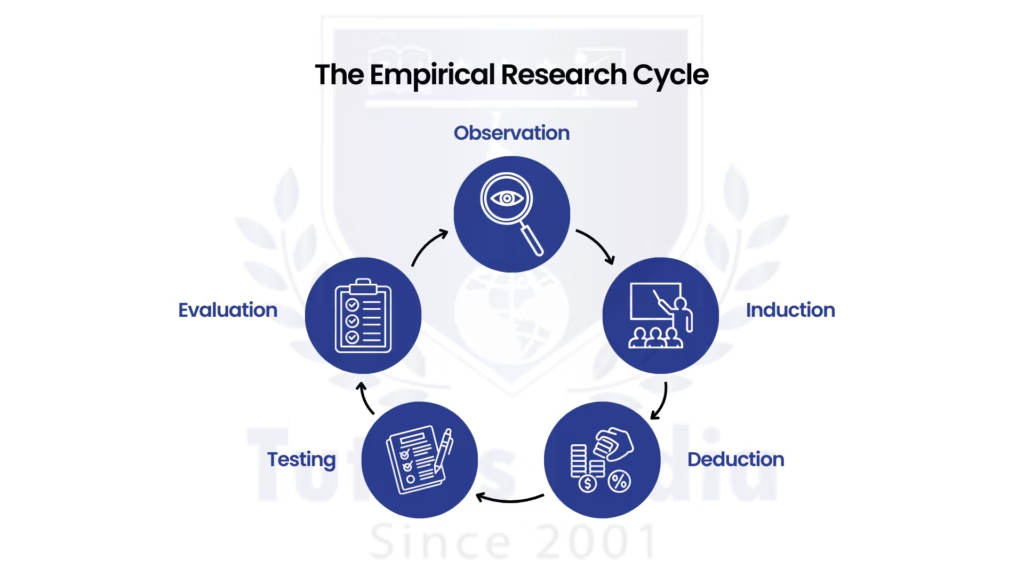
It is evident that poor selection of source material will lead to limited and unconvincing critical debate on the topic.
5. Lack of Clear Structure and Thematic Organisation
Most college students arrange their literature review in a chronological order or by citing certain individual authors related to the area of research. This results in:
- Redundant documentation of sources
- No logical flow to research
- Weak linkage back to the research question being proposed.
Instead of arranging the literature review based upon individual authors – the literature review should be grouped by themes, methodologies or viewpoints.
6. Insufficient Linking Back to the Proposed Study
Literature reviews are frequently reviewed by students, although many fail to relate it back to their own research proposal. Evaluators will anticipate the literature review to indicate:
- Current materials inform the methodology used
- Establish the need for the proposed study
- Explain how the study will contribute to the field
Without these links, the literature review lacks purpose within the research project proposal.
Challenges with Academic Writing and Language
Critical writing requires precise academic language such as:[4]
- “However,”, “in contrast”, “similarly”, “a limitation of this study is…”
Students who lack confidence in academic English tend to avoid evaluation and stick to safe description.
7. Summary of Key Difficulties and Solutions
Common Difficulty | Why It Happens | How to Overcome It |
Writing descriptively | Misunderstanding “critical” | Evaluate and compare studies |
No synthesis | Reviewing sources individually | Group sources by themes |
Missing research gap | Narrow reading | Conduct broad, up-to-date searches |
Weak sources | Using non-academic material | Use peer-reviewed journals |
Poor structure | Writing chronologically | Organise by debates/themes |
No link to proposal | Treating review as separate | Relate every section to your question |
Language insecurity | Limited academic writing skills | Use critical language frameworks |
8. Practical Strategies for Writing Critically
Writing a thorough and comprehensive literature review is vital to your overall research project. A well-written literature review should help direct your research and provide a solid foundation for your entire dissertation or thesis. The following activities can help you strengthen your literature review:
- Find Review Articles to Study the Major Debates Within Your Research Area.
- Develop Comparison Charts of Key Studies.
| While You Are Reading, Ask Yourself the Following Questions | Examples of Critical Questions to Ask |
|---|---|
|
|
9. The Role of Supervisor and Academic Support
With guidance from both supervisors and academic writing support, students can achieve: [5]
- Clarifying their expectations of criticality
- Select appropriate sources
- Refining their overall structure and argument
Early feedback helps prevent the literature review from becoming overly descriptive and supports the development of a strong example literature review.
Conclusion
Students’ difficulty in producing an effective critical literature review for a UK research project proposal stem from misunderstanding critical analysis, over-reliance on description, difficulty identifying research gaps, weak structure, and limited use of high-quality sources. By synthesising and evaluating contemporary, peer-reviewed research, students can produce a convincing literature review that demonstrates academic engagement, supports the proposed study, and aligns with UK university expectations.
Why Do Students Find It Difficult to Write a Critical Literature Review for a UK Research Proposal? [Get Ethical Dissertation Support] or [Schedule a Free Consultation]
References
- Leite, D. F. B., Padilha, M. A. S., & Cecatti, J. G. (2019). Approaching literature review for academic purposes: The Literature Review Checklist. Clinics (Sao Paulo, Brazil), 74, e1403. https://doi.org/10.6061/clinics/2019/e1403
- Hung, M., Bounsanga, J., & Voss, M. W. (2017). Interpretation of correlations in clinical research. Postgraduate medicine, 129(8), 902–906. https://doi.org/10.1080/00325481.2017.1383820
- Hempel, S., Gore, K., & Belsher, B. (2019). Identifying Research Gaps and Prioritizing Psychological Health Evidence Synthesis Needs. Medical care, 57 Suppl 10 Suppl 3(10 Suppl 3), S259–S264. https://doi.org/10.1097/MLR.0000000000001175
- Zhang, H., Xu, X., Lei, V. N., Hong, W. C. H., & Jie, W. (2025). Academic writing challenges and supports for early-stage Chinese postgraduates: A mixed-methods study on teaching-research integration, supervisor engagement, and self-efficacy. PloS one, 20(2), e0317470. https://doi.org/10.1371/journal.pone.0317470
- Birkeli, C. N., Isaksson Rø, K., Rustad, L., & Kvernenes, M. (2023). Educational supervisor’s perceptions of their role in supporting residents’ learning: a qualitative study. International journal of medical education, 14, 178–186. https://doi.org/10.5116/ijme.6544.cf18