
What Are the Common Challenges Students Face When Writing a master’s Dissertation
- Home
- How To Article
- What Are the Common Challenges Students Face When Writing a master’s Dissertation
Approved Dissertation Topic Selection
- Introduction
- Selecting a Suitable Research Topic
- Conducting an Effective Literature Review
- Research Methodology and Design Issues
- Academic Writing and Structure
- Formatting, Referencing, and Appendices
- Time Management and Deadlines
- Supervisor Communication and Feedback
- Summary of Common Master’s Dissertation Challenges
- Conclusion

What Are the Common Challenges Students Face When Writing a master’s Dissertation
A master’s dissertation is one of the largest academic achievements a student can receive regarding an academic program and how a student should have gained the analytical and critical thinking skills to perform independent research and academic writing. The dissertation provides an opportunity for a student to make an original and meaningful contribution to their programme of study on multiple levels, but many students will encounter several significant challenges in writing a dissertation, particularly at the master’s level. While the challenges can potentially affect academic performance, the technical completion of the master’s dissertation may also have a significant impact on the student’s ability to deliver high-quality work within the established timeframe. Learning about these challenges helps students prepare for them and supports overcoming dissertation challenges when needed.[1]
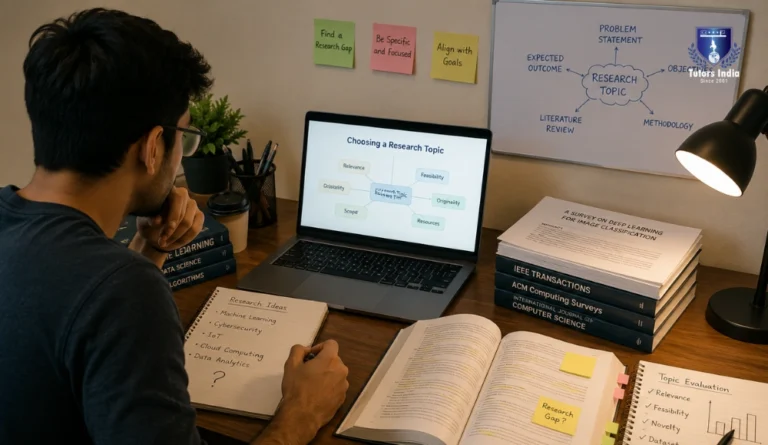
1. Selecting a Suitable Research Topic
Selecting a clear, relevant, and researchable topic is frequently one of the earliest and most common dissertations writing problems for students preparing to write their dissertations. Many students find it difficult to strike a balance between personal interest and topics that allow successful completion of a master’s dissertation.[2]
Typical issues include the following:
- Difficulty finding a legitimate research gap
- Selecting a subject that is either too broad or too narrow
- A lack of alignment with the supervisor’s area of expertise
- Limited access to either data or literature
If the topic selected is not appropriate and aligned with the research objectives, there may be multiple revisions and delays in the overall process due to lack of motivation.
2. Conducting an Effective Literature Review
Developing a literature review is daunting for many students due to the time-consuming nature of critically evaluating existing research and positioning their work within an academic framework. The volume of available information further contributes to common dissertation writing problems faced by postgraduate students. [3]
Some of the challenges associated with writing a literature review include:
- Finding appropriate academic sources
- Synthesizing literature instead of simply summarising it
- Identifying suitable theoretical frameworks for your research study
- Managing the myriads of information available to you
Without proper organization, a literature review will not have the necessary flow to allow for a complete understanding of an author’s critical evaluation of his/her work.
3. Research Methodology and Design Issues
Selecting and justifying an appropriate methodology is one of the most complex challenges in writing a dissertation, as a weak research design can undermine the entire study.[4]
The following are Typical Challenges Students Face When Selecting Methodologies and Justifying Methodologies:
- Deciding Between Qualitative, Quantitative and Mixed Methodologies.
- Creating Valid Instruments for Research (Questionnaires, Interviews).
- Being Aware of Sampling Techniques.
- Obtaining Ethical Approval and Informed Consent.
- Students Are Uncomfortable Utilizing Correct Academic Language to Describe Their Methodological Choice.
4. Academic Writing and Structure
Academic writing at master’s level requires clarity, accuracy, and formal conventions. Transitioning from coursework-based assessments often creates additional dissertation writing problems for students. [5]
The following are some of the most common writing challenges faced by graduate students:
- Maintaining a Formal Academic Tone
- Structuring Chapters Logically
- Avoiding Plagiarism and Improper Paraphrasing
- Linking Arguments Coherently Across Chapters.
Although students may be conducting good quality research, if their writing skills are not solid, their grades will reflect this shortcoming.
5. Formatting, Referencing, and Appendices
Students frequently underestimate the complexity of formatting and referencing requirements, which are recurring challenges in writing a dissertation.[6]
- Inconsistent Citations (e.g., APA, Harvard, etc.)
- Incorrect Table/Figure Formatting
- Uncertainty Regarding Appendices
- Meeting Word Limits
Students who do not comply with the university’s format requirements may have marks deducted.
6. Time Management and Deadlines
Balancing dissertation work with employment, family, or other commitments is a major source of master’s thesis difficulties.
Postgraduate students have several time-related challenges:
- Challenge of complexity is a source of procrastination
- Poorly planned schedules or unrealistic timeframes
- Writing and editing the dissertation at the very end of the process
- Feeling stressed out by short deadlines to submit their dissertation
When postgraduate students cannot manage their time effectively, they usually wind up with poor quality materials.
7. Supervisor Communication and Feedback
Effective communication with supervisors is essential, yet many students struggle with interpreting feedback, adding to common dissertation writing problems.[7]
Challenges faced by students include:
- Feedback that is vague or contradictory
- Limited access to a supervisor
- A need to feel comfortable asking a supervisor question
- Misunderstanding what is expected from them as an academic student.
Consequently, these problems can cause delays in a student’s academic progression, as well as frustration.
8. Summary of Common Master’s Dissertation Challenges
|
Challenge Area |
Description |
|
Topic Selection |
Difficulty identifying a focused, feasible research topic |
|
Literature Review |
Managing sources and developing critical analysis |
|
Methodology |
Selecting and justifying appropriate research methods |
|
Maintaining structure, coherence, and scholarly tone |
|
|
Meeting institutional guidelines and citation rules |
|
|
Time Management |
Balancing deadlines with other responsibilities |
|
Supervisor Interaction |
Interpreting feedback and maintaining communication |
Conclusion
Writing a master’s dissertation involves far more than conducting research. Students face numerous challenges in writing a dissertation, including topic selection, literature review, methodology design, formatting, time management, and supervision. Although these dissertation writing problems are common, they can be addressed through early preparation, skill development, effective communication, and structured academic support. Understanding these master’s thesis difficulties early enables students to adopt strategies for overcoming dissertation challenges and completing their dissertation with confidence.
Struggling with your master’s dissertation? Get ethical, university-aligned guidance from experienced academic mentors at Tutors India. [Talk to a Dissertation Expert | Book a Free 15-Minute Consultation]
References
- How to write a dissertation or masters thesis. (n.d.). Postgrad.com. Retrieved January 28, 2026, from https://www.postgrad.com/advice/exams/dissertations_and_theses/top_tips_writing_postgraduate_thesis/
- McBeath, B., & Hopkins, K. (2024). Strategies for selecting and changing research topics. Human Service Organizations, Management, Leadership & Governance, 48(1), 117–121. https://doi.org/10.1080/23303131.2023.2300108
- Snyder, H. (2019). Literature review as a research methodology: An overview and guidelines. Journal of Business Research, 104, 333–339. https://doi.org/10.1016/j.jbusres.2019.07.039
- Kapoor M. C. (2016). Types of studies and research design. Indian journal of anaesthesia, 60(9), 626–630. https://doi.org/10.4103/0019-5049.190616
- Phillips, V., & Barker, E. (2021). Writing for publication: Structure, form, content, and journal selection. Journal of perioperative practice, 31(6), 230–233. https://doi.org/10.1177/1750458921996249
- Kambhampati, S. B. S., & Maini, L. (2019). Formatting References for Scientific Manuscripts. Indian journal of orthopaedics, 53(3), 381–383. https://doi.org/10.4103/ortho.IJOrtho_197_19
- Bak H. (2020). Supervisor Feedback and Innovative Work Behavior: The Mediating Roles of Trust in Supervisor and Affective Commitment. Frontiers in psychology, 11, 559160. https://doi.org/10.3389/fpsyg.2020.559160