

Summary:
Public Health Master's Research in New Zealand needs an effective methodological approach to ensure reliability and scientific credibility. But there are many dissertations that get rejected due to ineffective research design, wrong choice of methodology, insufficient sampling, poor data analysis techniques, and little or no attention to ethics. This article highlights the common methodological issues and suggests ways of improving research methods.
Introduction
Public Health research makes a significant contribution to enhancing public health, addressing disparities, and formulating health policies based on scientific evidence in New Zealand. The universities encourage Master's students to conduct research in relation to contemporary issues in public health without compromising on the quality of methodology.
In conducting Public Health research related to the prevention of diseases, health promotion, environment, and health care delivery, the students are expected to conduct their research in a methodologically sound manner.
Many master's students who conduct excellent research face delays, revisions, and even rejection of the thesis due to some methodological problems. Some of these problems include choosing the wrong research methodology, using poor sampling techniques, conducting poor-quality data collection or not justifying the use of the methodological approach at all. Knowledge about these problems will be very helpful for the student to make their work better. At Tutors India, our experts help you build credible Public Health research methodology with expert Dissertation Methodology Services in Newzeland.
Why Does Dissertation Methodology Matter for Public Health research?
The research methodology forms the basis of effective Public Health research. It outlines the approach adopted for researching the questions under investigation, the collection of data, analysis of the same, and even the validity of findings.
A well-developed methodology helps researchers:
- Generate reproducible results.
- Choose the right research designs and methods.
- Reduce bias in collecting and analysing data.
- Contribute to evidence-based decisions for public health.
- Adhere to university and ethical research guidelines.
On the contrary, an inappropriate methodology will make the results of your research unreliable even when the research topic is relevant. To improve the quality of the research methodology, students often get professional guidance.
Why Are Public Health Master's Research Projects Rejected Due to Poor Methodology?
1. Poorly Defined Research Design and Objectives
Inadequate alignment between research objectives and the chosen study design is one of the most typical methodological problems in Public Health Master's projects. Often, students pose a broad question and then do not define measurable objectives, as well as the methodology suitable for answering those. The absence of such alignment leads to ambiguity both in the process of doing research and in obtaining results.
The selection of a research design that would be either quantitative, qualitative, or mixed can also cause difficulties for the researcher. An improper choice may have negative impacts on data quality and the validity of research results.
What Research Shows:
As per Creswell & Creswell (2023), it is essential to ensure that well-defined research goals play a role in choosing an appropriate research design. This will lead to improvement in validity, reliability, and quality of research results.
Tips:
- Select a research design that aligns with your research questions.
- Justify the choice of quantitative, qualitative, or mixed methods.
- Ensure methodological consistency throughout the study.
2. Inappropriate Sampling Strategy and Participant Selection
Sampling is an essential part of Public Health research since the quality of research results largely depends on the sampling procedure. Nevertheless, many Master's dissertations use convenience sampling without providing any reasons for using such sampling or without justifying sample size.
Poor sampling techniques may affect the validity of research in terms of bias, representativeness, and application. It is important to provide information regarding the population studied, sampling technique used, criteria for inclusion and exclusion, and justification of sample size.
What Research Shows:
According to Taherdoost (2023), the selection of a proper sampling method will increase the validity of research and make sure that the results obtained from the research are true representations of the target population. It also increases the credibility of health-related studies.
Tips:
- Clearly define the target population.
- Select an appropriate probability or non-probability sampling method.
- Justify your sample size using recognised approaches.
- Explain participant selection criteria clearly.
3. Poor Data Collection and Analysis
The accurate collection and analysis of data are fundamental to conducting high-quality studies in the field of Public Health. Nevertheless, numerous Master's theses contain improperly constructed questionnaires, unvalidated data-collection instruments, data-collection irregularities, and incorrect statistical approaches. Such problems make the results unreliable and decrease the contribution of the research to public health science.
One more issue is an insufficient explanation of the analytical approach. Many students conduct statistical analyses but do not justify their appropriateness to the aims and features of collected data. All analytical techniques must be chosen depending on the methodology of the research, type of variables, and its goals. A professional Health Methodology Services in Newzeland can help choose the right analytical techniques that align with the methodology.
What Research Shows:
As pointed out by the EQUATOR Network (2024), transparency of the data collection process and the method used for analysis enhances the quality and validity of research in health sciences. The clear description of research tools and the methodological approaches adopted facilitates evaluation of the scientific soundness of the research.
Tips:
- Use validated data collection instruments where possible.
- Select statistical methods that match your research objectives.
- Clearly justify all analytical techniques.
- Check data quality before conducting statistical analysis.
Explore the Research Methodology Services in Newzeland at Tutors India to improve the quality of public health research.
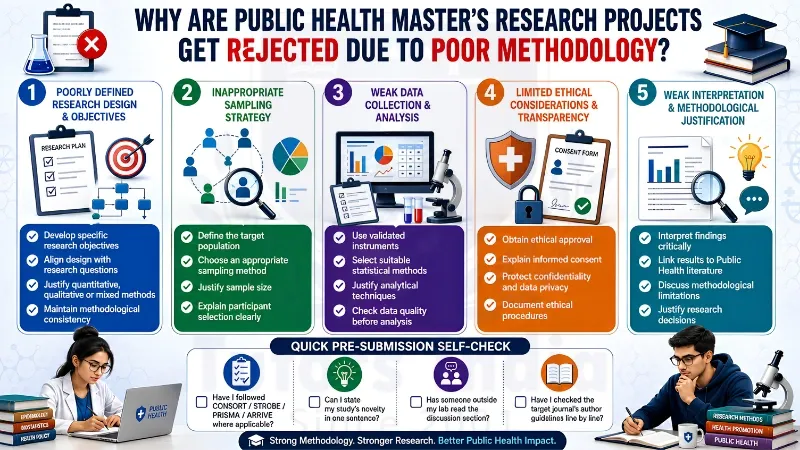
4. Limited Ethical Considerations and Research Transparency
Ethics play a critical role in Public Health research as it involves human subjects and personal information regarding health. Nonetheless, some Master's dissertations fail to consider ethical matters, such as obtaining ethical approval and informed consent, as well as ensuring participant confidentiality and proper handling of data. This will affect the quality of research being carried out and may hinder the approval process of the dissertation.
The researcher must be clear about how they safeguarded the confidentiality of the participant data, how they stored it and how ethically it was carried out. When research is carried out in New Zealand, one must ensure that the research practice is appropriate.
What Research Shows:
According to the Declaration of Helsinki by the World Medical Association (2024), it is crucial that the rights of the subjects should be protected, they should give informed consent, and there should be transparency in the process of conducting the research. Following these principles increases the credibility of research involving human subjects.
Tips:
- Obtain ethical approval before data collection.
- Clearly explain informed consent procedures.
- Protect the privacy of the participants.
- Ethical issues should be recorded during the research process.
Have you ever had a draft sent back over formatting, not content? It happens more than people admit.
5. Weak Interpretation and Methodological Justification
Methodology not only includes data analysis but also an explanation of why particular methodological choices have been made and why they contribute to achieving the aims of the research. Quite often, students doing their Master's analyse their results statistically without critical evaluation of the implications of this and discussion of how the chosen methodology impacted on the outcome of their study.
Students are supposed to relate their results to Public Health literature, indicate the limitations of their methodology and explain why they chose this or that research design.
What Research Shows:
Greenhalgh (2023) makes it very clear that good health research demands critical interpretation of results in relation to previous knowledge and understanding, considering both methodological strengths and weaknesses. A strong methodological rationale adds to the validity and relevance of research.
Tips:
- Interpret results considering the existing literature.
- Discuss how your methodology addresses the aims of your research.
- Describe your methodology's strengths and weaknesses.
- Clearly justify conclusions using research evidence.
Which Challenge Applies to You??
Identify the area where you need the most improvement:
→ If you're struggling with your research design:
Check if there is coherence between your research aims, research questions, and methodology before collecting any data.
→ If sampling is your biggest concern:
Check that your sampling technique reflects the target population and is justified by your inclusion and exclusion criteria.
→ If you're unsure about data analysis:
Select either statistical or qualitative analysis methods according to your research aims and justify every step in your methodology.
Quick Self-Check
- Have I selected the most appropriate research design?
- Are my research objectives aligned with my methodology?
- Have I justified my sampling strategy and sample size?
- Are my data collection and analysis methods clearly explained?
Conclusion:
The methodology is very important to conducting successful Public Health research. Lack of clarity in the design, unsuitable sampling, poor analysis of data, lack of consideration of ethics, and lack of methodological justification are some of the methodological problems that can influence the quality and credibility of a dissertation. Through proper addressing of these issues, students can conduct research in Public Health that is methodologically valid.
Avoid common methodology mistakes before submitting your dissertation. Tutors India provides expert guidance in Public Health research methodology, ethical documentation, and academic writing to help Master's students achieve successful research outcomes.
Book a Free Expert Consultation with Tutors India to get Master's Methodology Services in Newzeland.
References:
- Creswell, J. W., & Creswell, J. D. (2023). Research design: Qualitative, quantitative, and mixed methods approaches (7th ed.). SAGE Publications. https://www.scirp.org/reference/referencespapers?referenceid=3784840
- EQUATOR Network. (2024). Enhancing the QUAlity and Transparency Of Health Research. https://www.equator-network.org/
- Greenhalgh, T. (2023). How to read a paper: The basics of evidence-based medicine and healthcare (7th ed.). Wiley-Blackwell. https://www.wiley.com/en-us/How+to+Read+a+Paper%3A+the+Basics+of+Evidence-Based+Healthcare%2C+7th+Edition-p-9781394206926
- Taherdoost, H. (2023). Sampling methods in research methodology: How to choose an appropriate sampling technique. International Journal of Academic Research in Management, 12(1), 18–27. https://www.scirp.org/reference/referencespapers?referenceid=2968525
- World Medical Association. (2024). Declaration of Helsinki: Ethical principles for medical research involving human participants. https://www.wma.net/policies-post/wma-declaration-of-helsinki-ethical-principles-for-medical-research-involving-human-subjects/
FAQs:
1. Why is research methodology important in Public Health Master's research?
A well-developed methodology ensures that research findings are valid, reliable, and applicable to public health practice. It also improves the credibility and overall quality of the dissertation.
2. What are the common methodological reasons for Public Health dissertation rejection?
Common reasons include unclear research design, inappropriate sampling methods, weak data collection and analysis, limited ethical considerations, and inadequate justification of methodological decisions.
3. How do I choose the right research design for a Public Health study?
Select a research design that aligns with your research objectives, study population, and data collection methods. Clearly justify why the chosen approach is appropriate for addressing your research questions.
4. Why is sampling important in Public Health research?
An appropriate sampling strategy improves the representativeness of the study population, reduces bias, and enhances the validity and generalisability of research findings.
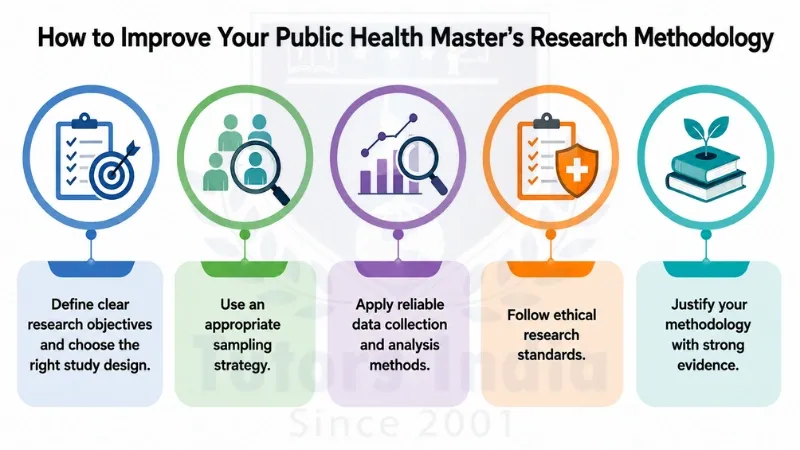
5. How can I strengthen my Public Health Master's research methodology?
Develop clear research objectives, select an appropriate study design, justify your sampling strategy, use validated data collection methods, apply suitable analytical techniques, and ensure ethical and methodological transparency throughout the research process.