
Computer Science & IT
Coding & Algorithms Development
Computer Science & IT
Shrewd Object Visualization Mechanism
AI For Cybersecurity and Knowledge Breach
Machine Learning in Hyperautomation
The Intersection of ML and IoT
Consistent Integration with Other Languages
Robotic Process Automation
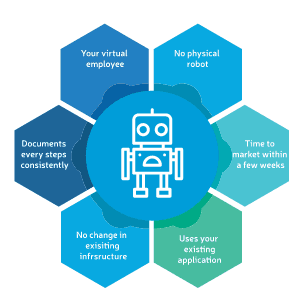
Robotic Process Automation refers to that technology which lets anybody these days to construct computer software, or a “robot” to compete with and assimilate the actions of a human interrelating within alphanumeric systems to perform a business process. RPA robots make use of the user interface to capture data and influence applications just as humans do. They understand, interpret, generate replies and communicate with all other systems so as to perform a vast variety of repetitive tasks. An RPA software robot seldom makes mistakes.
Unlike other traditional IT solutions, RPA permits establishments to automate and computerize at a fraction of the time and cost hitherto come across. RPA is also non-invasive and controls the existing infrastructure without causing interruption to basic systems, which would be challenging and expensive to replace.
RPA robots are adept at mimicking most of the human user actions. RPA robots log into applications, move folders and files, copy and paste data, fill up forms, extract semi-structured and structured data from scrape browsers, documents, and more. They deliver direct profitability, and improve accuracy across industries. They allow superior scalability and personalized response to specific needs. They integrate effortlessly into any system. Thus, with RPA, cost efficacy and amenability will be the consequence.

Source: indiamart.com
References
Hofmann, P., Samp, C., & Urbach, N. (2020). Robotic process automation. Electronic Markets, 30(1), 99-106.
Enríquez, J. G., Jiménez-Ramírez, A., Domínguez-Mayo, F. J., & García-García, J. A. (2020). Robotic process automation: a scientific and industrial systematic mapping study. IEEE Access, 8, 39113-39129.