
How to Write a Master’s Assignment Effectively While Managing Time and Understanding Requirements
How to Write a Master’s Assignment Effectively While Managing Time and Understanding Requirements
- Home
- How To Article
- How to Write a Master’s Assignment Effectively While Managing Time and Understanding Requirements

How to Write a Master’s Assignment Effectively While Managing Time and Understanding Requirements
To succeed in writing your master’s assignment, you must have strong academic skills, be able to manage your time, and know what is expected of you by the university. The assignment’s purpose in postgraduate education is to assess whether you have achieved knowledge of your field and whether you have developed critical thinking, independent research and writing skills appropriate to an academic level. Many students often search for guidance from a Writing best master’s level assignment writer or refer to a Master’s assignment UK sample to understand academic expectations. You may also have other responsibilities (ex. your courses, your employment, and personal obligations) in addition to a very strict timeline. As a result, understanding the assignment criteria and developing a systematic process for the writing of each master’s assignment will allow you to meet academic requirements and generate high-quality academic work. Students seeking structured guidance sometimes explore Best Master’s assignment writing service UK, Master’s Assignment help UK free, or British dissertation help to support their academic progress. In this article, I will give you some helpful ideas on how to write your master’s assignment promptly while also meeting your academic expectations.[1]
1. Understanding Assignment Requirements
The first step in writing an effective master’s assignment is correctly understanding the assignment brief. Misinterpreting it can lead to irrelevant content and lower grades. Many students consult a Master’s assignment UK sample or professional academic support resources to better understand expectations.[2]
- Assignment objectives and learning outcomes
- Word count and required format
- Referencing style (APA, Harvard, etc.)
- Assessment criteria and marking rubric
- Submission deadline and format
Understanding command words such as critically evaluate, analyse, or discuss helps determine the level of detail required. Students should seek clarification from assessors to avoid misunderstandings and ensure accurate interpretation of requirements.
2. Planning and Time Management Strategies
To finish completing your assignment with less trouble, effective time management is very important, especially since many postgraduate students have a busy schedule; therefore, planning becomes very important for them to effectively manage their time. Students who feel overwhelmed often turn to Best Master’s assignment writing service UK or academic planning support for guidance. [3]
Appropriate time management steps for the completion of your assignment:
- Divide the assignment into smaller elements.
- Have a weekly timetable that is realistic.
- Allocate enough time for research, writing and editing.
- Complete all the “personal deadlines” for your assignment before the actual due date.
- Do not start your assignment at the last minute.
3. Research and Resource Organisation
A strong master’s assignment uses reliable academic sources such as relevant journals, books, and peer-reviewed articles to support arguments. Many students seeking British dissertation help or academic guidance learn effective research organisation strategies.[4]
- Use academic databases like Google Scholar or university libraries
- Focus on peer-reviewed journals
- Keep organised notes while reading
- Record citations for reference lists
- Avoid non-academic websites for research data
Using digital tools and organised files helps students easily access research information during writing.
4. Structuring a master’s Level Assignment
A clear structure enhances readability and ensures the logical presentation of ideas. Most master’s assignments follow a formal academic structure, like those demonstrated in a Master’s assignment UK sample or academic writing guides.
Standard Assignment Structure
Section | Purpose |
Introduction | Introduces topic and objectives |
Main Body | Presents arguments and analysis |
Critical Discussion | Evaluates evidence and perspectives |
Conclusion | Summarises findings |
References | Lists cited sources |
A well-structured assignment demonstrates clarity of thought and academic discipline.
5. Academic Writing and Critical Analysis
Master’s-level academic writing should be analytical, clear, and formal, with arguments supported by strong evidence rather than simple description. Students aiming to achieve high grades sometimes consult a Writing best master’s level assignment writer or academic mentors to improve writing quality.[5]
| Effective academic writing includes | Common mistakes to avoid |
|---|---|
|
|
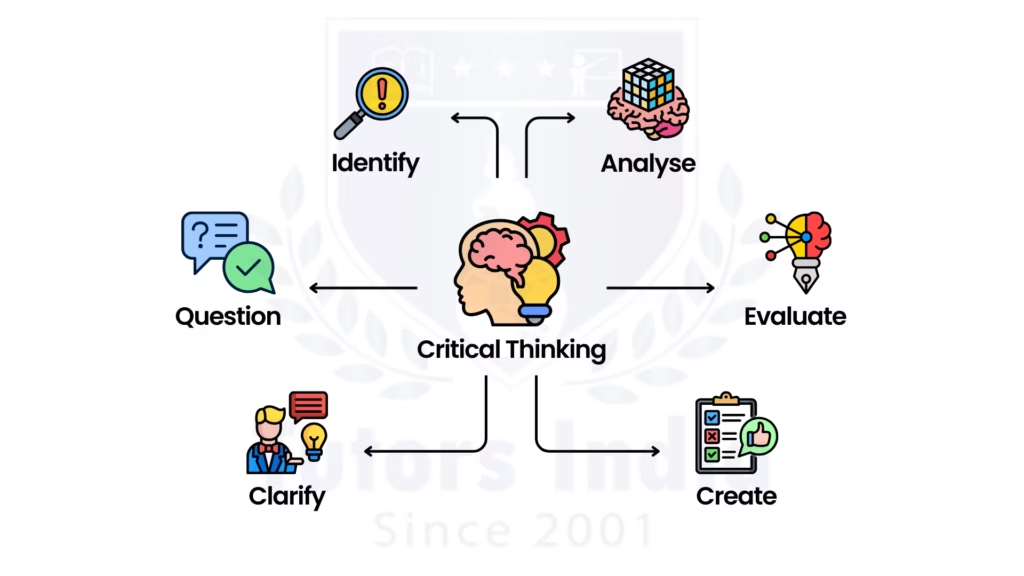
Critical analysis involves comparing different viewpoints, identifying research gaps, and forming evidence-based conclusions.
6. Editing, Proofreading, and Final Submission
Many students overlook editing and proofreading, but reviewing your assignment ensures it meets all requirements and is error-free. Students often seek British dissertation help or Writing services dissertation guidance for final editing and formatting. [6]
Submission checklist:
- Grammar and spelling
- Clear logical flow
- Correct referencing
- Proper formatting
- Accurate word count
Revise your assignment multiple times to improve clarity, quality, and coherence.
Conclusion
To write a master’s assignment successfully, you need to plan carefully, carry out good research, and manage your time very well. If you understand what is required in an assignment, organise all your research, and follow a structured approach to writing, you will get good results in academic writing. Many postgraduate students refer to Master’s assignment UK sample, Master’s Assignment help UK free, or Best Master’s assignment writing service UK resources to strengthen their work. When you develop your critical thinking abilities and academic writing skills, this improves your ability to do well in your studies, which gives you confidence when writing any type of academic work. If postgraduate students consistently work hard and have a plan before starting an assignment, they will have no trouble meeting the academic standard for their postgraduate studies and will produce high-quality results in their assignments.
How to Write a Master’s Assignment Effectively While Managing Time and Understanding Requirements. [Talk to a Dissertation Expert | Book a Free 15-Minute Consultation]
References
- How to manage time writing assignments. (n.d.). Newassignmenthelp.co.uk. Retrieved February 17, 2026, from https://www.newassignmenthelp.co.uk/how-to-manage-your-time-effectively-when-writing-an-assignment
- (N.d.). Nih.gov. Retrieved February 17, 2026, from https://www.niaid.nih.gov/grants-contracts/write-research-plan
- Addis, B. A., Gelaw, Y. M., Eyowas, F. A., Bogale, T. W., Aynalem, Z. B., & Guadie, H. A. (2023). “Time wasted by health professionals is time not invested in patients”: time management practice and associated factors among health professionals at public hospitals in Bahir Dar, Ethiopia: a multicenter mixed method study. Frontiers in public health, 11, 1159275. https://doi.org/10.3389/fpubh.2023.1159275
- 2.3 sharing research resources. (n.d.). Nih.gov. Retrieved February 17, 2026, from https://grants.nih.gov/grants/policy/nihgps/html5/section_8/8.2.3_sharing_research_resources.htm
- Song, C., & Song, Y. (2023). Enhancing academic writing skills and motivation: assessing the efficacy of ChatGPT in AI-assisted language learning for EFL students. Frontiers in psychology, 14, 1260843. https://doi.org/10.3389/fpsyg.2023.1260843
- Iyengar, K. P., Jain, V. K., & Vaishya, R. (2022). What do editors expect from authors in medical research? Journal of Orthopaedics, 32, 146–150. https://doi.org/10.1016/j.jor.2022.06.004