
Producing a Structurally Coherent and Examiner-Ready Dissertation in Accordance with UK Master’s Degree Assessment Criteria
Producing a Structurally Coherent and Examiner-Ready Dissertation in Accordance with UK Master’s Degree Assessment Criteria
- Home
- How To Article
- Producing a Structurally Coherent and Examiner-Ready Dissertation in Accordance with UK Master’s Degree Assessment Criteria
UK Dissertation Marketing Criteria
- Understanding UK Master’s Degree Dissertation Assessment Criteria
- Importance of Structural Coherence in a Dissertation
- Core Dissertation Structure for UK Master’s Degrees
- Writing an Examiner-Ready Introduction
- Developing a Critical Literature Review
- Methodology: Demonstrating Academic Rigor
- Academic Writing, Presentation, and Referencing

Producing a Structurally Coherent and Examiner-Ready Dissertation in Accordance with UK Master’s Degree Assessment Criteria
It is vital for any student working towards completing a UK master’s degree to produce a document that can serve as an examiner-ready dissertation that satisfies UK masters dissertation assessments criteria. UK Universities consider a variety of clearly defined criteria when marking dissertations, which typically include things such as structural coherence, academic rigor, originality, and compliance with formal conventions. A well-constructed dissertation that follows the correct dissertation format UK will enhance its readability and demonstrate to an examiner that a student has conducted independent research, has applied the knowledge of theory, and has effectively communicated their research outcomes. This article presents all the components required to produce an examiner-ready dissertation and describes how students can meet UK masters dissertation assessments criteria with regards to structure, clarity and academic presentation.[1]
1. Understanding UK Master’s Degree Dissertation Assessment Criteria
UK university dissertation marking criteria will assess both how well the dissertation meets academic requirements and how well it is presented in the approved dissertation format UK. Different institutions will have different marking scales, however the basic rules for all the relevant criteria are still the same. The assessment criteria for dissertations most commonly consists of the following elements aligned with UK masters dissertation assessments criteria: [2]
- Clearly defined research aims and objectives
- An appropriate and logical structure with good flow and cohesion
- Critical engagement with relevant and scholarly literature
- Use of appropriate and well-defended methodology without avoidable research methodology errors
- Robust data analysis and interpretation
- The overall quality of academic writing and appropriate referencing
- Submission of the dissertation in the appropriate format in accordance with the university’s specification.
2. Importance of Structural Coherence in a Dissertation
Coherence of the dissertation structure involves the logical organisation of chapter arrangements and the fluid movement of concepts from one chapter to the next according to accepted dissertation format UK standards. The examiner will typically expect that every chapter within a dissertation addresses some component of the research question(s).[3]
A dissertation that has structural coherence:
- Provides a logical pathway for the examiner from the introduction chapter through to the conclusion chapter
- Eliminates repetition of concepts and provides no unrelated contents, helping avoid common dissertation mistakes
- Supports an analytical development of concepts
- Provides a document that is clear to read and academically credible
An inadequate level of structural coherence can diminish the quality of the research findings and ultimately provide lower marks even when the findings demonstrate strong research
3. Core Dissertation Structure for UK Master’s Degrees
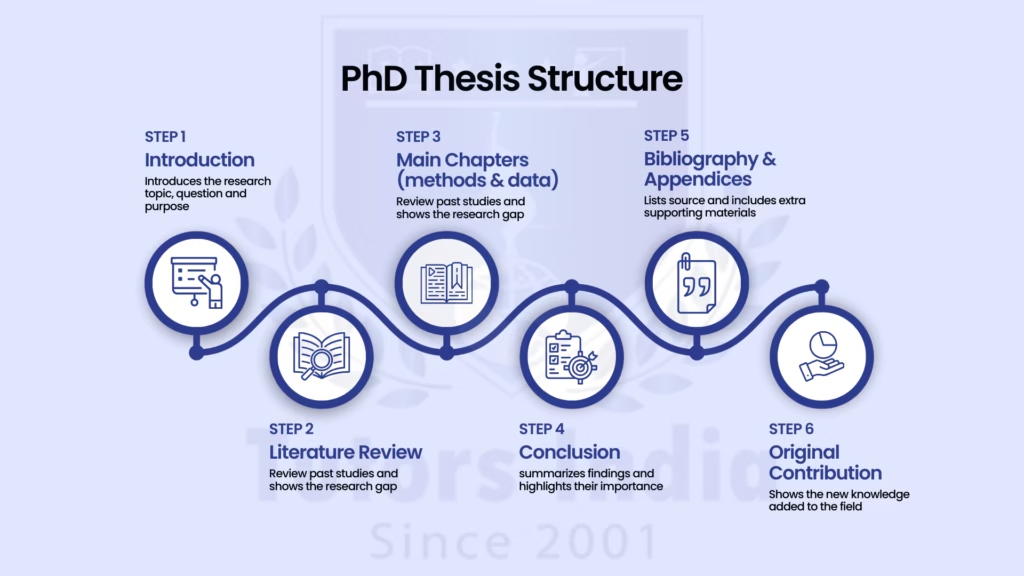
An examiner-ready dissertation typically follows a standard academic structure, as shown below.
4. Writing an Examiner-Ready Introduction
The dissertation’s academic foundation is established in its introductory section. The research work must be clearly defined as a research problem and support justification for conducting the study in line with UK masters dissertation assessments criteria.
| An introduction is effective if it includes both |
|
Examiners will look for clarity, focus, and relevance at this level and penalise vague openings as common dissertation mistakes.
5. Developing a Critical Literature Review
A literature review is a way for a student to critically evaluate prior research rather than simply reporting it. The UK assessment criteria require students to be able to: [4]
- Compare and contrast different academic points of view
- Identify gaps, inconsistencies or weaknesses in existing literature
- Create a theoretical framework
- Relate the literature directly to your research question(s)
- A coherent literature review provides the theoretical justification for conducting your research.
6. Methodology: Demonstrating Academic Rigor
The methodology chapter is a key element of UK masters dissertation assessments criteria because it demonstrates the validity of the research process and helps avoid serious research methodology errors.[5]
Key elements required are:
- A clear justification for the methodology and method selection used
- An explanation of the type of data collection tools designed/used
- Selection of an appropriate sampling strategy
- Ethical consideration of conducting the research
- Analysis techniques used for the research data
Examiners will evaluate whether the methodology selected is suitable, ethical, and justified appropriately in terms of the research undertaken, and they will penalise unaddressed research methodology errors.
7. Academic Writing, Presentation, and Referencing
The quality of academic writing has a major impact on the grade received under UK masters dissertation assessments criteria. All UK universities expect work to follow formal academic conventions and the required dissertation format UK.[6]
Students must ensure that they:
- Use clear, concise and correct academic language
- Structure their paragraphs logically
- Use terminology accurately
- Use a consistent referencing style (e.g., Harvard or APA) throughout the dissertation
- Format tables, figures and appendices correctly
If students do not follow presentation and formatting requirements, these common dissertation mistakes may lead to mark deductions.
Producing an Examiner-Ready Dissertation: Key Checklist
Before submission, students should ensure their dissertation:
- Aligns all chapters with research aims
- Maintains logical progression throughout
- Demonstrates critical analysis
- Meets word count and formatting requirements
- Follows university assessment criteria precisely
Attention to detail is essential for producing a high-quality final submission.
Conclusion
Students require meticulous planning, discipline in their academic work and careful attention to the finer details to construct a well-organised and examiner-ready dissertation that meets UK masters dissertation assessments criteria. In addition to conducting appropriate levels of research, students must logically structure their ideas, critically review their writing to avoid common dissertation mistakes, present their work using the correct dissertation format UK, and justify their methods without research methodology errors. Meeting these expectations increases the likelihood of achieving a positive academic outcome and success at master’s level in the UK.
Producing a Structurally Coherent and Examiner-Ready Dissertation in Accordance with UK Master’s Degree Assessment Criteria. [Talk to a Dissertation Expert | Book a Free 15-Minute Consultation]
References
- Improving clarity and coherence: Essential elements of dissertation writing. (n.d.). Falconediting.com. Retrieved January 30, 2026, from https://falconediting.com/en/blog/improving-clarity-and-coherence-essential-elements-of-dissertation-writing/
- Cordrey, T., Thomas, A., King, E., & Gustafson, O. (2024). Evaluating the perceived impact and legacy of master’s degree level research in the allied health professions: a UK-wide cross-sectional survey. BMC medical education, 24(1), 750. https://doi.org/10.1186/s12909-024-05582-0
- Eriksson M. The Sense of Coherence: The Concept and Its Relationship to Health. 2022 Jan 1. In: Mittelmark MB, Bauer GF, Vaandrager L, et al., editors. The Handbook of Salutogenesis [Internet]. 2nd edition. Cham (CH): Springer; 2022. Chapter 9. Available from: https://www.ncbi.nlm.nih.gov/books/NBK584067/ doi: 10.1007/978-3-030-79515-3_9
- Maggio, L. A., Sewell, J. L., & Artino, A. R., Jr (2016). The Literature Review: A Foundation for High-Quality Medical Education Research. Journal of graduate medical education, 8(3), 297–303. https://doi.org/10.4300/JGME-D-16-00175.1
- Yang, L. J., Chang, K. W., & Chung, K. C. (2012). Methodologically rigorous clinical research. Plastic and reconstructive surgery, 129(6), 979e–988e. https://doi.org/10.1097/PRS.0b013e31824eccb7
- Kozak M. (2020). Academic Writing, and How to Learn How to Write. Journal of graduate medical education, 12(3), 373–374. https://doi.org/10.4300/JGME-D-20-00154.1