
Struggling with ethics approval or GDPR in your UK dissertation?
Struggling with ethics approval or GDPR in your UK dissertation
- Home
- How To Article
- Struggling with ethics approval or GDPR in your UK dissertation
Approved Dissertation Topic Selection

Struggling with ethics approval or GDPR in your UK dissertation
The ethical aspect of dissertation research in the United Kingdom is one of the most important things researchers must think about, but it can also be one of the most confusing parts for undergraduate, master’s, and PhD students, particularly when dealing with ethical use in UK dissertations. Universities in the UK put a great deal of importance on carrying out ethical research practices this includes protecting your research participants, maintaining academic integrity, and complying with your institution’s rules and legal requirements. However, students often find it confusing to understand how to interpret ethical guidelines, how to complete their ethical approval for dissertations, and how to apply ethical principles in practice, which are common dissertation writing problems.[1]
This article will discuss some of the most common ethical dilemmas faced by UK students writing their dissertation, including those completing a master’s dissertation, as well as the steps that can be taken to help overcome these challenges and avoid common dissertation mistakes.
1. Understanding Research Ethics in the UK Context
Research ethics in higher education in the UK is a set of moral guidelines regarding the way in which research is planned, conducted, and reported. Many universities require students to gain ethical approval prior to collecting their data (particularly where human participants will be consulted), making ethical approval for dissertations a mandatory requirement.[2]
Some of the commonly used ethical frameworks include:
- University ethics policies and ethics committees
- UK Research Integrity Office (UKRIO) guidelines
- The General Data Protection Regulation (GDPR)
Even with these ethical frameworks, students frequently find it challenging to navigate ethics guidance and often require additional assistance to successfully interpret it, especially when overcoming dissertation challenges related to ethics.
2. Common Ethical Issues That Confuse Students
Many dissertation ethics problems arise not from misconduct, but from misunderstanding key ethical requirements. [3]
Ethical Area | What Students Often Find Confusing | Key Ethical Requirements |
Informed Consent | Students may assume verbal consent is sufficient or believe written consent is unnecessary. | Clearly explain the research purpose, participant involvement, right to withdraw, and data usage through written consent. |
Confidentiality vs Anonymity | Many students use these terms interchangeably or misunderstand their meanings. | Confidentiality means identities are known but protected; anonymity means identities are not collected at all. |
Data Protection & GDPR | Uncertainty about where data can be stored and how long it should be retained. | Store data securely, restrict access, and define a clear data retention policy in line with GDPR. |
Avoiding Harm to Participants | Students may underestimate emotional, psychological, or reputational risks. | Identify potential risks, provide support resources, and plan how to respond to participant distress. |
Timing of Ethics Approval | Some students believe ethics approval can be obtained after data collection begins. | Ethics approval must be secured before data collection to comply with UK university policies. |
3. Institutional Ethics Requirements: Where Students Struggle Most
The table below summarises common ethical challenges and their solutions: [4]
Ethical Area | Common Student Confusion | How It Can Be Addressed |
Ethics approval | When approval is required | Apply before data collection |
Consent forms | What details to include | Use university templates |
Data protection | GDPR compliance | Follow university IT policies |
Participant risk | Identifying harm | Conduct a risk assessment |
Vulnerable groups | When extra approval is needed | Seek supervisor guidance |
4. How These Ethical Challenges Can Be Addressed
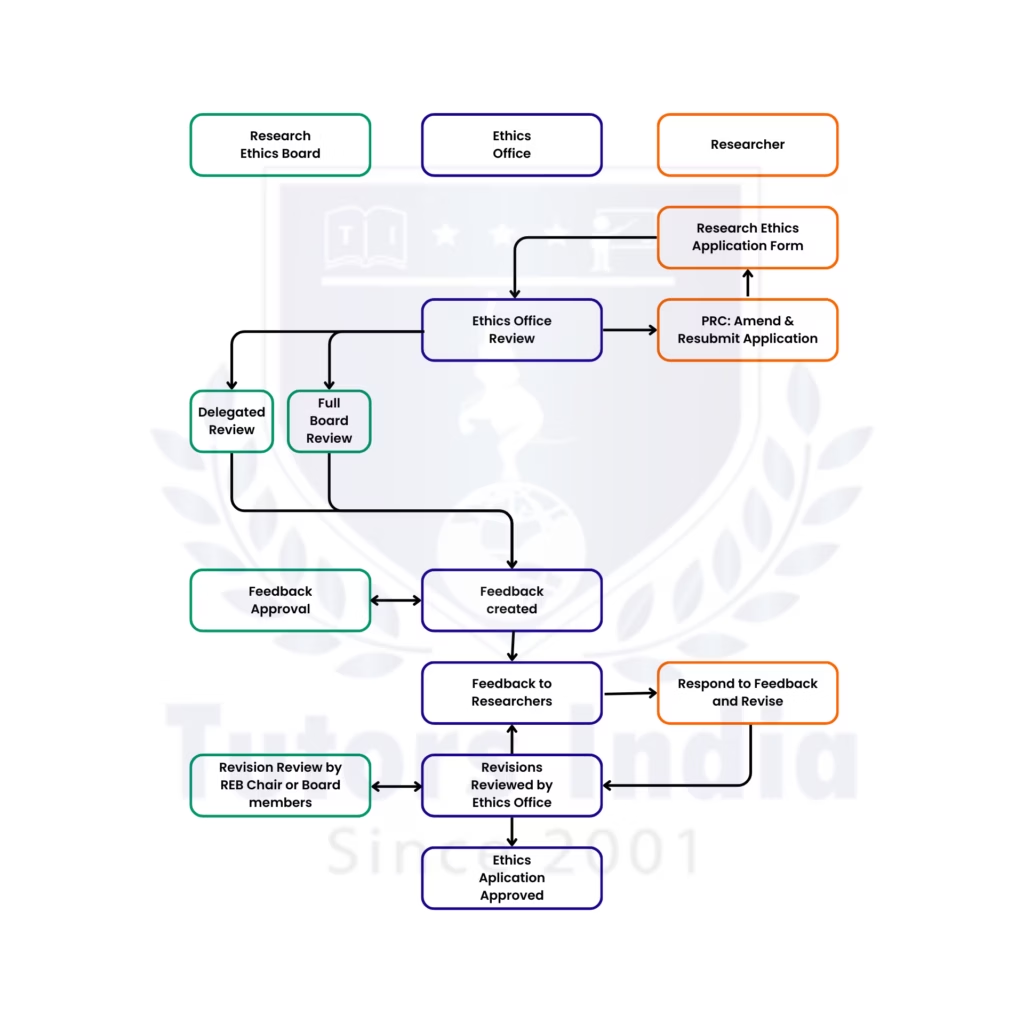
The methodology chapter should clearly explain how consent was obtained, confidentiality maintained, and data stored securely, demonstrating ethical awareness to examiners.[5]
5. The Role of Academic Support Services
Professional academic support services assist students with the following: [6]
- Interpreting ethical guidelines
- Drafting ethical applications
- Reviewing consent forms and data management plans
- Aligning with the standards of universities in the United Kingdom.
Such support is particularly beneficial for international students unfamiliar with UK ethics requirements and those facing dissertation writing problems.
Conclusion
The ethical aspects of dissertation research in the UK can be challenging due to complex and strictly enforced guidelines. Students commonly struggle with informed consent, data protection, confidentiality, and risk management key ethical considerations in UK dissertations. By planning early, working closely with supervisors, using institutional templates, and documenting ethical procedures clearly, students can effectively address these challenges.
Students who understand and apply ethical research practices not only meet university requirements but also enhance the quality, credibility, and integrity of their master’s dissertation or doctoral research while avoiding common dissertation mistakes.
Struggling with ethics approval or GDPR in your UK dissertation? Tutors India provides ethical, university-aligned guidance to help you navigate consent forms, ethics applications, and compliance confidently. [Get Ethical Dissertation Support | Book a Free Consultation]
References
- Ethical considerations in dissertation writing: Best practices. (n.d.). Falconediting.com. Retrieved January 29, 2026, from https://falconediting.com/en/blog/ethical-considerations-in-dissertation-writing-best-practices/
- Parsons, M., Ratcliff, J., Egan, B., Hassanin, H., & Ala, A. (2024). The UK research ethics committee: Making the case for better serving the underserved – can we do better? Clinical Medicine (London, England), 24(1), 100012. https://doi.org/10.1016/j.clinme.2023.100012
- Drolet, M. J., Rose-Derouin, E., Leblanc, J. C., Ruest, M., & Williams-Jones, B. (2023). Ethical Issues in Research: Perceptions of Researchers, Research Ethics Board Members and Research Ethics Experts. Journal of academic ethics, 21(2), 269–292. https://doi.org/10.1007/s10805-022-09455-3
- Capili, B., & Anastasi, J. K. (2024). Ethical Research and the Institutional Review Board: An Introduction. The American journal of nursing, 124(3), 50–54. https://doi.org/10.1097/01.NAJ.0001008420.28033.e8
- Nopita Wati, N. M., Juanamasta, I. G., Thongsalab, J., & Yunibhand, J. (2023). Strategies and challenges in addressing ethical issues in the hospital context: A phenomenological study of nurse team leaders. Belitung nursing journal, 9(2), 139–144. https://doi.org/10.33546/bnj.2446
- Johnson, C., Gitay, R., Abdel-Salam, A. G., BenSaid, A., Ismail, R., Naji Al-Tameemi, R. A., Romanowski, M. H., Kazem Al Fakih, B. M., & Al Hazaa, K. (2022). Student support in higher education: campus service utilization, impact, and challenges. Heliyon, 8(12), e12559. https://doi.org/10.1016/j.heliyon.2022.e12559