
Why Data Science Master’s Research Methodology Chapters Get Rejected in UAE
Why Data Science Master's Research Methodology Chapters Get Rejected in UAE
- Home
- How To Article
- Why Data Science Master's Research Methodology Chapters Get Rejected in UAE
Table of Content
- Importance of Dissertation Methodology Help in UAE
- Why Data Science Master's Research Methodology Chapters Get Rejected in UAE Universities?
- Poor Justification of Research Design
- Inappropriate Data Collection Methods
- Incorrect Application of Statistical and Machine Learning Techniques
- Correcting Lack of Reproducibility and Transparency with Data Science Research Methodology in UAE
- Weak Validity and Reliability Assessment
- Tips to Avoid Rejection of Data Science Research Methodology
- Conclusion

Why Data Science Master's Research Methodology Chapters Get Rejected in UAE
Summary
The dissertation chapter methodology is the most fundamental one in a data science master’s dissertation. Here we’ll examine the most widely accepted rationale for a rejected methodology chapter at UAE universities – and give you a few practical tips to improve yours! Reasons Why Your Methodology Chapter Might Be Rejected: Poor research design. It’s vital that your research design directly fits with your problem statement/research question.
Introduction
The research methodology of the study explains how the research was conducted, from the collection to analysis and interpretation of data and justifies the methodologies chosen. UAE universities place a great deal of value in methodological soundness, as a study’s reliability and validity depend greatly on the method employed.
There is a wide range of research areas, including Artificial Intelligence, Machine Learning, Big Data Analytics and Predictive Modelling, but a lot of student submissions are negatively reviewed with significant issues in the methodology chapter. Issues related to the reliability, validity, transparency and reproducibility of the research design.
The article will guide you on the most common reasons for rejection of Data Science master’s research methodology in UAE universities and how to avoid this rejection. Experts at Tutors India offer specialised Data Science support for master’s students regarding research methodology chapters.
Those who seek Research Methodology Writing Help in UAE at Tutors India are often made aware of these reasons prior to starting their work on it.
Importance of Dissertation Methodology Help in UAE
The research methodology chapter forms an integral section of a master’s dissertation since it defines the way in which the dissertation was implemented and how the presented results were produced.
It represents the systematic approach in which data were gathered and subsequently interpreted to provide the academic standards that a research methodology section requires. As many Data Science studies use huge data sets, it would be necessary to clarify each step and justify it. They can also consider structured Dissertation Methodology Help in UAE to justify their research correctly.
A well-researched method chapter also increases the reliability of your study results, implying the outcomes could be repeated. At most of the UAE universities, importance is given to the methodology chapter, which implies how credible your results are.
A well-developed methodology chapter helps students:
- Justify the chosen research design and analytical approach.
- Demonstrate data quality and reliability.
- Ensure reproducibility of results.
- Support valid interpretation of findings.
- Increase dissertation acceptance and academic credibility.
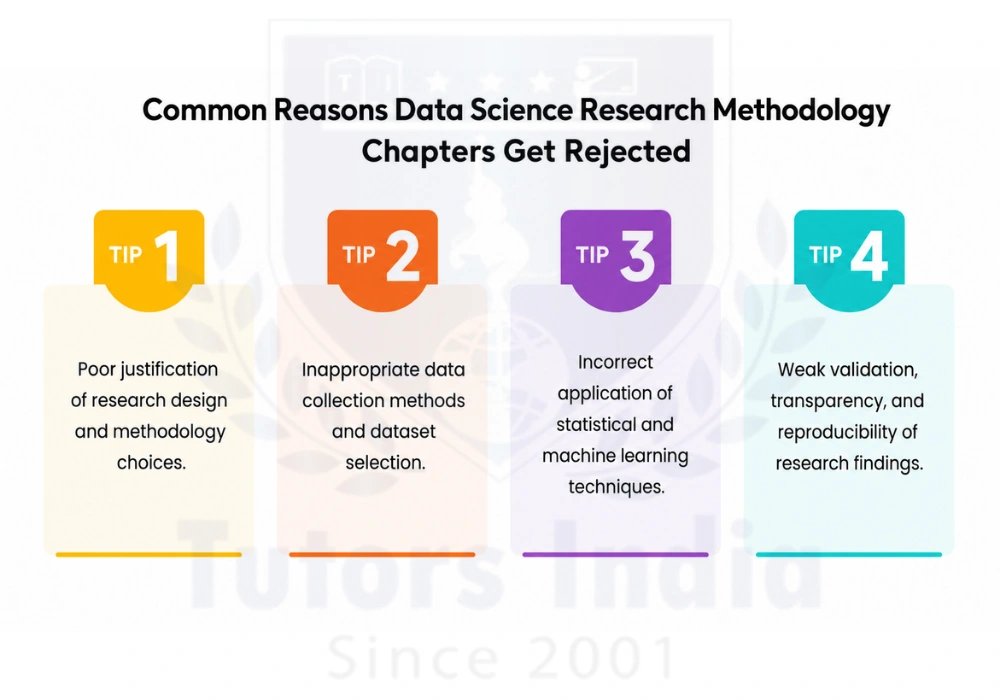
Why Data Science Master's Research Methodology Chapters Get Rejected in UAE Universities?
1. Poor Justification of Research Design
A major reason for rejection is the fact that students often don’t justify why the research design was chosen. Most students explain how the study would be conducted without really explaining why they chose a particular design, such as qualitative, quantitative, experimental, modelling or mixed-methods approach.
Research reviewers will want to understand why that methodology was chosen for that study and how that relates to the aims and research questions, for example.
Tips:
- Clearly explain the chosen research design.
- Align methodology with research objectives.
- Justify methodological choices using literature.
- Discuss strengths and limitations of the design.
Example: The research design is considered the architecture that shapes the data collected and analysed in a study (Creswell and Creswell, 2023). Without a clearly justifiable reason, there is diminished confidence in the conclusion reached through a study.
2. Inappropriate Data Collection Methods
Lack of relevant data (either the selected dataset is inappropriate for the problem or inadequate data collection was employed). Reviewers are very sensitive to the data since Data Science is a data-driven process.
Therefore, the quality of the selected dataset can affect the validity of your findings significantly.
Some common problems include biased datasets (size), old datasets, no explanation of the data collection process, not sufficient data preprocessing steps, and the question of whether the used data is relevant to the explored problem.
Tips:
- Use reliable, relevant, and sufficiently large datasets.
- Clearly explain data collection and acquisition procedures.
- Describe data cleaning and preprocessing techniques.
- Justify dataset selection based on research objectives.
Example: For dependable predictive models, James et al. (2023) advise careful consideration should be put towards both the machine learning methods to choose and the validation to use. While complex models might achieve good performance but might not necessarily translate well for the task at hand.
3. Incorrect Application of Statistical and Machine Learning Techniques
One of the main reasons for rejection is due to poor use of statistical and machine learning techniques. The majority of students using high-level computational and statistical methods do not explain the rationale behind their selection or their relevance to answering the question that is the focus of their research.
Authors are consistently faulted for not choosing a proper model, incorrect statistical testing, faulty feature selection, ignoring hyperparameter tuning and insufficient validation. Advanced models are useless without validation procedures proving they perform well in the problem.
Tips:
- Justify the selection of statistical and machine learning techniques.
- Explain model development and implementation procedures.
- Apply appropriate validation and testing methods.
- Report performance metrics clearly and accurately.
Example: Accuracy in your citation practices and referencing ensures the academic rigour and value of your work. A well-developed reference list allows readers to trace your work and to see that you’ve engaged widely in the body of literature; a poorly written bibliography raises concerns about whether you’ve plagiarised (Pecorari 2008).
Get the pricing details for the Master’s research methodology service at Tutors India, designed to assist students in completing their thesis.
4. Correcting Lack of Reproducibility and Transparency with Data Science Research Methodology in UAE
Reproducibility is a cornerstone of Data Science research in general. Your methodology section should be detailed enough that someone else will be able to rerun your experiment and get similar results. But you need to mention tools, software, preprocessing, feature selection, model choice, etc in your dissertation to make it reproducible.
An absence of transparency increases the confidence with which readers can hold a reviewer’s opinion of a paper. Well-documented work will seem professional and credible. Students often consider professional Data Science Research Methodology in UAE to solve the reproducibility and transparency issues.
Tips:
- Clearly describe software platforms and tools used.
- Explain data preprocessing and feature engineering procedures.
- Document model parameters and experimental settings.
- Provide sufficient detail for replication.
Example: According to Peng (2011) reproducible science can increase scientific validity since other scientists can verify the findings and use all the provided information about the software packages, dataset, preprocessing information, and the configuration setting of the model.
5. Weak Validity and Reliability Assessment
Most students fail to understand the importance of their findings and validation. Their methodology sections often fail to include valid validation techniques, robustness tests, and checks for bias, reliability, etc.
An important step in any research project under data science and machine learning that requires prediction models. Validation is crucial to understand if models will perform reasonably well over unseen data.
A poorly done validation could give us results that would not generalise and would have very little real meaning or usefulness. In general, students are asked by reviewers to show how consistent their models are and whether they make sense out of the initial dataset used.
Tips:
- Conduct comprehensive model validation procedures.
- Evaluate reliability and consistency of results.
- Assess bias and potential sources of error.
- Report validation metrics and performance indicators comprehensively.
Example: Shmueli et al. (2020) acknowledge that a more thorough validation provides more confidence in the predictive analytics and enable trustworthiness decision. Methods such as cross-validation, robustness testing, and bias testing demonstrate the stability of the model on various datasets.
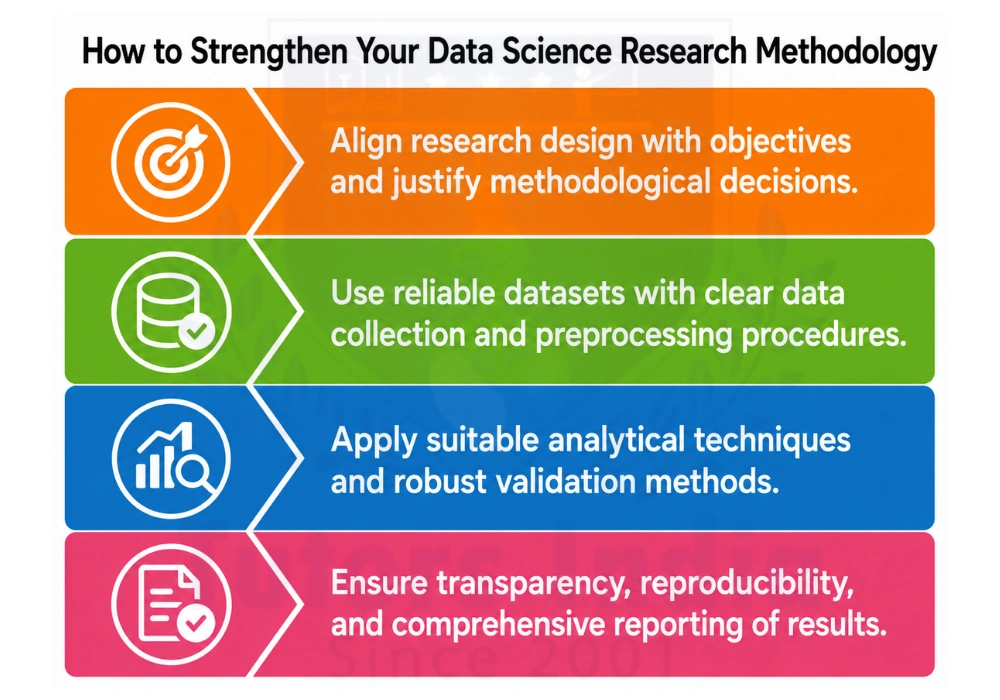
Tips to Avoid Rejection of Data Science Research Methodology
- Clearly justify all methodological decisions.
- Use appropriate and reliable datasets.
- Apply suitable statistical and machine learning techniques.
- Ensure research transparency and reproducibility.
- Validate models using recognised evaluation methods.
- Seek expert Dissertation Data Science Methodology in UAE to avoid these common errors.
Conclusion
One of the most frequently debated chapters in any master’s dissertation in UAE university courses is the methodology. However, strong topic interest alone cannot save you if the results are flawed due to poor methodology.
Students may make their dissertation more agreeable to approval committees by using an appropriate research design and method with solid explanations in the method chapter of the data science project work and report for data collection, research design analysis, validation method for the research and replicability measures. Methodology enhances the value of the research work and makes the research result effective and replicable in its effect.
Get expert Master’s Research Methodology Help in UAE from Tutors India to avoid rejection of data science research methodology chapters in the UAE.
Book a Free Expert Consultation with Tutors India to develop your research methodology chapters based on your university requirements.
References
- Creswell, J. W., & Creswell, J. D. (2023). Research Design: Qualitative, Quantitative, and Mixed Methods Approaches (6th ed.). Sage Publications.
- Hair, J. F., Black, W. C., Babin, B. J., & Anderson, R. E. (2022). Multivariate Data Analysis (9th ed.). Cengage Learning.
- James, G., Witten, D., Hastie, T., & Tibshirani, R. (2023). An Introduction to Statistical Learning: With Applications in Python (2nd ed.). Springer. https://doi.org/10.1007/978-3-031-38747-0
- Peng, R. D. (2011). Reproducible Research in Computational Science. Science, 334(6060), 1226–1227. https://doi.org/10.1126/science.1213847
- Shmueli, G., Bruce, P. C., Gedeck, P., & Patel, N. R. (2020). Data Mining for Business Analytics: Concepts, Techniques, and Applications in Python. Wiley.