
Why AI Literature Reviews Fail to Identify Research Gaps in Australian Universities
Why AI Literature Reviews Fail to Identify Research Gaps in Australian Universities
- Home
- How To Article
- Why AI Literature Reviews Fail to Identify Research Gaps in Australian Universities
Table of Content
- Understanding the Importance of Dissertation Literature Review Help in Australia
- Why Do AI Literature Reviews Fail to Identify Research Gaps in Australian Universities?
- Over-Reliance on Summarisation Instead of Critical Analysis
- Addressing Challenges in Identifying Emerging Research Areas with MBA Literature Review Help in Australia
- Limited Ability to Interpret Context and Research Significance
- Challenges in Evaluating Contradictory Findings
- Inability to Fully Assess Methodological Weaknesses
- How to Improve Research Gap Identification Beyond AI Literature Reviews?
- Conclusion

Why AI Literature Reviews Fail to Identify Research Gaps in Australian Universities
Summary
AI helps in reducing research effort but has its limitations in highlighting real research gaps due to poor criticality and insufficient contextual evaluation. Therefore, it’s advisable to enhance AI with your thinking abilities, intuition and expert supervision for groundbreaking research outcomes.
Introduction
Artificial intelligence has had a profound impact on academic research, and this includes making the research available more efficiently with easier access to articles, automating the searches of the scientific literature, summarising the articles and providing analysis on the future of research. As well, most of the universities in Australia are now providing guidance to researchers about the acceptable use of such tools to enhance the effectiveness of their research.
Unfortunately, this also implies that numerous researchers, especially novice researchers, often fall back on AI to produce entire literature reviews. These reviews often contain summaries of the studies but not always a critical assessment of the implications of these studies, any remaining questions and potential for further investigation. This leaves a wide variety of unexplored questions.
Literature Review Writing Help in Australia in Tutors India supports students in preparing authentic, analytic, and exhaustive literature reviews in the Australian context, enabling them to discover the research gap successfully.
Understanding the Importance of Dissertation Literature Review Help in Australia
The literature review will underpin the whole of the research project through an examination of what already has been discovered in the area, what directions of enquiry are prevalent, and what is unknown and must be ascertained. The quality of the literature review affects topic choice, research questions, methodological framework and the value of the overall research.
As AI tools to support research are increasingly being used, researchers can go through more literature at a faster speed. But it still is not enough to review others’ research when looking for research gaps. Instead, we need to analyse, compare and evaluate the theory, understand nuance and make sense of the heterogeneity of the literature.
Expert Dissertation Literature Review Help in Australia allow researchers to leverage professional knowledge alongside Artificial Intelligence to recognise important research gaps, support research rationales, and produce quality studies.
Why Do AI Literature Reviews Fail to Identify Research Gaps in Australian Universities?
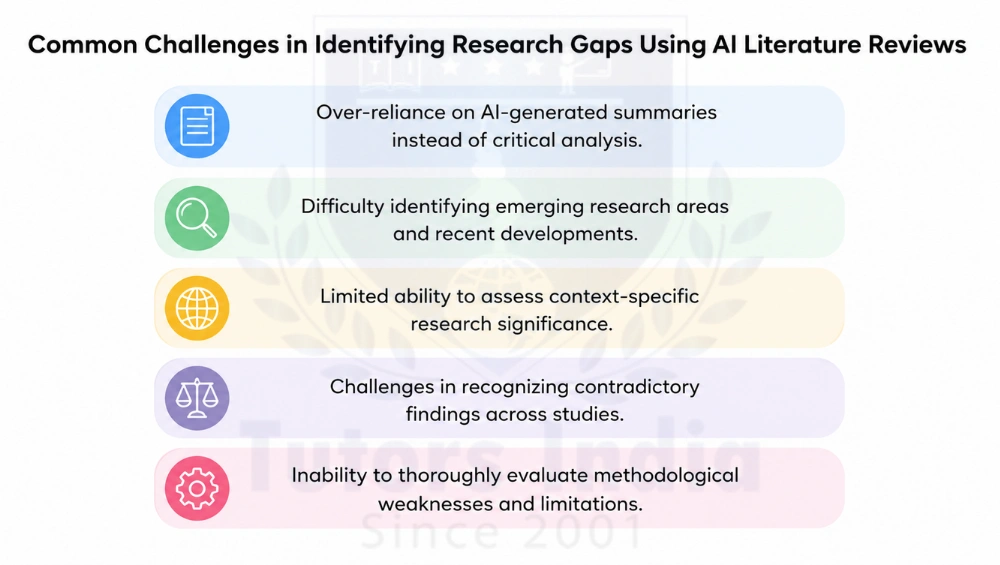
1. Over-Reliance on Summarisation Instead of Critical Analysis
The main constraint with existing literature review techniques in the realm of AI is the lack of critical assessment instead of just summarising existing research. The ability to find out the research conclusions, methods and outcomes of studies from existing literature is high. What it’s typically missing is the evaluation of the existing research – strengths, weaknesses or any possible limitations.
With the lack of this aspect, researchers end up receiving detailed summaries without any insight into what questions are still unfulfilled and sometimes contradicting or methodologically flawed and what avenues for further research. It is through critiquing of the available literature that research gaps become apparent – research gaps don’t come through just a summary.
Researchers must use the output of AI as a basis and critically examine the literature by themselves to identify any gaps and questions.
Example: Webster and Watson (2002) indicate that a sound literature review should be analytical, critique previous research, and reveal problems that need further inquiry rather than only providing a general description of existing literature. This suggests the necessity for an analytical evaluation in exploring meaningful research gaps.
2. Addressing Challenges in Identifying Emerging Research Areas with MBA Literature Review Help in Australia
Currently, the main basis for AI models is prior published works and historic data. In a way, this means AI may be a step behind the current and new emerging trends in research which are not widely published yet.
For domains like Artificial Intelligence, Cyber Security, Data Science, Healthcare Informatics and Technologies such as Green Energy, emerging trends and new lines of research will always appear constantly, as AI models tend to focus on more widely presented works and not these lesser-known and recent ones.
In addition to using AI-generated reviews to perform literature searches, researchers can use conference proceedings (which provide the latest work in a field) to locate the latest research. Industry reports, research grants, and papers focused on newly developed technologies can also be very useful. Furthermore, students can succeed at their literature review through structured MBA Literature Review Help in Australia.
Example: Jordan and Mitchell (2015) found that machine learning technology is consistently creating novel avenues of investigation for new papers across a variety of research areas. They argued that it is important to follow the trends of novel developments to investigate the novelty in the topic.
3. Limited Ability to Interpret Context and Research Significance
Research Gaps are context-specific, determined by geography, society, industry or technology. Tools will identify common themes in findings but will not be able to assess whether the findings are universally transferable.
For instance, findings from research conducted in North America may not apply to Australian industries, healthcare facilities, education, or the environment. AI systems might not factor in these unique context differences to the full extent when constructing an AI-assisted literature review.
Researchers then need to assess and ask whether findings from prior work apply to their research setting and areas in their context that remain understudied.
Example: Creswell and Creswell (2018) insisted that the significance of the study really varies according to its context and study purpose. It implies that context-specific value judgments need to be considered for determining a significant research gap.
Get the pricing details for the literature review at Tutors India, designed to assist students in conducting a robust literature review.
4. Challenges in Evaluating Contradictory Findings
Most research gaps usually arise when a few previous studies have come up with conflicting and differing results. However, the artificial intelligence research summary has information compiled together in a form that doesn’t bring to light any disagreements between the researchers’ works.
The researcher might fail to identify and utilise any possibilities to pursue the subject because of ignoring conflicting findings. It will simply bring out an essay with repeated findings of the existing research without solving any academic disputes.
Researchers need to analyse data sources, methods, and outcomes of several studies, for instance. This will enable identifying those issues where more evidence is still needed, or where outcomes are conflicting.
Example: Kitchenham and Charters (2007) drew attention to the benefits of systematic literature reviews in allowing researchers to “detect conflict and contradictions that arise in the results of different papers; these conflicts can also serve as starting points for research.
5. Inability to Fully Assess Methodological Weaknesses
There are numerous gaps in the existing literature due to methodological shortcomings, which may manifest as a sample too small, lack of data, geographical scope too narrow, an inappropriate validation method, or lack of a strong theory, etc.
While many AI tools can do a good job of summarising a methodology, they cannot effectively appraise the quality of the methodology, pinpoint specific weaknesses or methodological flaws that call for more work. Therefore, chances to improve research design can go unseen.
Researchers need to investigate methodology from previous research and find ways to overcome any limitations by better research design.
Example: Snyder (2019) suggested that literature reviews identify strengths and weaknesses in the methodology to build better future research knowledge on. The review concluded that critical analysis is central to identifying a research gap.
How to Improve Research Gap Identification Beyond AI Literature Reviews?
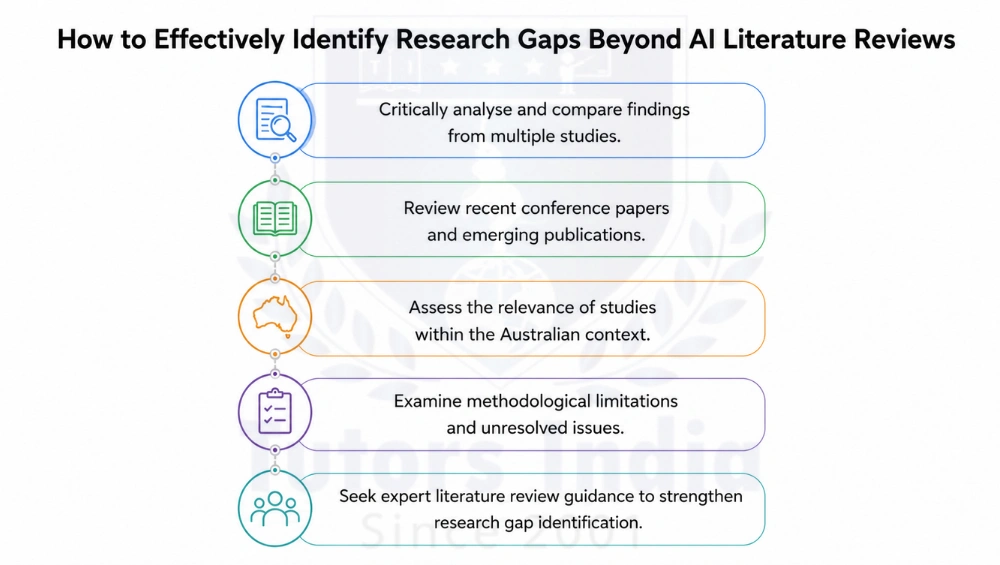
- Compare studies to identify contradictions and unresolved issues.
- Review recent conference papers and emerging research publications.
- Assess contextual and industry-specific relevance of previous studies.
- Examine methodological limitations in existing research.
- Develop strong analytical and critical thinking skills.
- Seek expert Dissertation Literature Review Service in Australia to strengthen research gap identification.
Conclusion
The rapid use of AI systems and their ability to search large amounts of academic information has helped with the review. Yet the generated literature doesn’t show any worthy gaps in studies because of the system’s ability to sum up rather than to critically read or comprehend context and conflict among contradictory data and/or weaknesses in research methods.
University researchers in Australia need to balance the use of an AI-aided literature search with analytical thinking, their own expertise, and objective peer review, so they can then uncover truly new and exciting research ideas. A more critical approach plus expert advice where needed will lead to sounder bases for new and better research.
Students can avail guided Master’s Literature Review Help in Australia at Tutors India to enhance the choice of topic and successfully compile their master’s dissertation.
Book a Free Expert Consultation with Tutors India to select a significant research topic.
References
- Creswell, J. W., & Creswell, J. D. (2018). Research Design: Qualitative, Quantitative, and Mixed Methods Approaches (5th ed.). Sage Publications. https://www.ucg.ac.me/skladiste/blog_609332/objava_105202/fajlovi/Creswell.pdf
- Domingos, P. (2012). A Few Useful Things to Know About Machine Learning. Communications of the ACM, 55(10), 78–87. https://doi.org/10.1145/2347736.2347755
- Jordan, M. I., & Mitchell, T. M. (2015). Machine Learning: Trends, Perspectives, and Prospects. Science, 349(6245), 255–260. https://doi.org/10.1126/science.aaa8415
- Kitchenham, B., & Charters, S. (2007). Guidelines for Performing Systematic Literature Reviews in Software Engineering. Keele University and Durham University Joint Report. https://www.scirp.org/reference/ReferencesPapers?ReferenceID=1555797
- Snyder, H. (2019). Literature Review as a Research Methodology: An Overview and Guidelines. Journal of Business Research, 104, 333–339. https://doi.org/10.1016/j.jbusres.2019.07.039
- Webster, J., & Watson, R. T. (2002). Analyzing the Past to Prepare for the Future: Writing a Literature Review. MIS Quarterly, 26(2), xiii–xxiii. https://www.jstor.org/stable/4132319