
Why Australian Data Science Students Struggle with Statistical Analysis Projects
Why Australian Data Science Students Struggle with Statistical Analysis Projects
- Home
- How To Article
- Why Australian Data Science Students Struggle with Statistical Analysis Projects
Table of Content
- Understanding the Importance of Dissertation Statistical Analysis Help in Australia
- Why Data Science Students Struggle with Statistical Analysis Projects?
- Difficulty in Choosing the Right Statistical Test
- Problems in Data Preparation and Dataset Management
- Addressing Challenges in Statistical Software Using Expert Data Science Statistical Analysis Help in Australia
- Challenges in Interpreting Statistical Results
- Lack of Understanding in Assumption Testing
- How to overcome this problem?
- Conclusion

Why Australian Data Science Students Struggle with Statistical Analysis Projects
Statistics are very important in doing data science research, especially for those who are pursuing their master’s degrees in Australia. Regardless of whether it is about using statistics in prediction and machine learning, business intelligence, or dealing with big data analysis, understanding statistical tools is important for doing proper research. But students may find statistical analysis very difficult due to several reasons.
As academic pressure increases in Australian universities, there is a necessity to apply advanced statistical methods such as SPSS, R Programming, Python, SAS, and MATLAB. Some students pursuing a postgraduate degree struggle with selecting the proper statistical tests, analysing data, and interpreting results.
Some of the issues associated with statistical analysis among Australian students have been elaborated in this article. Tutors India offers professional assistance with Master’s Statistical Analysis Help in Australia.
Understanding the Importance of Dissertation Statistical Analysis Help in Australia
It is vital to understand that statistical analysis is essential in dissertation studies as this will help students analyse their data scientifically. Regarding statistical methods used in data science dissertations in Australia, there is a large list of statistical techniques, including regression analysis, forecasting techniques, hypothesis testing, and machine learning techniques.
It is important to note that quality statistics are crucial for ensuring that your research is valid, accurate, and credible. Statistics may pose problems for students who conduct research in areas such as business analytics, health care analytics, artificial intelligence, and finance forecasting because it is quite difficult to determine which techniques to use.
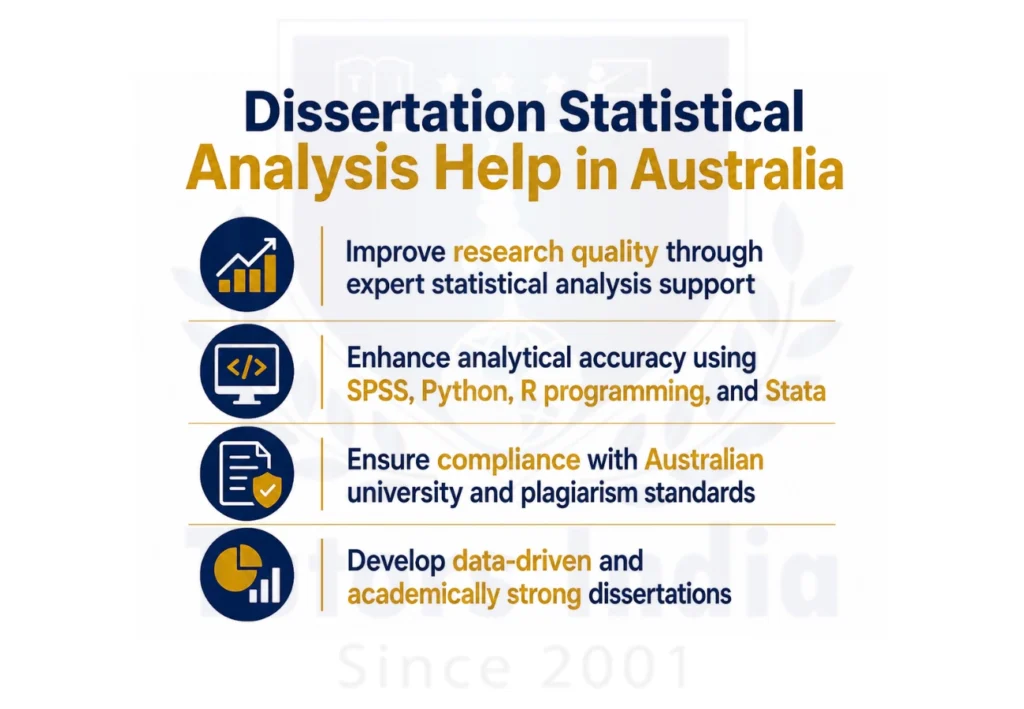
As academic pressures rise in Australian institutions, students have to possess analytical capabilities to cope with data sets, understand software results, and present their research conclusions convincingly. Professional Dissertation Statistical Analysis Help in Australia helps students enhance their understanding of statistics, software handling, and conduct effective research for academic dissertations.
Why Data Science Students Struggle with Statistical Analysis Projects?
1. Difficulty in Choosing the Right Statistical Test
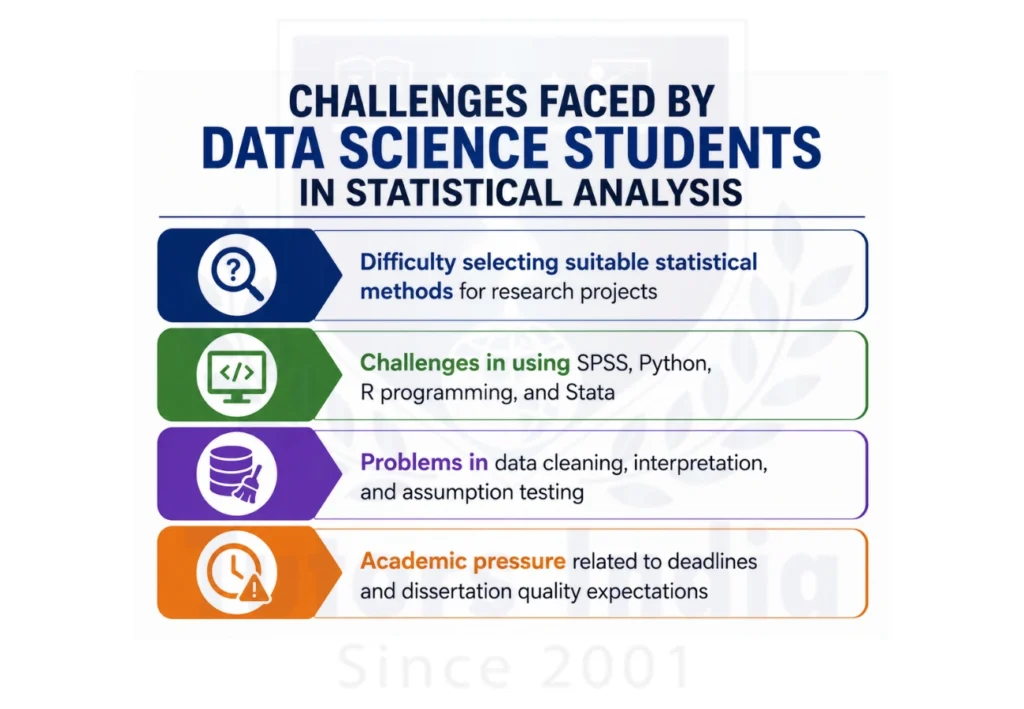
The selection of an appropriate statistical test presents a critical challenge for data science students in Australia. Many students find it difficult to ascertain whether their research should be analysed through parametric or non-parametric statistics. Additionally, the selection of a proper statistical technique, such as regression analysis, ANOVA, correlation, or SEM, presents a challenge.
The problem of choosing appropriate statistical techniques also poses a challenge for students. Most projects entail analysing sophisticated datasets that demand strong statistical knowledge. Lacking this understanding, students tend to feel frustrated while choosing appropriate statistical methods for prediction analysis or machine learning analysis.
Indeed, according to a study by Onwuegbuzie and Wilson (2003), post-graduate students frequently suffer from statistics anxiety because of their poor comprehension of statistical concepts. For instance, a student who needs to analyse customer behaviour may find it difficult to determine whether he/she should use regression analysis or factor analysis.
2. Problems in Data Preparation and Dataset Management
Data preparation is one other problem that Australian students face in learning about data science. Many of the datasets that have been used for research are likely to have problems with missing data, duplicate entries, and inconsistency, which will need to be corrected before analysis can be done. Data preparation may not be taken seriously by some students.
Outliers, skewness, and missing observations present problems when doing statistical analysis. The sample size for many postgraduate studies is quite small, hence making it hard to get accurate results from the analysis process. Bad data preparation may lead to incorrect research findings.
As per Rahm and Do (2000), who conducted peer-reviewed research on data cleansing, preprocessing can be regarded as one of the most tedious processes in the context of data analysis because most data sets are likely to be missing some information. In such situations, where a student is analysing data sets in healthcare, incomplete patient records are not easy to handle. In such circumstances, learners need help in data science analysis in Australia.
3. Addressing Challenges in Statistical Software Using Expert Data Science Statistical Analysis Help in Australia
Students in data science are required to analyse their data with SPSS, R programming, Python, Stata, and SAS programs. But there are difficulties faced by the postgraduate students in coding, data management, statistics analysis, and interpreting the results due to their weak technical and analytical knowledge. Those who do not know about any programming find it hard to master this program.
One difficulty here involves learning new software programs, depending on various requirements in each university or in different fields of research. In the case where research may need SPSS for analysing its data, there might be other projects that require Python or R programming languages. Such changes might also cause additional research pressure on the students.
According to Garfield & Ben-Zvi (2007), most postgraduate students had challenges with statistics because of poor conceptual knowledge of statistics, despite the application of analytical techniques and software packages. For instance, a student may have produced regression outputs effectively in Python software but may not understand how to interpret them in the academic context. Hence, many students opt to get professional Data Science Statistical Analysis Help in Australia.
Get the pricing details for the master’s statistical struggle service at Tutors India, designed to assist students in conducting accurate data analysis.
3. Challenges in Interpreting Statistical Results
The comprehension of p-values, confidence intervals, coefficients, and significant values is not always possible without proper statistical literacy. In many cases, postgraduates concentrate exclusively on statistical significance but forget about the relevance of the study outcomes.
Interpreting statistics as per the goals of research is an important skill for postgraduate students. Interpretation skills directly influence the quality of discussions in dissertations.
A study by Cassidy et al. (2019) indicated that a lack of statistical knowledge among students hampers their ability to communicate and improve the results. A student can detect the existence of significant relationships between different variables but may not be able to articulate the implications of such relationships. This explains why students need help with dissertation statistics analysis in Australia.
5. Lack of Understanding in Assumption Testing
Most Australian postgraduate students are not aware of the concept of assumption testing for statistics prior to performing the analysis. Significant assumptions like normality, homogeneity, linearity, and multicollinearity go unnoticed, or incorrect assumption tests are performed. These lead to invalid statistical results.
Additionally, students lack skills in identifying other approaches to use in case assumptions are violated. As a result, they continue using flawed statistical analysis approaches.
According to Osborne & Waters (2002) in their study of regression analysis, not testing the assumptions is among the commonest shortcomings in master’s research work. The student performing regression analysis might ignore the issues related to multicollinearity and, therefore, come up with invalid predictions in their analysis.
How to overcome this problem?
- Improve understanding of statistical concepts before starting the research project
- Select statistical tests based on research objectives and data type
- Practice regularly using SPSS, Python, R programming, and Stata
- Attend university workshops and online training for statistical software
- Use sample datasets to improve analytical and interpretation skills
- Perform proper data cleaning before conducting statistical analysis
- Check statistical assumptions such as normality and multicollinearity carefully
- Seek regular guidance from supervisors and academic experts
- Allocate dedicated time for statistical analysis during dissertation planning
- Get consultation from a reliable Master’s Statistical Analysis Service in Australia to improve essential skills.
Conclusion
Statistical analysis is still one of the hardest parts for postgraduate data science students in Australia. The difficulties faced in conducting proper analyses, using statistical tools, analysing the data and linking it to the research objective tend to undermine the quality of work.
In today’s university education in Australia, it has become common practice that students studying master’s programs must engage in data-based research by employing statistical tools. Yet, because of a lack of technical expertise and the pressures associated with the academic environment, statistical analysis can be very stressful for the students involved.
Professional Master’s Data Science Analysis Help in Australia support the students to create precise and scientifically sound research projects through their assignments.
Book a Free Expert Consultation with Tutors India to conduct an accurate statistical analysis.
References
- Onwuegbuzie, A. J., & Wilson, V. A. (2003). Statistics anxiety: Nature, etiology, antecedents, effects, and treatments—A comprehensive review of the literature. Teaching in Higher Education, 8(2), 195–209.
- Garfield, J., & Ben-Zvi, D. (2007). How students learn statistics revisited: A current review of research on teaching and learning statistics. International Statistical Review, 75(3), 372–396.
- Rahm, E., & Do, H. H. (2000). Data cleaning: Problems and current approaches. IEEE Data Engineering Bulletin,
- Cassidy, S. A., Dimova, R., Giguère, B., Spence, J. R., & Stanley, D. J. (2019). Failing grade: 89% of introduction-to-psychology textbooks that define or explain statistical significance do so incorrectly. Advances in Methods and Practices in Psychological Science, 2(3), 233–239
- Osborne, J. W., & Waters, E. (2002). Four assumptions of multiple regression that researchers should always test. Practical Assessment, Research & Evaluation, 8(2), 1–9.