
How Should UAE Students Structure and Write Their PhD Research Methodology?
How Should UAE Students Structure and Write Their PhD Research Methodology?
- Home
- How To Article
- How Should UAE Students Structure and Write Their PhD Research Methodology?
Table of Content
- Understanding the Purpose of a Research Methodology
- Core Structure of a PhD Research Methodology
- Research Philosophy and Approach
- Research Design and Data Collection
- Sampling Strategy and Data Analysis
- Ethical Considerations in the UAE Context
- Writing Style and Academic Expectations
- Common Challenges Faced by UAE PhD Students
- Conclusion

How Should UAE Students Structure and Write Their PhD Research Methodology?
The development of a Research Methodology for UAE PhD Dissertation is one of the most crucial aspects of a research project for UAE research students. A research methodology reflects not only the approach and methods to be employed in the research but also the academic rigor and relevance of the research. In UAE research institutions such as the United Arab Emirates University and Khalifa University, the research methodology is a crucial aspect of a research project because it is often aligned with research areas such as sustainable development and innovation. In this context, research and methodology play a central role in ensuring high-quality academic outcomes. [1]
1. Understanding the Purpose of a Research Methodology
Research methodology is an explanation of the systematic process used for answering the research questions or testing the hypothesis. It not only describes the methods used for the purpose but also justifies the reasons for using those methods. This section for UAE-based students would require an emphasis on the UAE-based research policy and ethics, particularly in research in research methodology, where methodological clarity is essential.[2]
The writing of the methodology section requires an effective expression of philosophical assumptions, research design, and methods for collecting and analysing the data. It does not remain an instrumental task but becomes an analytical and reflective process, often supported by professional dissertation writing services for enhanced academic precision.
2. Core Structure of a PhD Research Methodology
The structure of a PhD methodology typically follows a logical progression that ensures clarity and replicability. The table below outlines the essential components: [3]
Section | Description | Key Considerations |
Research Philosophy | Underlying worldview guiding the study | Positivism, interpretivism, pragmatism |
Research Approach | Strategy for theory development | Deductive, inductive, abductive |
Research Design | Overall plan of the study | Experimental, case study, survey |
Data Collection Methods | Techniques used to gather data | Interviews, surveys, observations |
Sampling Strategy | Selection of participants or data sources | Probability vs non-probability |
Data Analysis | Techniques for interpreting data | Statistical analysis, thematic coding |
Ethical Considerations | Ensuring responsible research conduct | Consent, confidentiality |
Limitations | Constraints affecting the study | Scope, bias, generalizability |
This structure is widely accepted across UAE institutions and aligns with international academic standards.
3. Research Philosophy and Approach
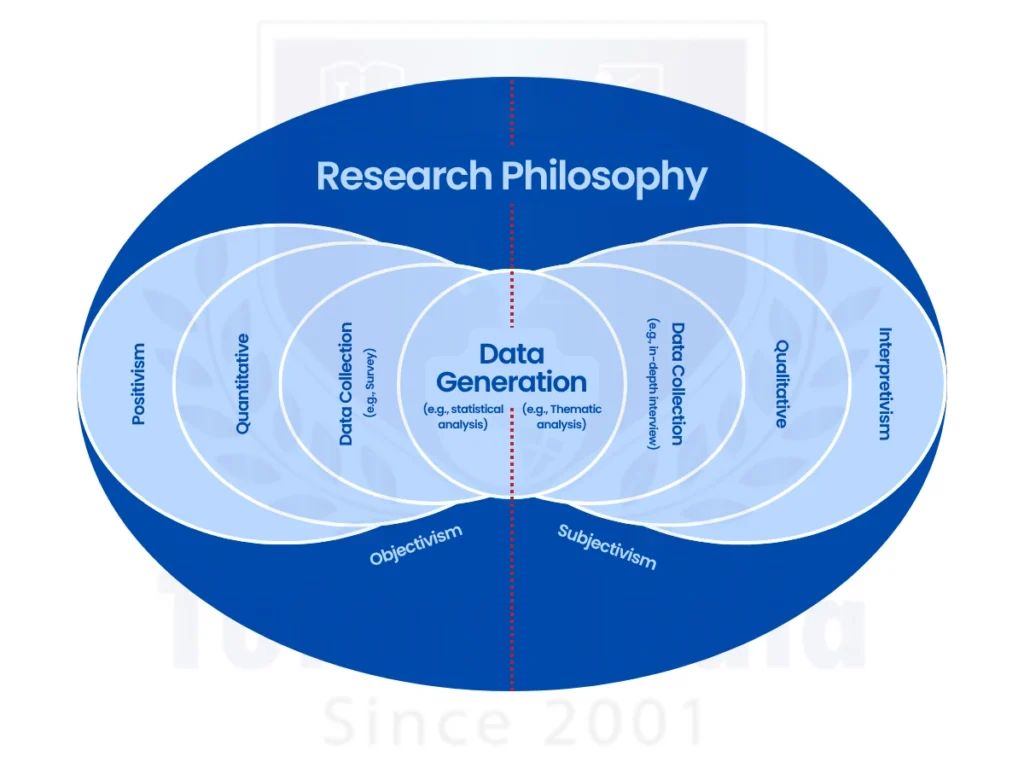
Research Philosophy: Research philosophy is an important aspect that determines how knowledge is viewed and constructed. For instance, in the UAE, positivism is used in engineering and science fields in universities such as Khalifa University, whereas interpretivism is used in social sciences in the American University of Sharjah. This distinction is critical in shaping research in research methodology practices.
Research Approach: This is based on the research philosophy. A deductive approach is used in theory testing, whereas an inductive approach is used in theory construction. Students in the UAE are encouraged to explain their choice based on research questions and academic expectations, often guided by thesis writing services.
4. Research Design and Data Collection
The research design operationalises the research. In the UAE, case studies are commonly used in business and policy research, while experimental design is commonly used in STEM disciplines. Surveys are also commonly used in research, especially in research that uses insights from the population of the UAE, such as in Dubai and Abu Dhabi.[4]
The methods of data collection need to be elaborated on, including how the instruments of collection are validated. For example, a structured questionnaire will need to prove its reliability and validity, often through pilot studies among the UAE population. In quantitative optimisation studies, advanced tools such as the response surface model may also be applied.
5. Sampling and Data Analysis
Sampling strategies must be tailored according to the scope of the research. In UAE-based research studies, cultural diversity is an essential factor. In addition, the UAE is a multilingual country. In this regard, the sampling strategies may include stratified sampling. [5]
The data analysis tools may vary according to the nature of the research. In quantitative research studies, statistical tools like SPSS or R programming may be used. In the case of qualitative research studies, thematic data analysis tools may be applied. The methodology section must clearly describe the data analysis process, especially when addressing research methodology challenges.
6. Ethical Considerations in the UAE Context
Ethical compliance is of major importance in the UAE, as there are strict institutional and government regulations. In most cases, approval from university ethics committees, as well as from some national committees, is required. Researchers need to deal with informed consent, privacy, and data protection in accordance with UAE laws.
Cultural sensitivity is another aspect of major importance. For instance, there are gender, privacy, and language factors that need to be taken into consideration in the collection of data. These ethical considerations are integral to Research Methodology for UAE PhD Dissertation development. [6]
7. Writing Style and Academic Expectations
Formal tone is used in writing the methodology section of the research paper. It is important that it is written in a way that is easily understandable by others, as they will be evaluating whether they can reproduce the research. It is important for UAE universities to follow international standards set by APA (American Psychological Association) and the Harvard Referencing System.[7]
It is important for students not to use descriptive writing in this section of the research paper. It is important for each, and every choice made in the methodology section of the research paper to be backed by scholarly sources. It adds credibility to the methodology.
8. Common Challenges Faced by UAE PhD Students
However, there are research methodology challenges that most doctoral students in the UAE face, such as a lack of access to data, cultural factors in accessing participants, and difficulties in selecting the most appropriate methodology. These challenges can be addressed by careful planning and consultation with supervisors.
The role of institutional support, workshops, and training programs provided by universities such as Zayed University is significant in helping students refine their methodology approaches. Additionally, external academic assistance, such as dissertation writing services and thesis writing services can support students in overcoming these barriers.
Conclusion
A well-structured Research Methodology for UAE PhD Dissertation is essential for conducting quality research in academia. This includes a clear understanding of research philosophy, research design, methods for collecting data, and ethics. By adhering to these guidelines, UAE students can develop high-quality research methodologies while effectively addressing research methodology challenges and contributing to excellence in research in research methodology.
How Should UAE Students Structure and Write Their PhD Research Methodology? [Talk to a Dissertation Expert | Book a Free 15-Minute Consultation]
References
- Ahmad H. R. (2016). How to write a Doctoral Thesis. Pakistan journal of medical sciences, 32(2), 270–273. https://doi.org/10.12669/pjms.322.10
- Nayak B. K. (2009). Why learn research methodology?. Indian journal of ophthalmology, 57(3), 173–174. https://doi.org/10.4103/0301-4738.49389
- Eldawlatly, A. A., & Meo, S. A. (2019). Writing the methods section. Saudi journal of anaesthesia, 13(Suppl 1), S20–S22. https://doi.org/10.4103/sja.SJA_805
- Paradis, E., O’Brien, B., Nimmon, L., Bandiera, G., & Martimianakis, M. A. (2016). Design: Selection of Data Collection Methods. Journal of graduate medical education, 8(2), 263–264. https://doi.org/10.4300/JGME-D-16-00098.1
- Szwarcwald C. L. (2023). National health surveys: overview of sampling techniques and data collected using complex designs. Epidemiologia e servicos de saude : revista do Sistema Unico de Saude do Brasil, 32(3), e2023431. https://doi.org/10.1590/S2237-96222023000300014.EN
- Hasan, H.E., Jaber, D., Khabour, O.F. et al.Ethical considerations and concerns in the implementation of AI in pharmacy practice: a cross-sectional study. BMC Med Ethics 25, 55 (2024). https://doi.org/10.1186/s12910-024-01062-8
- McRell, A. S., Wilson, B. L., & Levkoff, S. E. (2021). Writing Skills Development for Graduate Studies and Career Readiness in Science and Aging Fields: A Case Study Approach. Frontiers in public health, 9, 727064. https://doi.org/10.3389/fpubh.2021