
How Should UAE Students Structure and Write Their Master’s Research Methodology?
How Should UAE Students Structure and Write Their Master’s Research Methodology?
- Home
- How To Article
- How Should UAE Students Structure and Write Their Master’s Research Methodology?

How Should UAE Students Structure and Write Their Master’s Research Methodology?
Writing the chapter on research and methodology is considered one of the most critical phases of completing a master’s dissertation. For postgraduate students in the United Arab Emirates (UAE), the Research Methodology for UAE Master’s Dissertations must be clear and precise. Whether the student is enrolled in a government or a private university, which follows a British or American model, the student must ensure that the methodology adopted for the research is logical and appropriate for the UAE.[1]
The chapter on methodology describes the process adopted for conducting the research and the rationale for the methods adopted. It must be grounded in theory and practicality and should reflect the principles of research in research methodology.
1. Understanding UAE University Expectations
Assessment criteria for the methodology chapter of UAE universities include: [2]
- Clear link between research questions and research method
- Justification of research design
- Satisfying ethical considerations
- Cultural understanding
- Satisfying transparency criteria for analysis
Most universities in the UAE adopt the UK dissertation model, requiring students to justify the research method rather than describe the process. Students must also be aware of common research methodology challenges while structuring their dissertation methodology chapter.
2. Core Components of a master’s Research Methodology
A well-structured methodology chapter for a Research Methodology for UAE Master’s Dissertation should include the following sub-sections: [3]
Section | Purpose | Examiner Focus |
Research Design | Explains overall strategy | Logical alignment |
Research Approach | Qualitative, Quantitative, Mixed | Justification |
Data Collection | Tools and procedures | Suitability |
Sampling | Who and how selected | Representativeness |
Data Analysis | Techniques used | Accuracy |
Ethical Considerations | Consent and approval | Compliance |
Each section should clearly explain why the chosen method is appropriate for the research problem.
3. Choosing the Right Research Design
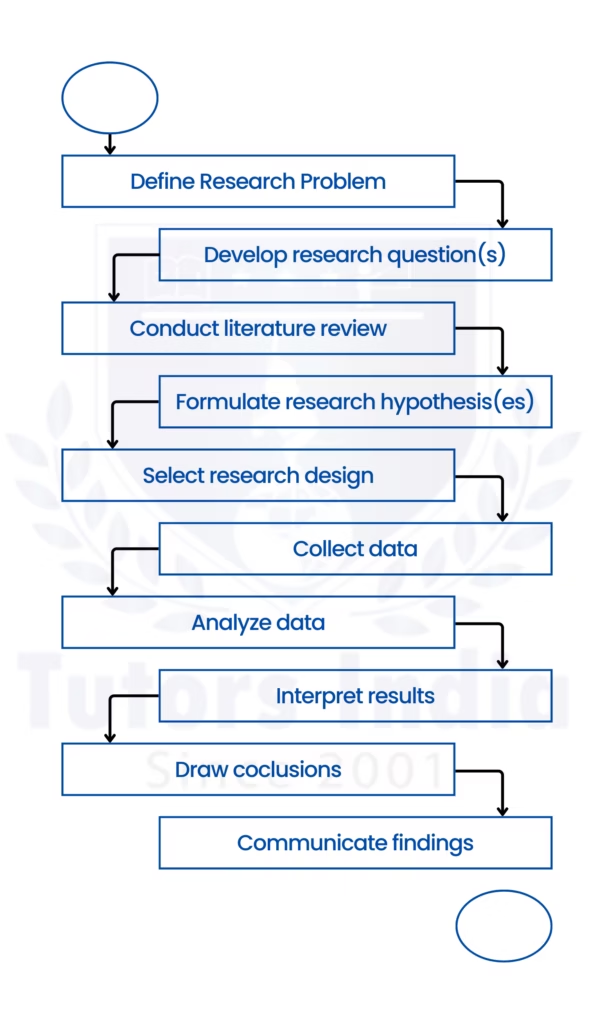
Students must first understand whether their research is:
- Qualitative (Interviews, Focus Groups, Case Studies)
- Quantitative (Surveys, Statistical Analysis)
- Mixed Methods (Combination of Quantitative and Qualitative)
This depends on:
- Nature of the research question
- Type of data needed
- Resources available
- Time constraints
For instance, students of education and business in the UAE may prefer surveys for quantitative research, whereas students of social science may prefer interviews for qualitative research.[4]
4. Data Collection Methods in the UAE Context
Some common tools for collecting data include |
|
The students are required to justify
|
|
When conducting research in the UAE, some factors to consider include |
|
These aspects are important when addressing potential research methodology challenges.
5. Ethical Considerations
- Ethical approval from the institution
- Informed consent from participants
- Participant confidentiality protection
- Secure data handling and storage
- Compliance with university research ethics guidelines.
6. Data Analysis Techniques
This content explains data analysis techniques used in research and methodology. It outlines how quantitative research uses statistical methods such as descriptive statistics, correlation, and regression, while qualitative research uses thematic analysis, content analysis, and coding. It also highlights the importance of stating the software used, analytical procedures, and the connection between analysis and the research question to ensure clarity and transparency.[5]
7. Common Mistakes and Practical Tips
Many master’s students in the UAE face problems in writing the methodology chapter due to: [6]
- Too descriptive writing
- Insufficient method justification
- Weak link between theory and methods
- Missing ethical approvals
Practical Tips
Define the research question before choosing the method
- Write methodology in the past tense
- Clearly justify chosen method
- Link sampling and analysis to the research question
- Seek supervisor guidance early
Students who face difficulties in structuring their dissertation may also seek academic assistance through dissertation writing services or thesis writing services to better understand the structure of research methodology chapters.
Conclusion
In the case of UAE master’s students, a good Research Methodology for UAE Master’s dissertations should be clear, logically argued, and highly compliant with academic and ethical standards. In this regard, the chapter should be clear and justifiable in terms of the research design, sampling, methods of data collection, and methods of analysing the collected data. This is because, if well-arranged and contextualised, the methodology not only ensures the validity of the research findings but also enhances the quality of the dissertation.
Through the understanding of institutional requirements, cultural sensitivity, and transparency in methodology, UAE students can develop a good and examination-ready research methodology chapter based on strong research in research methodology principles.
How Should UAE Students Structure and Write Their Master’s Research Methodology? [Talk to a Dissertation Expert | Book a Free 15-Minute Consultation]
References
- Eldawlatly, A. A., & Meo, S. A. (2019). Writing the methods section. Saudi journal of anaesthesia, 13(Suppl 1), S20–S22. https://doi.org/10.4103/sja.SJA_805_18
- Alalalmeh, S. O., Hegazi, O. E., Shahwan, M., Hassan, N., Humaid Alnuaimi, G. R., Alaila, R. F., Jairoun, A., Tariq Hamdi, Y., Abdullah, M. T., Abdullah, R. M., & Zyoud, S. H. (2024). Assessing mental health among students in the UAE: A cross-sectional study utilizing the DASS-21 scale. Saudi pharmaceutical journal : SPJ : the official publication of the Saudi Pharmaceutical Society, 32(4), 101987. https://doi.org/10.1016/j.jsps.2024.101987
- Willis L. D. (2023). How to Write the Methods Section of a Research Manuscript. Respiratory care, 68(12), 1763–1770. https://doi.org/10.4187/respcare.11437
- Teherani, A., Martimianakis, T., Stenfors-Hayes, T., Wadhwa, A., & Varpio, L. (2015). Choosing a Qualitative Research Approach. Journal of graduate medical education, 7(4), 669–670. https://doi.org/10.4300/JGME-D-15-00414.1
- Ali, Z., & Bhaskar, S. B. (2016). Basic statistical tools in research and data analysis. Indian journal of anaesthesia, 60(9), 662–669. https://doi.org/10.4103/0019-5049.190623
- Makin, T. R., & Orban de Xivry, J. J. (2019). Ten common statistical mistakes to watch out for when writing or reviewing a manuscript. eLife, 8, e48175. https://doi.org/10.7554/eLife.48175