
Types of Statistical Data Analysis for master’s Thesis in the Netherlands
Types of Statistical Data Analysis for master’s Thesis in the Netherlands
- Home
- How To Article
- Types of Statistical Data Analysis for master’s Thesis in the Netherlands

Types of Statistical Data Analysis for master’s Thesis in the Netherlands
In the context of the Netherlands, it is expected that the master’s thesis research conducted by students will reflect high analytical skills, methodological clarity, and academic precision. Statistical Data Analysis for Masters Thesis plays a significant role in achieving these academic standards, particularly in fields such as social sciences, economics, psychology, and business studies.[1]
Statistical analysis helps the researcher identify patterns, test hypotheses, and draw meaningful conclusions from available data. Students often combine quantitative research methodology, qualitative research methodology, or even mixed methodology research in Masters thesis projects to validate their research findings.[2]
1. Importance of Statistical Data Analysis in Dutch Master’s Research
Statistical data analysis ensures that the research findings are reliable, valid, and scientifically defendable. Universities in the Netherlands require students to show their proficiency in using data analysis tools like SPSS, R, Python, or Stata in their research.[3]
The key reasons why statistical analysis is important in research include:
- Interpreting raw data to gain meaningful insights
- Testing hypotheses or theoretical constructs
- Supporting research findings with empirical evidence
- Ensuring research findings have credibility
These analytical processes form a crucial component of quantitative research methodology, which is widely applied in master’s research. Students who require guidance in performing complex analyses often seek master’s dissertation help or academic support while preparing their thesis.
2. Descriptive Statistical Analysis
Descriptive statistics are methods of summarising and structuring the data to obtain an overview of the information. [4]
The most common methods of using descriptive statistics are as follows:
- Mean (average)
- Median (middle value of the dataset)
- Mode (most common value)
- Standard deviation (spread of the data)
- Frequency distributions
Researchers use descriptive statistics to understand the characteristics of data before performing advanced statistical analysis. These techniques are commonly used in quantitative research methodology to summarise numerical datasets.
3. Inferential Statistical Analysis
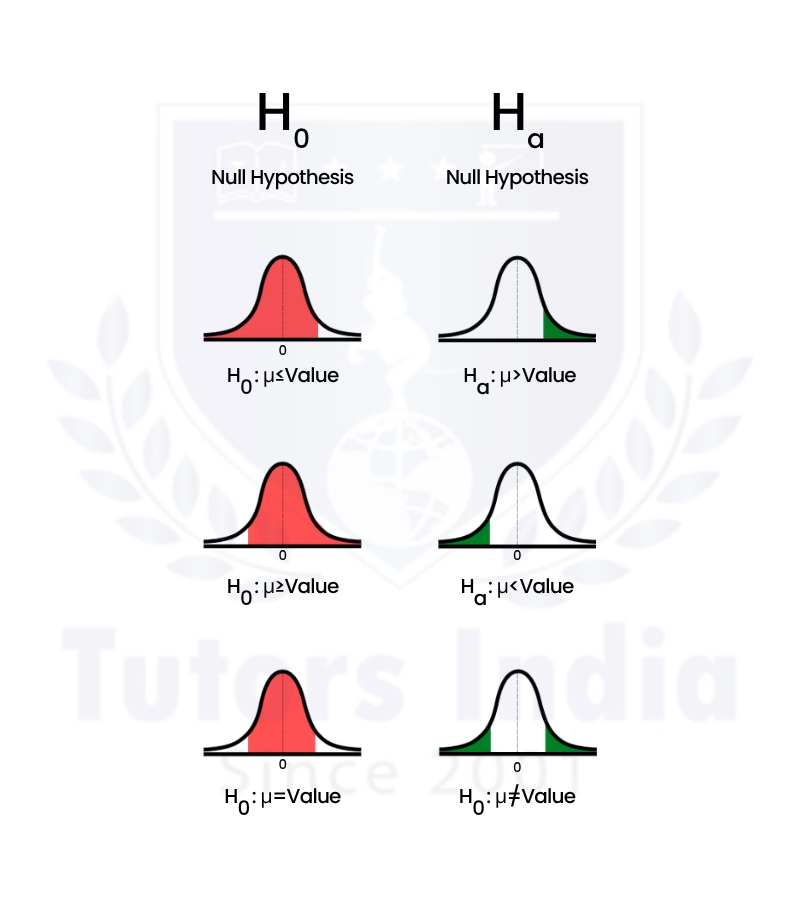
Inferential statistics allow us to make conclusions or inferences about the population. This type of statistic includes tests that allow us to test our hypothesis, as well as compare data relationships.
The types of tests that are considered inferential statistics include:
- T-tests – This is used to compare two different groups
- Analysis of variance (ANOVA) – This is used to compare multiple groups
- Chi-square tests – This is used to compare relationships between data
- Confidence intervals – This is used to determine the reliability of our data
Regression models help researchers understand predictive relationships between variables. Many students preparing empirical dissertations often seek master’s dissertation help or master’s thesis writing services to ensure their statistical models are correctly applied.
Selecting a design should depend on the research question, availability of data, and the overall aim of the dissertation.
4. Regression Analysis in master’s Theses
Regression analysis is used to study the association between dependent and independent variables. Regression analysis is often used in business, economics, and social sciences. [5]
The most used regression analysis techniques are:
- Simple Linear Regression – Studies the association between two variables
- Multiple Regression – Studies multiple independent variables
- Logistic Regression – Studies binary outcome variables
Regression analysis helps in identifying the predictive association between the variables and measuring the strength of the association
5. Multivariate Statistical Techniques
Multivariate analysis is used for complex data sets with many variables. These are normally used in advanced research.
Examples of multivariate analysis include:
- Factor Analysis – Used to find underlying variables or factors
- Principal Component Analysis (PCA) – Used to reduce complex data sets
- Cluster Analysis – Used to group similar data points together
- MANOVA – Used to find differences in many dependent variables
These techniques are often used in marketing research, psychology studies, and business analytics projects. In many cases, they are applied in mixed methodology research in Masters thesis, where both qualitative and quantitative data are analysed.
6. Choosing the Right Statistical Method
Selecting the correct statistical analysis method depends on several factors.[6]
Factors Influencing Statistical Method Selection
Factor | Description | Example |
Research Question | Determines the type of analysis needed | Relationship or comparison |
Data Type | Numerical, categorical, ordinal | Survey responses |
Sample Size | Influence on the reliability of results | Large vs small dataset |
Research Design | Experimental or observational | Survey study |
Students should ensure that the statistical methods align with their hypotheses and the structure of their data.
Conclusion
Statistical data analysis is a key component of master’s thesis research in the Netherlands. Proper Statistical Data Analysis for Masters Thesis helps students interpret raw data and support their research objectives. Methods such as descriptive statistics, inferential testing, regression analysis, and multivariate analysis enable researchers to produce evidence-based conclusions. These techniques are essential in quantitative research methodology, while complex studies may apply mixed methodology research in Masters thesis. Students seeking support often use Masters thesis writing services or masters dissertation help to ensure their statistical analysis meets academic standards and improves the quality of their thesis.
Types of Statistical Data Analysis for master’s Thesis in the Netherlands [Talk to a Dissertation Expert | Book a Free 15-Minute Consultation]
References
- Debusho, L. K., Mashabela, M. R., Sebatjane, P. N., Sithole, S., Tabo, B., & Rapoo, E. M. (2025). Evaluation of statistical methods applied in theses and dissertations in an Open, Distance and e-Learning University. PloS one, 20(3), e0319654. https://doi.org/10.1371/journal.pone
- Augusteijn, H. E. M., Wicherts, J. M., Sijtsma, K., & van Assen, M. A. L. M. (2026). Assessing Questionable and Responsible Research Practices in Psychology Master’s Theses. Behavioral sciences (Basel, Switzerland), 16(1), 110. https://doi.org/10.3390/bs16010110
- Hiemstra, B., Keus, F., Wetterslev, J., Gluud, C., & van der Horst, I. C. C. (2019). DEBATE-statistical analysis plans for observational studies. BMC medical research methodology, 19(1), 233. https://doi.org/10.1186/s12874-019-0879-5
- Cooksey R. W. (2020). Descriptive Statistics for Summarising Data. Illustrating Statistical Procedures: Finding Meaning in Quantitative Data , 61–139. https://doi.org/10.1007/978-981-15-2537-7_5
- Bzovsky, S., Phillips, M. R., Guymer, R. H., Wykoff, C. C., Thabane, L., Bhandari, M., Chaudhary, V., & R.E.T.I.N.A. study group (2022). The clinician’s guide to interpreting a regression analysis. Eye (London, England), 36(9), 1715–1717. https://doi.org/10.1038/s41433-022-01949-z
- Nayak, B. K., & Hazra, A. (2011). How to choose the right statistical test?. Indian journal of ophthalmology, 59(2), 85–86. https://doi.org/10.4103/0301-4738.77005