
What Are the Different Sampling Techniques in Research and How Do You Choose the Right One for a UK Dissertation?
What Are the Different Sampling Techniques in Research and How Do You Choose the Right One for a UK Dissertation?
- Home
- How To Article
- What Are the Different Sampling Techniques in Research and How Do You Choose the Right One for a UK Dissertation?

What Are the Different Sampling Techniques in Research and How Do You Choose the Right One for a UK Dissertation?
Sampling techniques are an integral part of Sampling Techniques in UK Research Methodology, and they play a significant role in determining the way participants or data points are sampled from a larger population. Sampling techniques have a direct impact on the validity, reliability, and generalisability of research findings. In quantitative and qualitative research, it is very important for researchers to select appropriate sampling methods to ensure accurate representation of research findings for a targeted population or research phenomenon.[1]
UK-based universities often require students to justify their sampling techniques in the methodology chapter of research. When learning how to write a research methodology, students must clearly explain the reason for using a specific sampling technique based on the research objectives and constraints.
1. Understanding Sampling in Research
Sampling is defined as the process of choosing a group of people or information from a large population and representing it for use in research. In most cases, it is impossible for researchers to work with the entire population of interest. Thus, they use sampling methods for effective and convenient research. Sampling represents the characteristics of the targeted population. [2]
- Sampling reduces research costs and time
- Sampling allows for statistical analysis and generalization
- Sampling improves research feasibility
There are different sampling methods for use in research, and they are categorized into probability and non-probability sampling.
2. Probability Sampling Techniques
Probability sampling techniques use random selection, ensuring that every member of the population has an equal or known chance of being selected. These techniques are commonly used in quantitative research and statistical analysis. [3]
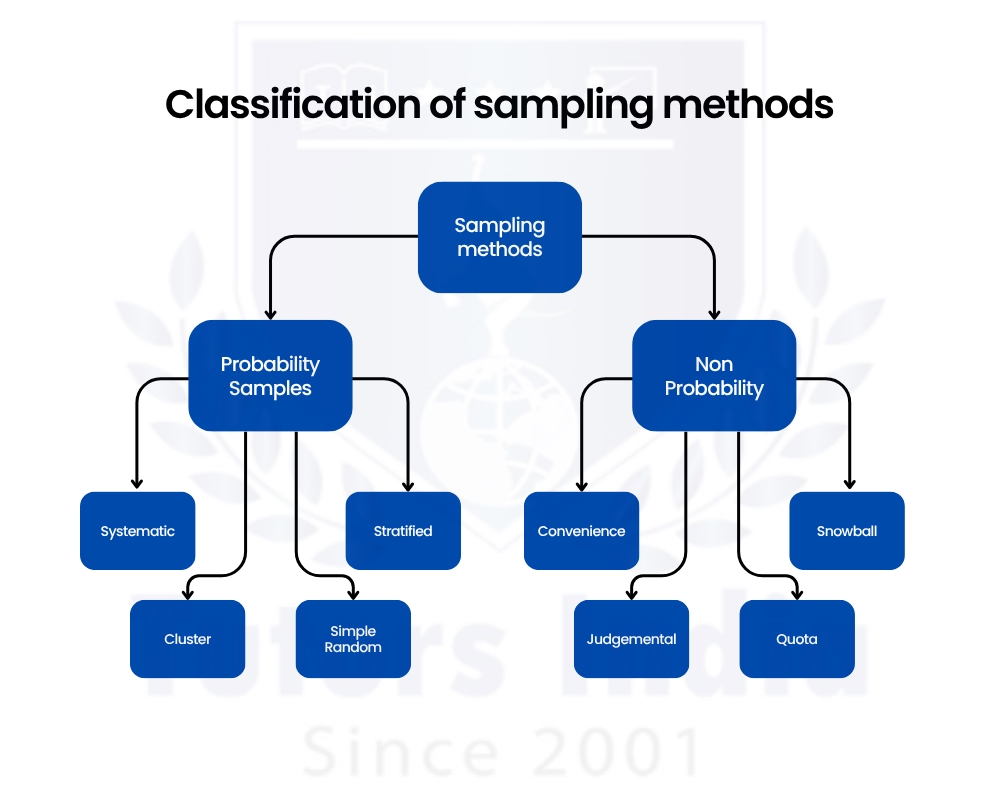
2.1. Common Probability Sampling Methods
| Sampling Method | Description | Example |
| Simple Random Sampling | Every member of the population has an equal chance of selection. | Randomly selecting students from a university database |
| Systematic Sampling | Selecting every nth participant from a list. | Choosing every 10th student from the enrolment records |
| Stratified Sampling | Population divided into subgroups (strata) and sampled proportionally. | Sampling male and female students separately |
| Cluster Sampling | Population divided into clusters, and random clusters are selected. | Selecting specific universities as clusters |
Advantages of probability sampling:
- Reduces sampling bias
- Allows statistical generalisation
- Supports quantitative data analysis
However, these techniques may require large population lists and complex data management.
3. Non-Probability Sampling Techniques
Non-probability sampling techniques are widely used in qualitative research and exploratory studies where statistical representation is not the primary goal.[4]
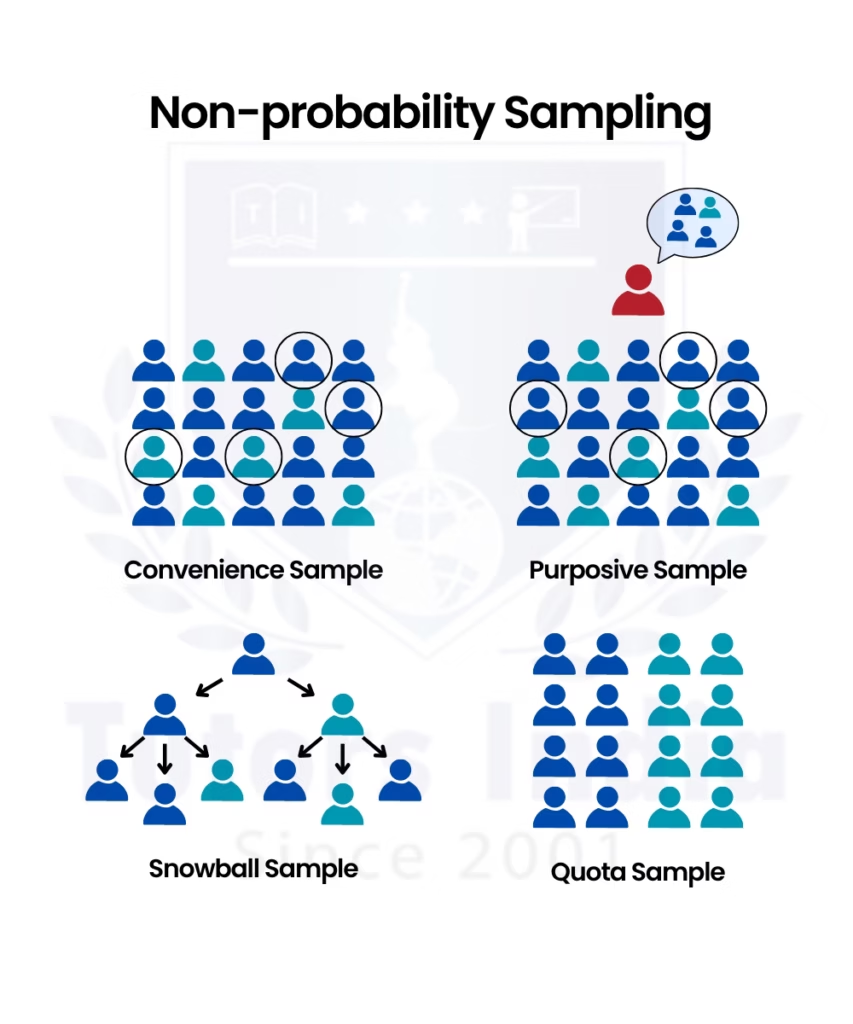
3.1. Common Non-Probability Sampling Methods
| Sampling Method | Description | Example |
| Convenience Sampling | Selecting participants who are easily accessible. | Surveying classmates |
| Purposive Sampling | Selecting participants with specific characteristics. | Interviewing experienced healthcare professionals |
| Snowball Sampling | Existing participants recruit new participants. | Recruiting participants through referrals |
| Quota Sampling | Ensuring a fixed number of participants from specific groups. | Sampling equal numbers of different age groups |
Advantages of non-probability sampling:
- Easier and faster to implement
- Suitable for qualitative research
- Useful for hard-to-reach populations
However, findings may not always be generalisable to the wider population.
4. Factors to Consider When Choosing a Sampling Technique
The selection of the most appropriate sampling method for a dissertation in the UK involves the careful consideration of several research factors. [5]
- Research objectives: Research that aims to be exploratory in nature will use qualitative sampling.
- Research design: Research that aims to be quantitative in nature will require probability sampling.
- Size of the population: Research that involves a large population will require stratified or cluster sampling.
- Availability of time and resources: Research that requires time will require convenience sampling.
- Access to the population: Research that requires access to a hard-to-reach population will require snowball sampling.
Understanding these factors is an essential part of learning how to write a research methodology effectively.
5. Comparing Sampling Techniques for Dissertation Research
| Criteria | Probability Sampling | Non-Probability Sampling |
| Selection method | Random selection | Non-random selection |
| Research type | Quantitative | Qualitative |
| Generalisability | High | Limited |
| Complexity | Higher | Lower |
| Cost and time | More resource-intensive | Faster and cheaper |
6. Practical Steps for Choosing the Right Sampling Technique
Students working on their dissertations in the UK need to adopt a systematic process in selecting their sampling strategy.
- Well-defined population to be researched.
- Deciding on the research approach to be adopted (quantitative, qualitative, or mixed).
- Deciding on the sample size to be selected for analysis.
- Assessing the feasibility of accessing the population or sources.
- Justifying the selected sampling strategy in the methodology chapter.
A well-justified sampling strategy strengthens the overall Sampling Techniques in UK Research Methodology and improves research credibility.
Conclusion
The use of sampling techniques is very important in the design and execution of research in UK dissertations. Probability sampling techniques, including the random sampling method, are highly useful in quantitative research because they provide statistical reliability. On the other hand, non-probability sampling techniques, such as the convenience sampling method, are often applied in qualitative and exploratory research. Therefore, by choosing and justifying the most appropriate sampling technique, the research carried out in a dissertation can be validated in terms of its quality and reliability.
What Are the Different Sampling Techniques in Research and How Do You Choose the Right One for a UK Dissertation? [Talk to a Dissertation Expert | Book a Free 15-Minute Consultation]
References
- Setia M. S. (2016). Methodology Series Module 5: Sampling Strategies. Indian journal of dermatology, 61(5), 505–509. https://doi.org/10.4103/0019-5154.190118
- Luborsky, M. R., & Rubinstein, R. L. (1995). Sampling in Qualitative Research: Rationale, Issues, and Methods. Research on aging, 17(1), 89–113. https://doi.org/10.1177/0164027595171
- Tyrer, S., & Heyman, B. (2016). Sampling in epidemiological research: issues, hazards and pitfalls. BJPsych bulletin, 40(2), 57–60. https://doi.org/10.1192/pb.bp.114.0502
- Turban, J. L., Almazan, A. N., Reisner, S. L., & Keuroghlian, A. S. (2023). The Importance of Non-Probability Samples in Minority Health Research: Lessons Learned from Studies of Transgender and Gender Diverse Mental Health. Transgender health, 8(4), 302–306. https://doi.org/10.1089/trgh.2021.0132
- Williams, D. N., & Williams, K. A. (2020). Sample Size Considerations: Basics for Preparing Clinical or Basic Research. Annals of nuclear cardiology, 6(1), 81–85. https://doi.org/10.17996/anc.20-00122