
Why Is Sampling Strategy Critical for Valid and Reliable Results in a USA Management Dissertation?
Why Is Sampling Strategy Critical for Valid and Reliable Results in a USA Management Dissertation?
- Home
- How To Article
- Why Is Sampling Strategy Critical for Valid and Reliable Results in a USA Management Dissertation?
Table of Content
- Understanding Sampling in Management Research
- Types of Sampling Methods in Management Research
- Role of Sampling Strategy in Research Validity
- Impact of Sampling on Reliability
- Key Sampling Considerations in USA Management Dissertations
- Determining Appropriate Sample Size
- Common Sampling Errors in Dissertation Research
- Strategies for Improving Sampling Quality
- Conclusion

Why Is Sampling Strategy Critical for Valid and Reliable Results in a USA Management Dissertation?
One of the most technically challenging elements of a management dissertation within the United States is the sampling strategy. The sampling strategy has a direct impact on the validity, reliability, and generalizability of the findings of the research. In Sampling Techniques in USA Masters Dissertation, the correct selection of sampling technique in research plays an essential role in ensuring scientific accuracy. For management research, it is common for the research to focus on organisational behaviour, leadership styles, marketing trends, and business strategies. The selection of appropriate sampling methods ensures that the findings of the research accurately reflect the larger population. [1]
If the sampling strategy is not properly selected, it can have a negative impact on the findings of the research, making it invalid and potentially causing the dissertation to be rejected. It is therefore necessary for the researcher to have a good understanding of the theoretical and conceptual foundations of the sampling strategy to produce scientifically valid research findings.[2]
1. Understanding Sampling in Management Research
Sampling can be defined as the selection of a small number of people, organisations, or data from the general population. Researching the entire population is often not feasible, which is why sampling methods are used as an alternative.[3]
- Managers of businesses
- Employees of organisations
- Executives of firms
- Customers
- Firms operating in a particular industry
A well-designed sample ensures that the results obtained can be generalised to the population.
2. Types of Sampling Methods in Management Research
Sampling strategies are broadly classified as probability sampling and non-probability sampling.
Probability Sampling | Non-Probability Sampling |
Probability sampling is a group of methods where every element of the population is offered a known probability of being sampled.
The above methods increase statistical validity and reduce sampling bias. | This is a group of methods where every element of the population is not offered a known probability of being sampled.
|
The use of probability sampling technique increases statistical validity and reduces sampling bias in management research.
3. Role of Sampling Strategy in Research Validity
The sampling strategy has a significant effect on internal validity and external validity. Internal validity means the research design can measure what it sets out to measure. External validity means the research can generalise the findings beyond the research itself. [4]
- Reducing selection bias
- Ensuring an accurate reflection of the population
- Ensuring the research controls confounding variables correctly
For example, in a dissertation on leadership style, where only one organization is used as the basis of the research, the results may not reflect overall management style.
4. Impact of Sampling on Reliability
Reliability refers to the consistency of research results if the research is replicated under similar conditions.
- It helps to make measurements stable
- It minimises errors in the sample
- It makes the results replicable
- It makes the results consistent statistically
Statistical formulas can be used to determine the sample size for the purpose of reliability.
5. Key Sampling Considerations in USA Management Dissertations
The table below summarises critical sampling considerations in management research.
Sampling Factor | Description | Research Impact |
Population definition | Clearly identifying the target population | Ensures research relevance |
Sampling frame | List or database of population elements | Improves selection accuracy |
Sample size | Number of observations selected | Affects statistical power |
Sampling technique | Method used to select participants | Influences bias and validity |
Response rate | Percentage of completed responses | Determines data reliability |
Careful planning of sampling methods helps researchers design robust and reliable research frameworks.
6. Determining Appropriate Sample Size
The determination of the correct sample size is vital to the accuracy of the statistics. In determining this, the following factors can be considered: [5]
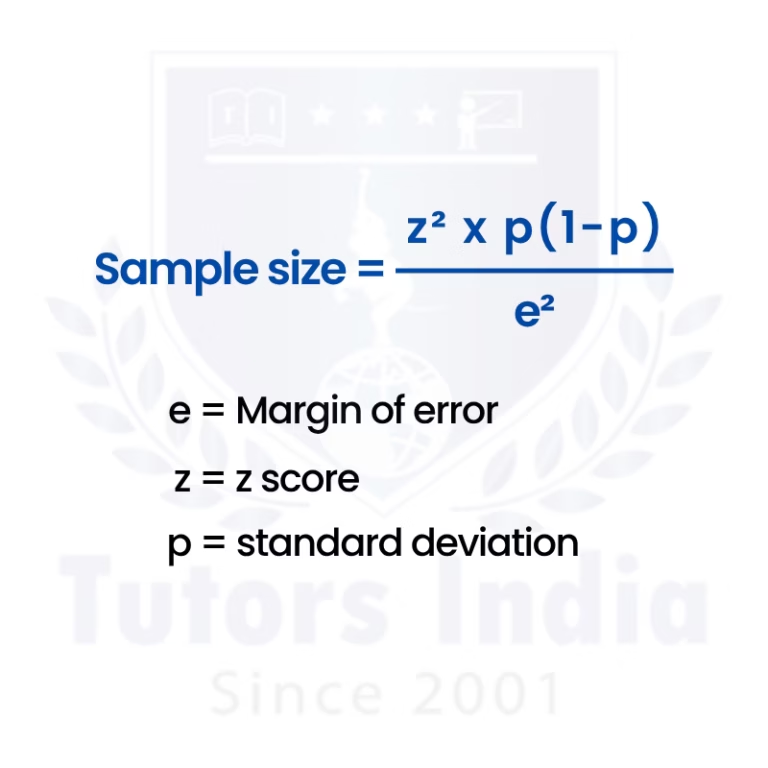
- Size of the population
- Confidence level (most often 95%)
- Margin of error
- Expected variations in responses
The most common statistical tools that can be used in a management dissertation include:
- Cochran’s sample size formula
- Power analysis
- Statistical software packages (SPSS, R, Stata)
If the sample size is too low, the findings may not be accurate, while too large a sample may not be analytically necessary and can be wasteful.
7. Common Sampling Errors in Dissertation Research
Many management dissertations experience sampling issues that affect the conclusions drawn in the research.
The common sampling mistakes in management research include:
- Selecting participants based on their accessibility
- Using a small sample size
- Not clearly defining the target population
- Not considering the responses
- Mixing different sampling techniques
The above-listed mistakes can affect the scientific conclusions drawn in research.
8. Strategies for Improving Sampling Quality
It is possible for researchers to enhance the rigour of sampling through the following measures: [6]
- Specifying research populations
- Applying probability sampling technique when possible, Carrying out pilot research prior to actual research
- Calculating statistically valid sample sizes
- Disclosing sampling procedures transparently
Through these measures, it is possible for research designs to match academic norms for doctoral and graduate work in the United States.
Conclusion
Sampling strategy assumes critical importance in ensuring the scientific quality of management dissertation research in the United States. By applying appropriate sampling technique in research, the validity and reliability of research findings can be significantly improved.
A well-designed sampling strategy strengthens the overall methodology and credibility of the dissertation. In Sampling Techniques in USA Masters Dissertation, proper application of probability sampling technique and non-probability sampling techniques helps produce accurate and reliable research outcomes.
Researchers who require additional methodological guidance sometimes explore academic resources such as MBA thesis writing services or thesis writing services to support the development of robust research designs.
Why Is Sampling Strategy Critical for Valid and Reliable Results in a USA Management Dissertation? [Talk to a Dissertation Expert | Book a Free 15-Minute Consultation]
References
- Palinkas, L. A., Horwitz, S. M., Green, C. A., Wisdom, J. P., Duan, N., & Hoagwood, K. (2015). Purposeful Sampling for Qualitative Data Collection and Analysis in Mixed Method Implementation Research. Administration and policy in mental health, 42(5), 533–544. https://doi.org/10.1007/s10488-013-0528-y
- Campbell, S., Greenwood, M., Prior, S., Shearer, T., Walkem, K., Young, S., Bywaters, D., & Walker, K. (2020). Purposive sampling: complex or simple? Research case examples. Journal of research in nursing : JRN, 25(8), 652–661. https://doi.org/10.1177/1744987120927206
- Martínez-Mesa, J., González-Chica, D. A., Duquia, R. P., Bonamigo, R. R., & Bastos, J. L. (2016). Sampling: how to select participants in my research study?. Anais brasileiros de dermatologia, 91(3), 326–330. https://doi.org/10.1590/abd1806-4841.20165254
- Suresh, K., Thomas, S. V., & Suresh, G. (2011). Design, data analysis and sampling techniques for clinical research. Annals of Indian Academy of Neurology, 14(4), 287–290. https://doi.org/10.4103/0972-2327.91951
- Althubaiti A. (2022). Sample size determination: A practical guide for health researchers. Journal of general and family medicine, 24(2), 72–78. https://doi.org/10.1002/jgf2.600
- Moser, A., & Korstjens, I. (2018). Series: Practical guidance to qualitative research. Part 3: Sampling, data collection and analysis. The European journal of general practice, 24(1), 9–18. https://doi.org/10.1080/13814788.2017.1375091