
What Are the Different Research Design Techniques and How Do You Choose the Best One for Your UK Master’s Dissertation?
What Are the Different Research Design Techniques and How Do You Choose the Best One for Your UK Master’s Dissertation?
- Home
- How To Article
- What Are the Different Research Design Techniques and How Do You Choose the Best One for Your UK Master’s Dissertation?

What Are the Different Research Design Techniques and How Do You Choose the Best One for Your UK Master’s Dissertation?
The selection of the appropriate research design for master’s dissertation is one of the most important decisions that one must make in the process of writing a UK master’s dissertation. UK universities grade master’s dissertations based on research aims clarity, research design justification, research analytical rigour, and research theory-methods coherence. An effective research design enables one to answer the research question effectively while meeting the institutional grading criteria. This article discusses different research design examples, including qualitative research methodology, quantitative research methodology, experimental research design, and descriptive research design, and explains how to choose the most appropriate one for a UK master’s dissertation.[1]
1. Understanding Research Design in UK Master’s Dissertations
Research design can be defined as the overall strategy for conducting research, which integrates research questions, data collection, and analysis. In the UK, research design for master’s dissertation must be justified when conducting research at any higher learning institution, such as the University of Oxford and the University of Manchester.
- It must align with research goals and objectives
- It must be theoretically and methodologically justified
- It must display ethical sensitivity
- It must ensure reliability and validity, or trustworthiness, for qualitative research
Research questions and research design must have some level of coherence for the data collected to meet the standards. [2]
2. Major Research Design Techniques
Mixed Methods Research Design
Mixed methods incorporate the use of both qualitative research methodology and quantitative research methodology in a single research design. [3]
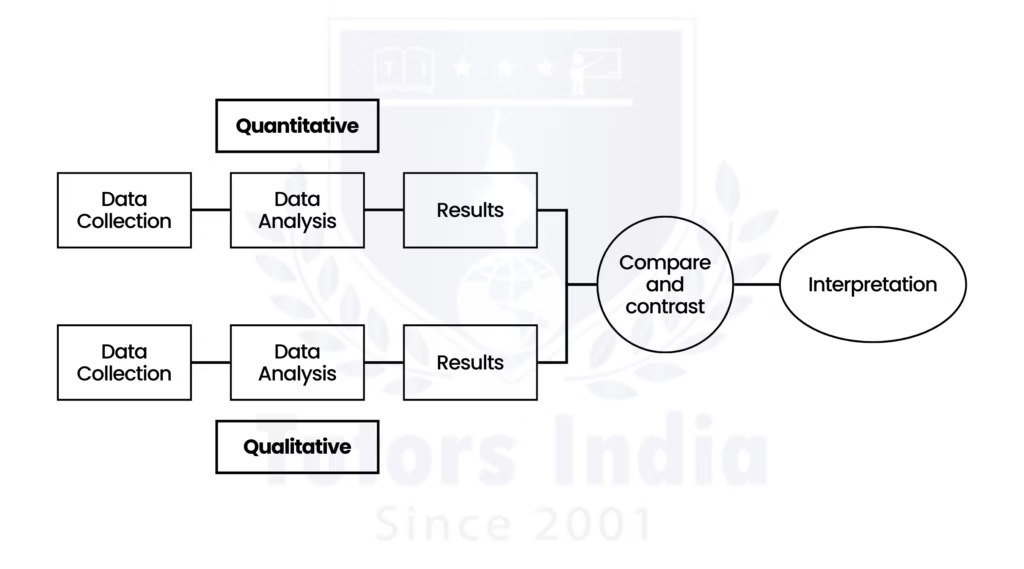
Mixed methods incorporate the use of both quantitative and qualitative methods in a single research.
Key characteristics
- Mixture of numerical and textual data
- Conducting data collection sequentially or concurrently
- Triangulation of data
Advantages | Limitations |
|
|
3. Comparing Research Design Approaches
| Research Design | Data Type | Sample Size | Strength | Limitation |
| Quantitative | Numerical | Large | Statistical reliability | Limited depth |
| Qualitative | Textual/Descriptive | Small | Rich insights | Limited generalisation |
| Mixed Methods | Both | Moderate | Comprehensive analysis | Complex design |
This comparison highlights how each design serves different research objectives.
4. How to Choose the Best Research Design
The selection of the appropriate design format for a research design for master’s dissertation depends on the following factors: [4]
Nature of Research Question
- “What is the relationship between X and Y?” → Quantitative
- “How do participants experience X?” → Qualitative
- “What and why?” → Mixed methods
Disciplinary Expectations
In the UK, certain programs may have certain expectations in terms of research methodologies. For example, business and finance programs may require quantitative research methodology, while education and social science programs may prefer qualitative research methodology or descriptive research design.
Available Resources
The research should not be affected by time constraints or participant availability.
Ethical Considerations
The research should not involve human participants.
Supervisor Guidance
It is important to consult supervisors to ensure that the research is in line with their expectations and the marking scheme.
5. Common Mistakes to Avoid
Students make avoidable methodological mistakes, including:
- Selecting a method before establishing research questions
- Failing to justify the research methods adopted
- Ignoring the limitations of the research methods adopted
- Overcomplicating the mixed methods approach
- Poor alignment between the research theory and the research approach adopted
UK examiners prefer clarity, coherence, and critical reasoning over methodological complexity when evaluating a research design for a master’s dissertation.
Conclusion
Choosing an appropriate and suitable research design for a master’s dissertation is of critical importance in creating a successful master’s dissertation in the UK. Regardless of whether students use quantitative research methodology, qualitative research methodology, experimental research design, or descriptive research design, they must match the research question with the theoretical framework and the methods of data collection. After critically evaluating the nature of the research question and available resources, students can select an appropriate research design example to meet the assessment criteria of the academic institution.
What Are the Different Research Design Techniques and How Do You Choose the Best One for Your UK Master’s Dissertation? [Talk to a Dissertation Expert | Book a Free 15-Minute Consultation]
References
- (2024, October 7). Choosing the research design and methodology for your dissertation. Statistics Solutions. https://www.statisticssolutions.com/choosing-the-research-design-and-methodology-for-your-dissertation-a-guide-for-your-dissertation/
- Harsoor, S. S., Panditrao, M. M., Rao, S., Bajwa, S. J. S., Sahay, N., & Tantry, T. P. (2022). Dissertation writing in post graduate medical education. Indian journal of anaesthesia, 66(1), 34–46. https://doi.org/10.4103/ija.ija_1106_21
- Chidambaram, A. G., & Josephson, M. (2019). Clinical research study designs: The essentials. Pediatric investigation, 3(4), 245–252. https://doi.org/10.1002/ped4.12166
- Mellis C. M. (2020). How to choose your study design. Journal of paediatrics and child health, 56(7), 1018–1022. https://doi.org/10.1111/jpc.14929