
How to Write a Master’s Manuscript: A Step-by-Step Guide
How to Write a Master’s Manuscript: A Step-by-Step Guide
- Home
- How To Article
- How to Write a Master’s Manuscript: A Step-by-Step Guide
Table of Content
- Understanding Institutional Requirements
- Defining a Clear Research Problem
- Conducting a Comprehensive Literature Review
- Developing a Robust Methodology
- Presenting Results Clearly
- Writing the Discussion and Conclusion
- Standard Master’s Manuscript Structure
- Editing and Proofreading the Manuscript
- Conclusion

How to Write a Master’s Manuscript: A Step-by-Step Guide
A master’s degree manuscript reflects the researcher’s academic development, research capability, mastery of the subject, and analytical communication ability. An organised manuscript that has followed a formal publication process demonstrates good research and compliance with university guidelines. This guide outlines each key step to producing a quality master’s manuscript and highlights the importance of manuscript editing for UK master’s dissertations to ensure academic quality and submission readiness.[1]
1. Understand Institutional Requirements
Review your institution’s manuscript, or thesis/dissertation; evaluate by:
- Word limits
- Format (font/spacing/margins)
- References styles (APA, Harvard | MLA | Chicago)
- Deadline for submission
- Ethics approval (needed)
A clear understanding of each of these factors aids in compliance and will reduce the potential for technical problems that could affect your final grade. Reviewing a Master’s manuscript PDF or a Master’s manuscript example can also help students understand formatting and structural expectations.
2. Define a Clear Research Problem
A strong manuscript begins with a focused research question or a problem statement. Your research problem should meet the following criteria: [2]
- Address a gap in the current literature
- Be feasible to do within your available time and resources
- Be consistent with your academic discipline
- Be focused and include measurable outcomes
The clearly defined problem helps to define the structure of the complete manuscript and ensures alignment with academic standards often required by best manuscript assessment UK guidelines.
3. Conduct a Comprehensive Literature Review
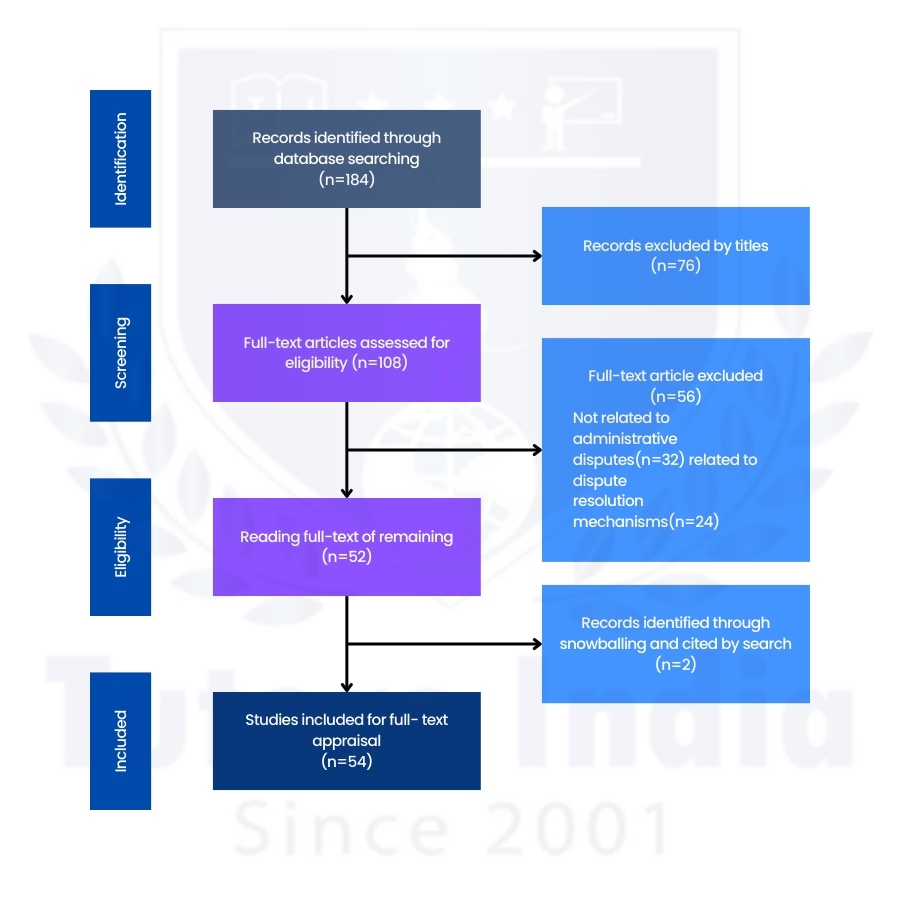
Your Literature Review should demonstrate that you understand what has been researched before by providing evidence of:
- A summary of key debates and theories
- An evaluation of the quality of previous research through critical analysis
- The gaps that will be filled by your research
- The creation of a conceptual framework
The Literature Review should not simply provide descriptions but should provide both comparisons and syntheses of the research collected. Reviewing a Master’s manuscript assessment example can guide students in structuring a strong literature review. [3]
4. Develop a Robust Methodology
The methodology chapter describes the way the research was conducted. It comprises:
| A good methodology should contain:
|
The examiners will consider whether your chosen methods adequately address the research objectives, which is a key evaluation area in many best manuscript writing services and academic review processes.
5. Present Results Clearly
Tables, graphs, statistical summaries, and sometimes even a descriptive point system are the means for presenting results in a clear and organised fashion (interpretative statements will occur in the corresponding ‘Discussion’ section). Visuals must be appropriately labelled and referenced in writing.
6. Write the Discussion and Conclusion
This discussion links your findings with the literature review and includes: [4]
- An explanation of your most important results.
- A comparison of your results with previous studies.
- An identification of any theoretical or practical implications arising out of your research.
- An acknowledgement of any limitations or weaknesses of your study.
The conclusion will summarise your contributions, make recommendations, and suggest future research. Many students seek UK dissertation writing services or dissertation proposal writing services for guidance at this stage.
7. Standard Master’s Manuscript Structure
Chapter | Purpose | Key Focus |
Introduction | Introduce the research problem | Background, aims, objectives |
Literature Review | Review existing studies | Critical evaluation, research gap |
Methodology | Explain the research design | Methods, ethics, analysis plan |
Results | Present findings | Data presentation |
Discussion | Interpret findings | Comparison, implications |
Conclusion | Summarise contributions | Recommendations, future research |
8. Edit and Proofread Thoroughly
Editing will help you write an essay that is both clear and logical. When reviewing your essay, consider grammar and spelling, how well your arguments flow, whether you accurately referenced your sources, and whether your document is consistently formatted. After completing your essay, obtain feedback from a peer reviewer or supervisor before submitting your final draft. Many students also explore the best manuscript writing services to refine their work. [5]
Final Checklist Before Submission
- All chapters completed
- Ethical approval documented (if applicable)
- Tables and figures correctly formatted
- References complete and consistent
- Word count within limits
Conclusion
To create a master’s manuscript, one must plan meticulously, engage critically with literature, apply strong methodological rigour, and present research data in a clear and structured manner. This requires a systematic approach: define an explicit research problem, research thoroughly, justify the selected methodology, and present results logically to generate an academic manuscript that meets minimum academic standards and demonstrates scholarly competence. Using reliable Master’s manuscript examples and seeking appropriate academic support can significantly enhance the overall quality and success of the final submission.
How to Write a Master’s Manuscript: A Step-by-Step Guide [Talk to a Dissertation Expert | Book a Free 15-Minute Consultation]
References
- Poldiak, N. P., & Crossley, N. (2025). How to Write a Successful Research Manuscript: Back to Basics. HCA healthcare journal of medicine, 6(2), 193–203. https://doi.org/10.36518/2689-0216.1715
- Covvey, J. R., McClendon, C., & Gionfriddo, M. R. (2024). Back to the basics: Guidance for formulating good research questions. Research in social & administrative pharmacy : RSAP, 20(1), 66–69. https://doi.org/10.1016/j.sapharm.2023.09.009
- Goodfellow L. T. (2023). An Overview of How to Search and Write a Medical Literature Review. Respiratory care, 68(11), 1576–1584. https://doi.org/10.4187/respcare.11198
- Hess D. R. (2023). How to Write an Effective Discussion. Respiratory care, 68(12), 1771–1774. https://doi.org/10.4187/respcare.11435
- Wager, E., & Middleton, P. (2008). Technical editing of research reports in biomedical journals. The Cochrane database of systematic reviews, 2008(4), MR000002. https://doi.org/10.1002/14651858.MR000002.pub3