
How to Write a master’s Dissertation While Meeting Academic Writing Standards
How to Write a master’s Dissertation While Meeting Academic Writing Standards
- Home
- How To Article
- How to Write a master’s Dissertation While Meeting Academic Writing Standards

How to Write a master’s Dissertation While Meeting Academic Writing Standards
A master’s dissertation is a scholarly, validated, formal research undertaking that demonstrates independent research, independent analysis, and adequate academic presentation of these independent results. Understanding how to write dissertation work to university standards requires extensive planning and organization, structured writing, ethical research, and closely following established institutional guidelines.[1]
1. Understanding Academic Writing Standards
Formal, objective, and evidence-based writing and structure must adhere to basic principles of academic writing, as do master’s dissertations. Many students encounter common dissertation mistakes at this stage due to unfamiliarity with academic expectations: [2]
- Formal language is required (no conversational expressions/slang)
- Clear, clear and logical writing
- Support all claims with acceptable academic/scholarly sources
- Consistency (formatting, terminology and reference format)
- No plagiarism — cite and paraphrase correctly
Most universities have specific formatting guidelines (font, spacing, margins, reference style such as APA, Harvard or Vancouver) you must strictly follow.
2. Typical Structure of a master’s Dissertation
A standard master’s dissertation is divided into several key chapters. The table below summarizes the structure and purpose of each section. [3]
Section | Purpose |
Title Page | Provides the dissertation title, student name, degree, and institution |
Abstract | Summarizes the research objectives, methods, results, and conclusions |
Introduction | Introduces the research problem, aims, and significance |
Literature Review | Critically evaluates existing research |
Explains research design, data collection, and analysis methods | |
Results | Presents research findings clearly |
Discussion | Interprets results in relation to literature |
Conclusion | Summarizes findings and suggests future research |
References | Lists all cited sources |
Understanding this structure is essential when learning how to write dissertation chapters effectively
3. Planning and Research Process
Proper planning is critical to academic success and helps students avoid common dissertation mistakes. Developing your project from topic selection to completion according to a structured schedule involves: [4]
- A focused, specific topic that is within an acceptable range of academic exploration.
- Formulating clear research question(s) or hypotheses.
- Performing a systematic literature search utilizing available electronic databases (such as Google Scholar, PubMed, Scopus).
- Creating a reasonable timeframe for rewrites.
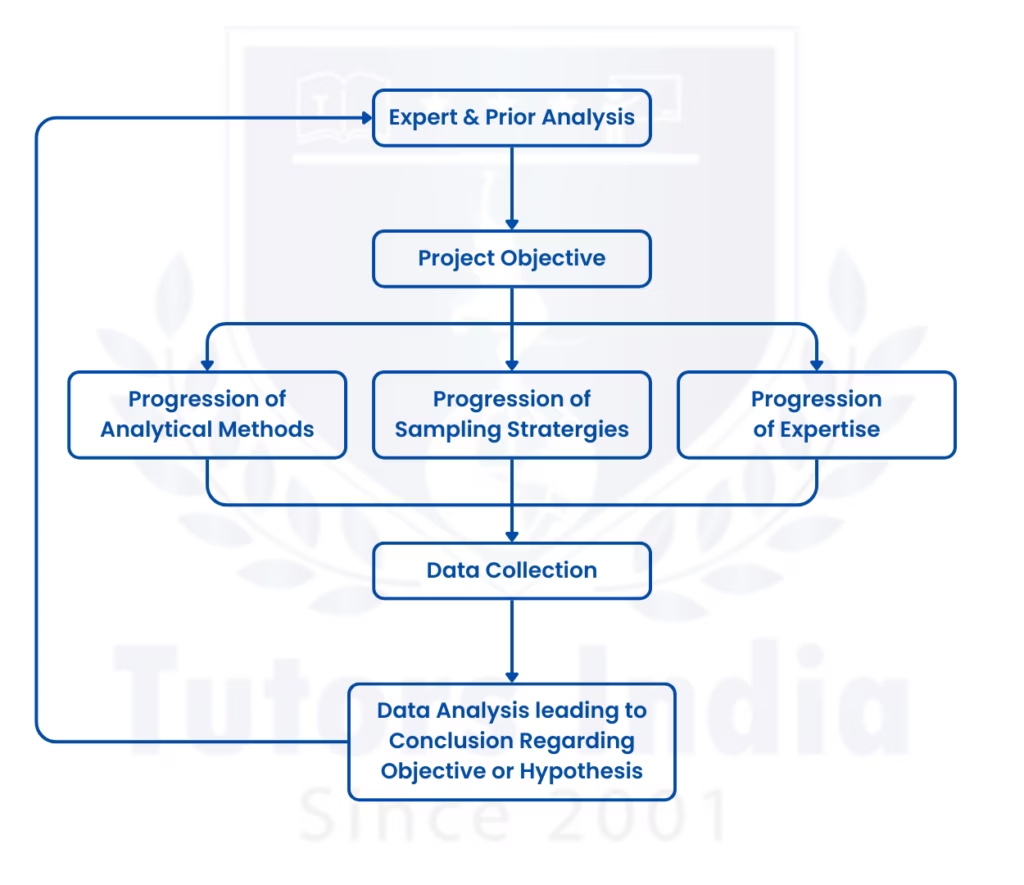
Proper planning reduces last-minute errors and improves the overall quality of the dissertation.
4. Writing the Literature Review
The literature review demonstrates critical thinking and subject expertise. Weak literature engagement is one of the most frequent common dissertation mistakes. [5]
Some examples of best practices include:
- Compare and contrast different types of literature
- Find gaps in current research
- Place all literature together by theme instead of by date of publication
- Utilize critical analyses instead of just providing descriptive statements about the literature.
Example (academic tone):
Previous studies have demonstrated significant associations between X and Y; however, limitations in sample size and methodology highlight the need for further investigation.
5. Methodology and Ethical Standards
The methodology must clearly explain research procedures so the study can be replicated. Many students face research methodology errors due to poor justification or unclear design. [6]
This includes | Ethical considerations must be taken into consideration by
|
Research Design Sampling Method/Size Data collection instruments Data analysis techniques
| Obtaining informed consent from the participants Protecting the confidentiality of all participants obtaining an institutional review board (IRB) approval when necessary.
|
6. Use of Tables, Figures, and Bullet Points
Correct use of tables and figures improves clarity and aligns with dissertation format UK standards.
Making Use of Tables and Figures:
- Number tables and figures consecutively
- Give tables and figures identifying titles and captions
- Reference tables and figures in your text
- Don’t overload chapters with pictures
Using bulleted items can enhance clarity; however, excessive use can take away from the academic tone of your writing, especially in the methodology or discussion section.
7. Editing, Proofreading, and Academic Integrity
Prior to submission
- Review grammar, punctuation, spelling and coherence
- Make sure formatting is uniform among documents
- Utilise programs to detect plagiarism
- Confirm that each in-text citation corresponds with its reference list
Maintaining academic integrity is essential; plagiarising can result in serious consequences including an incomplete doctorate or having the dissertation rejected.
Conclusion
Producing a high-quality master’s dissertation requires understanding how to write dissertation work according to academic standards. Careful planning, adherence to dissertation format UK requirements, avoidance of research methodology errors, and attention to academic integrity will ensure a structured and credible final submission. Students who avoid common dissertation mistakes and follow institutional guidelines demonstrate strong research capability and scholarly development.
How to Write a master’s Dissertation While Meeting Academic Writing Standards. [Talk to a Dissertation Expert | Book a Free 15-Minute Consultation]
References
- Resta, R. G., McCarthy Veach, P., Charles, S., Vogel, K., Blase, T., & Palmer, C. G. (2010). Publishing a master’s thesis: a guide for novice authors. Journal of genetic counseling, 19(3), 217–227. https://doi.org/10.1007/s10897-009-9276-2
- Kozak M. (2020). Academic Writing, and How to Learn How to Write. Journal of graduate medical education, 12(3), 373–374. https://doi.org/10.4300/JGME-D-20-00154.1
- Smaldone, A., Heitkemper, E., Jackman, K., Joanne Woo, K., & Kelson, J. (2019). Dissemination of PhD Dissertation Research by Dissertation Format: A Retrospective Cohort Study. Journal of nursing scholarship : an official publication of Sigma Theta Tau International Honor Society of Nursing, 51(5), 599–607. https://doi.org/10.1111/jnu.12504
- Shreffler J, Huecker MR. Common Pitfalls In The Research Process. [Updated 2023 Mar 6]. In: StatPearls [Internet]. Treasure Island (FL): StatPearls Publishing; 2025 Jan-. Available from: https://www.ncbi.nlm.nih.gov/books/NBK568780/
- Maggio, L. A., Sewell, J. L., & Artino, A. R., Jr (2016). The Literature Review: A Foundation for High-Quality Medical Education Research. Journal of graduate medical education, 8(3), 297–303. https://doi.org/10.4300/JGME-D-16-00175.1
- Barrow JM, Brannan GD, Khandhar PB. Research Ethics. [Updated 2022 Sep 18]. In: StatPearls [Internet]. Treasure Island (FL): StatPearls Publishing; 2025 Jan-. Available from: https://www.ncbi.nlm.nih.gov/books/NBK459281/