
How Do Referencing Requirements Differ Between Undergraduate and Master’s Assignments in Harvard and APA Styles?
How Do Referencing Requirements Differ Between Undergraduate and Master’s Assignments in Harvard and APA Styles?
- Home
- How To Article
- How Do Referencing Requirements Differ Between Undergraduate and Master’s Assignments in Harvard and APA Styles?
Table of Content
- Overview of Harvard and APA Referencing Styles
- Key Differences Between Undergraduate and Master’s Referencing Expectations
- Reference List Differences Between Harvard and APA
- Common Referencing Mistakes by Academic Level
- Academic Integrity and Plagiarism Considerations
- Strategies for Meeting Referencing Expectations
- Conclusion

How Do Referencing Requirements Differ Between Undergraduate and Master’s Assignments in Harvard and APA Styles?
Referencing is an essential academic skill throughout UK higher education, although it has different requirements from undergraduate study to master’s level. Both undergraduate and master’s level studies require appropriate referencing of sources using a referencing system (i.e., APA or Harvard), however, a master’s level assignment will typically have more stringent requirements about the referencing system used (i.e., more accurate) and critical evaluation of sources (i.e., critical engagement with relevant literature). The difference between a master ‘s-level assignment and an undergraduate assignment can have a significant impact on one’s level of academic success and scholarly integrity. This discussion of Harvard and APA style referencing in UG and master’s dissertations supports students engaged in UK master’s assignment writing and those seeking a UK master’s assignment sample or UK UG assignment sample to understand referencing expectations more clearly.[1]
1. Overview of Harvard and APA Referencing Styles
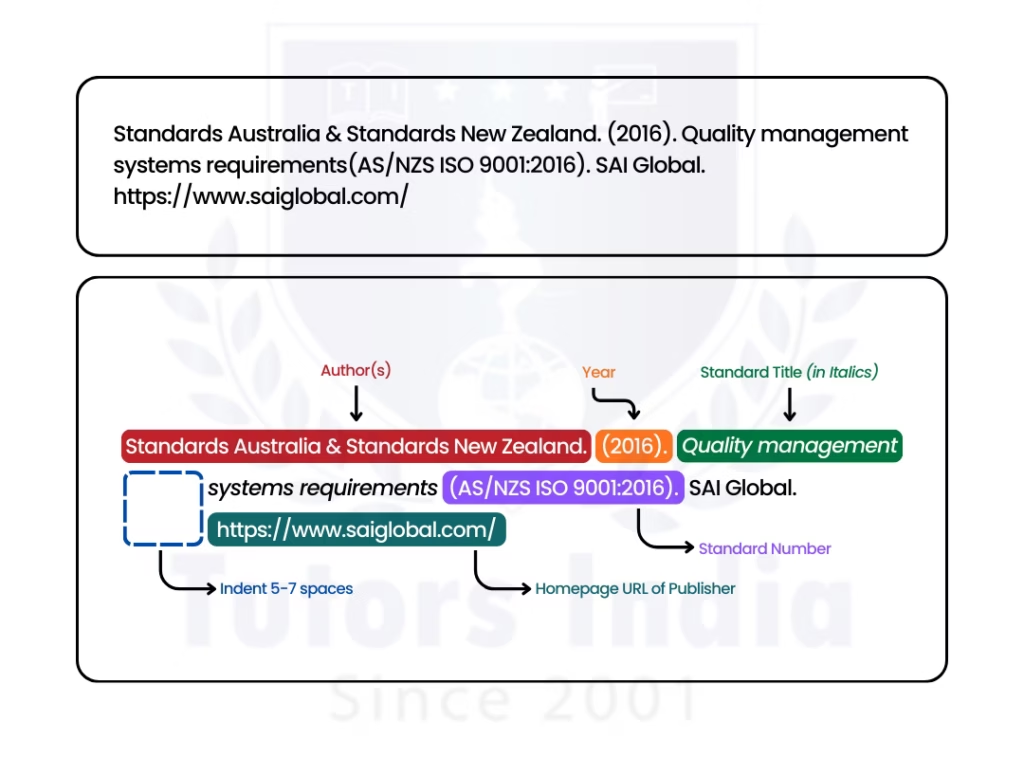
Harvard referencing style (also known as the author–date system) is a style that is popular at universities in the UK. This is accomplished by writing citations in-text, similar to other systems, but also using reference lists in alphabetical order.[2]
APA referencing style (7th edition) uses a similar author-date format as Harvard; yet, it has slightly different formatting guidelines than Harvard for some items, such as journal articles, DOIs, headings, and layout of reference lists. Structural similarities exist between these two systems, but there are significant differences in punctuation, capitalisation, and other formatting that can affect grading when either format.[3]
2. Key Differences Between Undergraduate and Master’s Referencing Expectations
Referencing at the undergraduate level focuses on accuracy and consistency, whereas the master’s level emphasises precision, source quality, and academic sophistication. This distinction is particularly important for students learning how to write a master’s assignment at an advanced level.
2.1. Depth and Quality of Sources
Level | Typical Source Expectations |
Undergraduate | Textbooks, lecture materials, introductory journal articles |
Master’s | Peer-reviewed journals, recent research (last 5–10 years), theoretical frameworks |
Master’s students are expected to rely less on textbooks and more on current, high-impact academic journals. This expectation is commonly emphasised in UK master’s assignment writing guidance and by providers of dissertation writing services.
2.2. Citation Accuracy and Technical Precision
If you have minor formatting inconsistencies as an undergraduate student, you will lose a few marks; however, as a master’s student, you will lose many more marks if you do not properly interpret APA punctuation (e.g. period vs comma) in your references or fail to include DOIs in APA 7th edition postings. Your referencing in Harvard style is not consistent with the standard. For master’s assignments, you must be able to reference virtually perfectly to earn maximum marks for referencing.[4]
2.3. Integration of Sources
When undergraduate students do research, they will frequently review their source materials. However, a master’s degree requires the following:
- Critical comparison between authors
- Synthesis of both sides of the author’s argument
- Demonstration of your theoretical position
Example (Undergraduate): According to Smith (2020), leadership has an impact on performance.
Example (Master’s): While Smith (2020) argues that leadership has a direct effect on performance, Brown (2021) disputes this by indicating that culture within the organisation is a key factor in the mediating effect between leadership and performance.
3. Reference List Differences
Harvard Citation Example:
Smith, John, Leadership in Organisations [book]. Routledge, London, 2020
APA Citation Example:
Smith, John, Leadership in Organisations, Routledge, 2020
APA Format Requires:
- Book title in italics
- Book title in sentence case
- DOI should be in hyperlink format
- Use hanging indent for the bibliographic entry.
That means that master’s assignments are generally to be written according to the latest edition (APA 7th).
4. Common Referencing Mistakes by Level
Undergraduate Level Mistakes:
- Page numbers are not included for citations
- Inconsistent formatting
- Heavy reliance of secondary sources
Master’s Level Mistakes:
- Citing outdated references
- Incorrectly formatted DOI reference (APA)
- Failure to correctly cite theoretical frameworks
- Inconsistent application of citation rules
At the master’s level, citation errors may affect the perceived academic credibility of scholars and researchers and reduce marks in UK master’s assignment writing assessments.
5. Academic Integrity and Plagiarism Considerations
Plagiarism is prohibited for both undergraduate and master’s-level assignments; however, master’s dissertations will be checked with stricter scrutiny by plagiarism detection software than undergraduate assignments. Master’s students must do the following when completing their dissertations: [5]
- Properly paraphrase
- Use a citation management tool such as EndNote or Mendeley
- Show evidence of originality in their work and cite correctly
6. Strategies for Meeting Referencing Expectations
To satisfy both APA and Harvard requirements you will need to:
- Refer to the specific referencing guide of your university
- Refer to up-to-date editions of APA (7th edition, where applicable)
- Remain consistent throughout the document
- Use reference management software
- Proofread the reference list on its own.
Master’s students, particularly, should cross-check all their references for both their overall completeness and formatting accuracy when preparing UK master’s assignment samples or final dissertations.
Conclusion
Referencing requirements are very different for undergraduates and post-graduates (master’s level) in both the Harvard and APA style guides. Undergraduates focus on demonstrating comprehension and consistency, whereas at the postgraduate level, referencing is a precise skill that utilises only high-quality and scholarly sources; further integration of research evidence into critical arguments is also required at this level.
As a result of recognising these differences, students will be able to align their referencing with the expectation of academic excellence and thus improve their performance in all forms of assessment, whether preparing undergraduate assignments, master’s dissertations, or seeking guidance on how to write a master’s assignment effectively.
How Do Referencing Requirements Differ Between Undergraduate and Master’s Assignments in Harvard and APA Styles? [Talk to a Dissertation Expert | Book a Free 15-Minute Consultation]
References
- References, citations and avoiding plagiarism. (2021, January 21). Ucl.ac.uk. https://library-guides.ucl.ac.uk/referencing-plagiarism/referencing-styles
- Dwyer M. (1995). A guide to the Harvard referencing system. British journal of nursing (Mark Allen Publishing), 4(10), 599–602. https://doi.org/10.12968/bjon.1995
- Anderton, L. (2023, September 11). Referencing guide at the University of Manchester: American psychological association APA. ac.uk. https://subjects.library.manchester
- Ngatuvai, M., Autrey, C., McKenny, M., & Elkbuli, A. (2021). Significance and implications of accurate and proper citations in clinical research studies. Annals of medicine and surgery (2012), 72, 102841. https://doi.org/10.1016/j.amsu.2021
- Zimba, O., & Gasparyan, A. Y. (2021). Plagiarism detection and prevention: a primer for researchers. Reumatologia, 59(3), 132–137. https://doi.org/10.5114/reum.2021.1059