
How Do UK Firms Overcome Barriers to Artificial Intelligence Adoption?
How Do UK Firms Overcome Barriers to Artificial Intelligence Adoption?
- Home
- How To Article
- How Do UK Firms Overcome Barriers to Artificial Intelligence Adoption?

How Do UK Firms Overcome Barriers to Artificial Intelligence Adoption?
Artificial Intelligence (AI) is changing how companies operate throughout the globe by giving them new ways of achieving better productivity, increased innovation and improved decision-making. Many UK businesses across multiple industries, including finance, health care, manufacturing and retail sectors, are increasingly beginning to use AI technology to remain competitive in today’s digital environment. Despite the acceleration of AI’s significance, many UK businesses still experience barriers to the successful adoption and misuse of AI technology. This issue is frequently examined in AI challenges in UK organisations’ research proposals, particularly when analysing emerging technologies such as generative AI and AI ChatGPT.[1]
Some barriers to AI implementation include high implementation costs; lack of technical expertise, data management, potential ethical implications, and an organisational reluctance to change. UK businesses need to find ways to develop organised strategies to overcome these barriers to remain a competitive force in the global marketplace. This article will discuss some of the most common barriers companies are currently facing in recognising and developing strategies for AI use and provide an overview of how some businesses in the UK are working to overcome these barriers through policy support, organisational readiness, and strategic investment. These themes are often explored in a research proposal example, dissertation proposal, or even a PhD research proposal focusing on digital transformation. [2]
1. Key Barriers to AI Adoption in UK Firms
In the UK, there are many obstacles for organisations that may hinder or slow the use of AI technology, whether they are financial, technological or organisationally based.[3] Such barriers are commonly discussed in a dissertation proposal help context when students develop academic work on AI integration.
The barriers that may define the use of AI within an organisation include the following:
- High initial and operational costs
- Shortage of AI-skilled and technical personnel
- Data privacy, governance and cybersecurity issues
- Resistance to change within the organisation
- Lack of clarity on returns from investment (ROI)
- Ethical and regulatory issues.
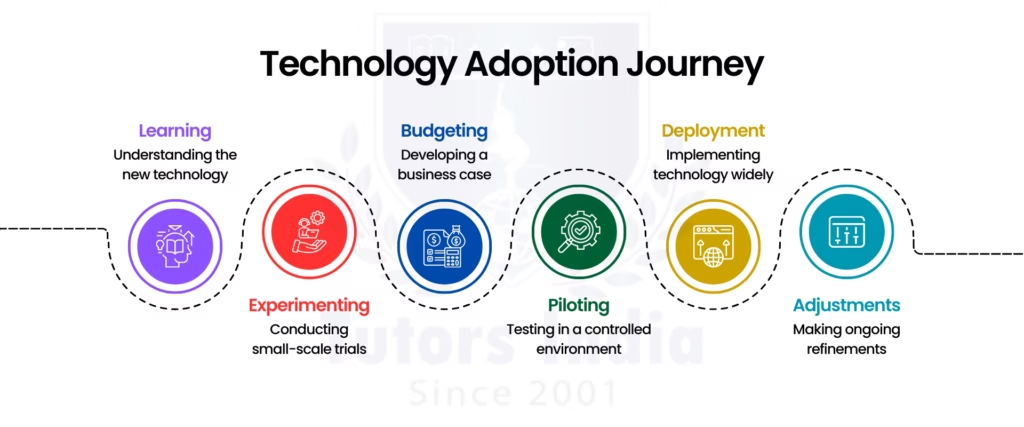
Many small and medium-sized enterprises (SMEs) in particular struggle with resource limitations, making AI adoption appear risky or unattainable without external support or partnerships.
2. Strategies UK Firms Use to Overcome AI Barriers
In the UK, companies are taking numerous practical measures to eliminate the obstacles to the use of AI and to maximise the value of digital transformation. Some common practices include: [4] These strategies are commonly outlined in a research proposal writing service document focused on AI adoption.
- Training employees and upskilling
- Collaborating with providers of AI technology as well as universities
- Using cloud-based AI solutions to minimise infrastructure expenses
- Running pilot projects before rolling out entirely
- Creating a clear framework for data governance
Using an incremental and scalable approach helps reduce the risks to organisations as they develop their confidence in the use of AI technologies now and into the future. These practices permit a company to trial out the use of AI, measure its success or otherwise, and expand its use to all areas, over time.
3. Organisational and Cultural Transformation
Adopting an Effective AI System Requires Both Technology Investments as Well as Cultural & Organisational Change. In The UK, Many Companies Have Already Restructured Their Processes to Promote Innovation-Driven Mindsets Through the Following Organisational Changes:[5]
- Increased Commitment from Leadership to Support the Digital Transformation Initiative.
- Encourage Collaboration Between IT Departments and Other Parts of The Business.
- Use Data to Drive Decisions.
- Promote Innovation Ideas.
An AI-ready corporate culture means employees will understand the value of technologies such as generative AI and AI ChatGPT and be open to adjusting to new systems and processes. These transformational elements are often discussed in a PhD research proposal examining AI integration within UK firms.
4. Government and Industry Support
AI integration into business will be enhanced by the government’s initiatives (funding programmes, support with developing a regulatory framework, etc.). Research collaboration by businesses, universities and public institutions provides businesses with access to the support, resources and expertise they require to be successful in developing and integrating AI.
The key types of initiatives introduced by the government to support AI include:
- AI Innovation Grants
- A National AI Strategy and Policy Framework
- Research Collaboration between Universities and Industry
- Innovation Hubs and Technology Incubators
These initiatives support businesses with research partnerships, financial assistance and technical advice for the successful development and integration of AI into business. Collaboration in AI strengthens the UK’s position as an internationally leading innovator and adopter of AI. These collaborative models are frequently highlighted in a research proposal example or dissertation proposal focusing on AI strategy.
5. Case-Based Insights Table
Barrier to AI Adoption | Impact on Firms | Strategies Used by UK Firms |
High implementation cost | Delays adoption | Cloud-based AI and phased investment |
Skills shortage | Limited technical capability | Training, hiring specialists, partnerships |
Data privacy concerns | Compliance risks | Strong data governance frameworks |
Organisational resistance | Slow implementation | Change management and leadership support |
This table highlights how UK firms align specific strategies with challenges to ensure smoother AI adoption.
Conclusion
UK businesses are increasingly adopting AI to improve efficiency, innovation and global competitiveness. However, challenges such as high implementation costs, skills shortages and organisational resistance can slow adoption. To overcome these barriers, organisations should invest in employee training, build strategic partnerships, adopt scalable technologies and utilise government support. A structured approach combining technological investment and organisational change can ensure successful and sustainable AI implementation. UK companies that proactively address AI adoption challenges will be better positioned to succeed in a rapidly evolving digital economy. These strategic insights are frequently developed within an AI challenge in UK organisations’ research proposals, supported by a research proposal writing service or a dissertation proposal service for academic purposes.
How Do UK Firms Overcome Barriers to Artificial Intelligence Adoption? [Talk to a Dissertation Expert | Book a Free 15-Minute Consultation]
References
- Hoffman, J., Wenke, R., Angus, R. L., Shinners, L., Richards, B., & Hattingh, L. (2025). Overcoming barriers and enabling artificial intelligence adoption in allied health clinical practice: A qualitative study. Digital health, 11, 20552076241311144. https://doi.org/10.1177/20552076241311144
- Hassan, M., Kushniruk, A., & Borycki, E. (2024). Barriers to and Facilitators of Artificial Intelligence Adoption in Health Care: Scoping Review. JMIR human factors, 11, e48633. https://doi.org/10.2196/48633
- Ahmed, M. I., Spooner, B., Isherwood, J., Lane, M., Orrock, E., & Dennison, A. (2023). A Systematic Review of the Barriers to the Implementation of Artificial Intelligence in Healthcare. Cureus, 15(10), e46454. https://doi.org/10.7759/cureus.46454
- Nair, M., Svedberg, P., Larsson, I., & Nygren, J. M. (2024). A comprehensive overview of barriers and strategies for AI implementation in healthcare: Mixed-method design. PloS one, 19(8), e0305949. https://doi.org/10.1371/journal.pone.0305949
- Parmelli, E., Flodgren, G., Schaafsma, M. E., Baillie, N., Beyer, F. R., & Eccles, M. P. (2011). The effectiveness of strategies to change organisational culture to improve healthcare performance. The Cochrane database of systematic reviews, (1), CD008315. https://doi.org/10.1002/14651858.CD008315.pub2