
Step-by-Step Guide to Writing a French Master’s Research Methodology
Step-by-Step Guide to Writing a French Master’s Research Methodology
- Home
- How To Article
- Step-by-Step Guide to Writing a French Master’s Research Methodology
Table of Content
- Understanding the Role of Methodology in French Master’s Research
- Define the Epistemological Position
- Choose the Appropriate Research Design
- Develop Data Collection Methods
- Establish Sampling Strategy
- Plan Data Analysis Techniques
- Address Ethical Considerations
- Writing and Structuring the Methodology Chapter
- Visual Overview of the Research Methodology Process

Step-by-Step Guide to Writing a French Master’s Research Methodology
In writing the research methodology for a French master’s dissertation, it is necessary to pay particular attention to the theoretical position, academic rigour, and methodological precision. In France, academic institutions place significant importance on epistemology; it is necessary to justify the way in which knowledge is produced and how research methods correspond to theoretical presuppositions. In contrast to technical writing in research methodology, in French academic writing, the chapter that outlines the research methodology for dissertation includes theoretical presuppositions, research design methodology, and analytical justification.[1]
In general, a good research methodology chapter should describe how the research was conducted, why the research was conducted in a particular way, and how the research methods used in the dissertation will help to answer the research questions. This French master’s Research Methodology Guide describes the necessary steps to develop a good research methodology chapter.
1. Understanding the Role of Methodology in French Master’s Research
In the French academic environment, methodology entails more than just the process followed, but it is an intellectual process as well. The students need to clearly show the interrelation between theory, research, and analytical methods, as expected by the examiners.[2]
- Explaining the research design and approach
- Justifying the methodology used
- Showing transparency in the research
- Ensuring the validity and reliability of the research
A good methodology helps in increasing the credibility of the research, while at the same time offering a framework for understanding the results obtained.
2. Define the Epistemological Position
The starting point in writing a methodology chapter is to establish the epistemological stance that informs the study. Epistemology is the theory of knowledge and shapes the way in which data is interpreted and analysed. [3]
Some of the common epistemological stances are:
- Positivism: Concentrates on objective measurement and quantitative analysis.
- Interpretivism: Concentrates on interpreting human experiences through qualitative research methodology.
- Constructivism: Assumes that knowledge is created through social interactions.
Choosing the right epistemological stance ensures that the research methodology aligns with the theoretical framework and the literature review in research methodology
3. Choose the Appropriate Research Design
Research design is the determinant of the general approach that will be employed to answer the research questions. In master’s dissertations in French universities, students are required to provide a clear justification of why a certain research design methodology is appropriate.[4]
Some of the common research designs include:
- Qualitative research methodology (interviews, case studies, and observations)
- Quantitative research designs (surveys and statistical analysis)
- Mixed designs that combine qualitative and quantitative approaches.
4. Develop Data Collection Methods
Data collection methods are a description of how data is going to be collected in addressing the problem of concern. Methodological sections in French academia place great emphasis on transparency. [5]
Some of the data collection methods include:
- Structured interviews
- Semi-structured interviews
- Surveys
- Observations
- Document analysis
Students should indicate how they developed and validated their research tools such as questionnaires and interviews.
5. Establish Sampling Strategy
Sampling involves the selection of participants or data sources who are relevant to the study. The use of an appropriate sampling method ensures that the results are representative and meaningful.
- Random sampling for quantitative studies
- Purposive sampling for qualitative studies
- Snowball sampling for specialised participants
The methodology should explain the reason for the selection of the sample size and why the selected participants are relevant to the topic of study.
6. Plan Data Analysis Techniques
Data analysis explains how collected data will be interpreted to produce findings. Selecting suitable data analysis techniques is essential for ensuring research transparency.[6]
Some of the common methods used in data analysis include:
- Statistical analysis using software such as SPSS or R
- Thematic analysis of qualitative data from interviews
- Content analysis of text-based research
These data analysis techniques should be clearly described to demonstrate methodological rigour.
7. Address Ethical Considerations
Adherence to ethical research practices is vital in French academic research. Universities usually require students to consider ethical issues when gathering data. [7]
The most important ethical issues to consider are:
- Informed consent from participants
- Confidentiality and anonymity
- Protection of data from participants
- Avoiding plagiarism and research misconduct
Ethical compliance is often linked with transparency in the research methodology for a dissertation.
8. Writing and Structuring the Methodology Chapter
The methodology chapter should be logically structured to guide readers through the research process. A clear structure enhances readability and demonstrates academic rigour.
Typical Methodology Structure
Section | Purpose |
Research Philosophy | Explains the epistemological perspective |
Research Design | Describes overall strategy |
Data Collection | Explains methods used to gather information |
Sampling | Identifies participants and selection criteria |
Data Analysis | Describes analytical techniques |
Ethics | Addresses ethical considerations |
A well-developed structure should also align with the literature review in research methodology presented earlier in the dissertation.
9. Visual Overview of the Research Methodology Process
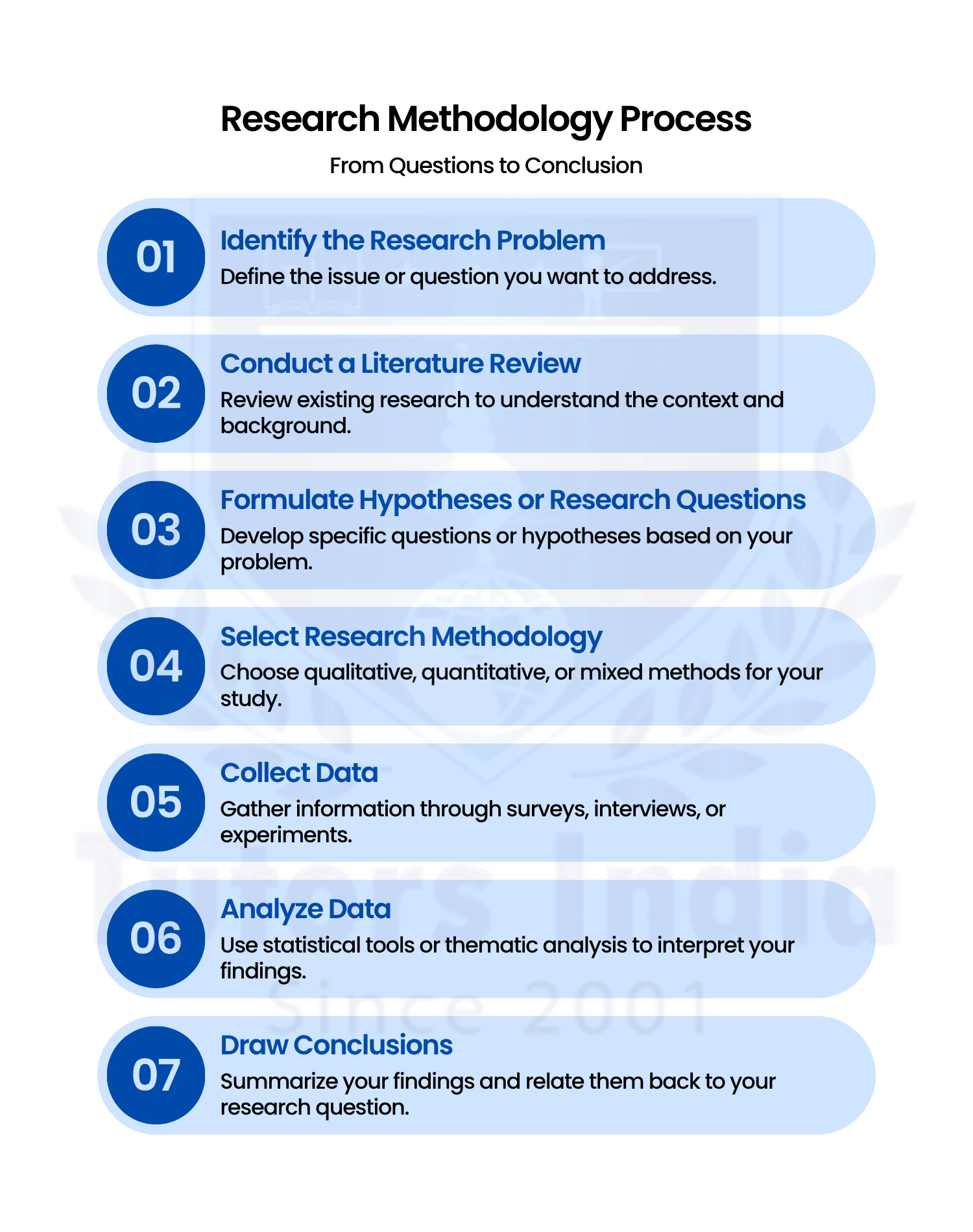
These visuals illustrate how research methodology progresses from theoretical foundation to data analysis.
Conclusion
Having a robust methodology chapter is crucial for producing a high-quality dissertation. By applying the principles outlined in this French master’s Research Methodology Guide, students can ensure that their research demonstrates strong methodological clarity.
By carefully integrating qualitative research methodology, appropriate research design methodology, well-developed data analysis techniques, and a structured questionnaire in research methodology, students can create a dissertation that meets academic expectations. A strong methodology chapter, supported by a clear literature review in research methodology, significantly enhances the credibility and academic contribution of the research.
Step-by-Step Guide to Writing a French Master’s Research Methodology? A master’s Dissertation Study [Talk to a Dissertation Expert | Book a Free 15-Minute Consultation]
References
- Willis L. D. (2023). How to Write the Methods Section of a Research Manuscript. Respiratory care, 68(12), 1763–1770. https://doi.org/10.4187/respcare.114
- Signorell, A., Saric, J., Appenzeller-Herzog, C., Ewald, H., Burri, C., Goetz, M., & Gerold, J. (2021). Methodological approaches for conducting follow-up research with clinical trial participants: a scoping review and expert interviews. Trials, 22(1), 961. https://doi.org/10.1186/s13063-021-05866-6
- Negri, A., & Barazzetti, A. (2025). Epistemological Foundation for the Use of the Linguistic Measures of the Referential Process. Journal of psycholinguistic research, 54(3), 33. https://doi.org/10.1007/s10936-025-10149-1
- Bayot ML, Moore N, Brannan JM, et al. Human Subjects Research Design. [Updated 2026 Jan 12]. In: StatPearls [Internet]. Treasure Island (FL): StatPearls Publishing; 2026 Jan-. Available from: https://www.ncbi.nlm.nih.gov/book
- Paradis, E., O’Brien, B., Nimmon, L., Bandiera, G., & Martimianakis, M. A. (2016). Design: Selection of Data Collection Methods. Journal of graduate medical education, 8(2), 263–264. https://doi.org/10.4300/JGME-D-16-00098.1
- Simpson S. H. (2015). Creating a Data Analysis Plan: What to Consider When Choosing Statistics for a Study. The Canadian journal of hospital pharmacy, 68(4), 311–317. https://doi.org/10.4212/cjhp.v68i4.14
- Smith PG, Morrow RH, Ross DA, editors. Field Trials of Health Interventions: A Toolbox. 3rd edition. Oxford (UK): OUP Oxford; 2015 Jun 1. Chapter 6, Ethical considerations. Available from: https://www.ncbi.nlm.nih.gov/book