
Why Do UK Master’s Students Struggle to Identify Clear Research Gaps in Their Dissertations?
Why Do UK Master’s Students Struggle to Identify Clear Research Gaps in Their Dissertations?
- Home
- How To Article
- Why Do UK Master’s Students Struggle to Identify Clear Research Gaps in Their Dissertations?

Why Do UK Master’s Students Struggle to Identify Clear Research Gaps in Their Dissertations?
Finding a clear research gap in UK master’s dissertation work is one of the hardest stages of writing a UK master’s dissertation. Although students are required to show their reasoning ability and new ideas, many students find it difficult to move beyond summing up what is already known about their topic to identify what else is missing, not studied enough or not studied in detail enough. Dissertations are graded on whether they add something new, provide a critical assessment of existing literature and the links made with debates in the academic world. Understanding what is a research gap and how to identify one requires the ability to analyse, know about different ways of doing research and be able to carry out a systematic review of the literature.[1]
This article will discuss the reasons that contribute to master’s students in the UK having difficulty identifying a research gap and what can effectively help them to overcome these obstacles, particularly when preparing a dissertation proposal or reviewing a research proposal example.
1. What Is a Research Gap
A research gap is defined as a lack of research on something, an inadequate exploration of something, or an inadequate way of studying something in an already existing body of work or debating something in the field of research. Additionally, there may still be research gaps even if another researcher chooses to study an entirely different topic than previously studied by another researcher.
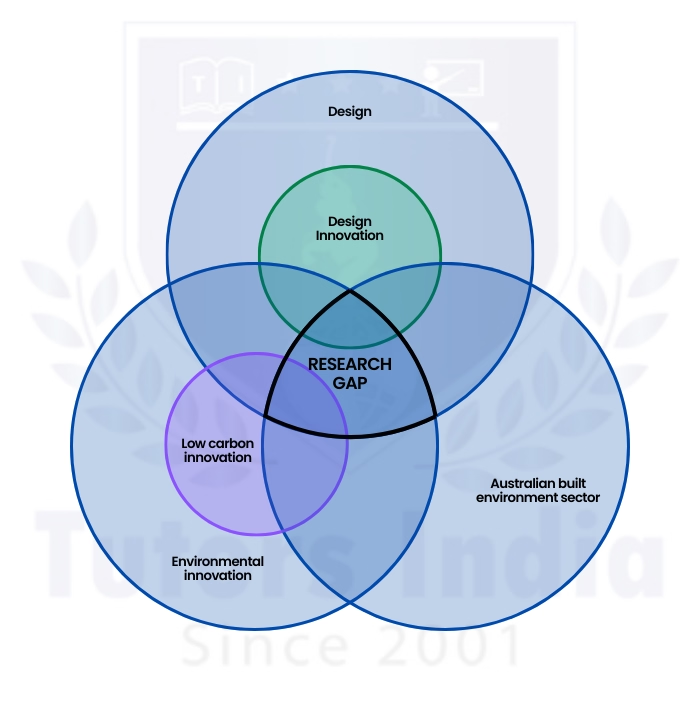
A research gap may involve:
- Old research does not require new research.
- Opposing results will be examined.
- Groups of people or settings that have not received enough attention.
- Previous research has methodological issues.
- Perspectives that haven’t yet been applied in the literature are available.
Although theoretical models are abundant, many students find it difficult to implement these models into practice, especially when learning how to write research gap sections effectively.
2. Why Do UK Master’s Students Struggle?
A. Descriptive Literature Review Over-Reliance
Many students will take the previous literature into account and summarise it without identifying its limitations or weaknesses. UK marking criteria expect critical engagement with the literature rather than description. Failure to identify a literature gap example weakens the overall argument. [2]
B. Critical Thinking Confidence is Limited
Many students may struggle with their ability to critique the work of published scholars and believe that published work should generally be considered a complete and perfect product.
C. Limited Scope of Reading
A limited number of references will give the reader a narrow understanding of the debate or conflicting opinions in the field. Without broad reading, identifying a research gap in UK master’s dissertation becomes difficult.
D. Challenges Creating a Link Between Theory and Method
Some students struggle with knowing how the limitations of the methods they are using create an opportunity for the future.
E. Time Constraints
Literature reviews that take too long to complete limit the student’s opportunity for thoughtful reflection and thematic comparison. This can weaken the clarity of the dissertation proposal.
3. Common Mistakes in Identifying Research Gaps
Common Mistake | Why It Happens | Impact on Dissertation |
Choosing an overly broad topic | Lack of focus | Weak or unclear contribution |
Claiming “no research exists” | Limited reading | Inaccurate justification |
Confusing topic with gap | Misunderstanding concept | Vague research aim |
Ignoring contradictory findings | Surface-level review | Limited critical depth |
Failing to justify relevance | Weak argumentation | Lower marks |
4. How Students Can Identify a Clear Research Gap
4.1 Develop a Thematic Literature Review
Instead of summarising studies one after another, review studies in terms of themes and compare results across those themes. This helps generate a strong research gap example supported by analysis. [3]
4.2 Identify Keywords in Research Papers
Researchers frequently indicate research gaps by using language such as:
- Future research should be conducted.
- There is limited evidence for.
- This research does not include
- Future studies should be completed.
4.3 Identify Methodological Limitations
- Were the sample sizes small?
- Were the research projects confined to a certain area?
- Were the research methods only qualitative or only quantitative types?
These limitations may highlight either a quantitative research gap or a qualitative research gap, or even justify a mixed-method approach in a dissertation proposal.[4]
4.4 Identify Contextual Gaps
Many UK master’s students will be able to contribute by applying existing theories to:
- Other geographical areas.
- Other industries.
- Emerging technologies.
- Other demographic groups.
4.5 Consult Early with Supervisors
Supervisors can assist in converting broad ideas into specific, researchable gaps, especially when refining a research proposal example or drafting the initial dissertation proposal.
5. Visual Process: From Literature Review to Research Gap
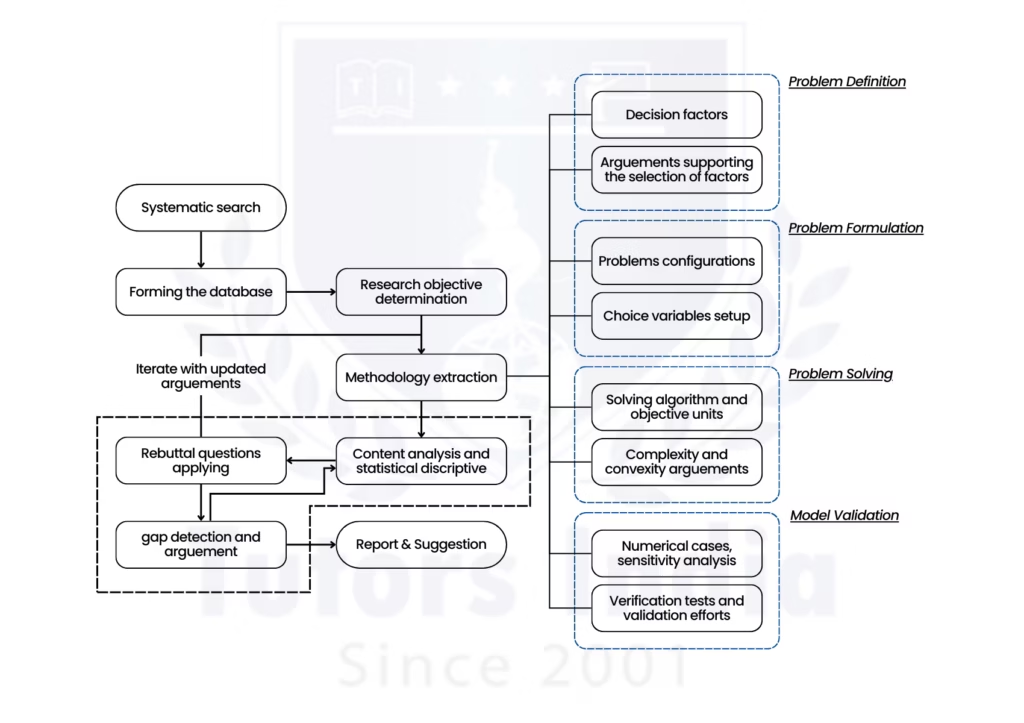
Step-by-step progression
- Broad topic selection
- Comprehensive literature search
- Thematic comparison of studies
- Identification of limitations or contradictions
- Narrowed research question
This structured approach helps students clarify what is a dissertation expected to achieve in terms of originality and contribution.
6. Signs You Have Found a Strong Research Gap
The research addresses a clearly defined problem based on existing literature and identifies a justified research gap in UK master’s dissertation work. It is feasible within the dissertation timeframe and contributes new theoretical, methodological, or contextual insights. The study also aligns with UK Master’s academic standards, demonstrating critical analysis, originality, and proper structure expected in what is a dissertation framework.[5]
7. Institutional Expectations in the UK
The quality of UK master’s potential dissertations will be judged based on four key criteria:
- Contribution and Novelty
- Critical Thinking & Analysis
- Academic Rigour
- Cohesion of Argument
If there is no clear research area that needs further investigation, all these areas may be adversely impacted. Some students seek guidance from a master’s dissertation service when struggling to refine their research gap. [6]
Conclusion
Master’s students in the UK often struggle to identify research gaps due to limited critical engagement with sources, reliance on descriptive literature reviews, and uncertainty about challenging existing studies. Understanding what is a research gap and reviewing strong research proposal examples can provide clarity. With thematic analysis, awareness of methodological limitations, and early supervisor guidance, students can identify clear and defensible gaps.
Research gaps are not entirely new ideas, but ways to extend existing knowledge through critical evaluation of current literature. Learning how to write research gap sections effectively improves clarity, originality, and overall master’s dissertation quality.
Why Do UK Master’s Students Struggle to Identify Clear Research Gaps in Their Dissertations? [Talk to a Dissertation Expert | Book a Free 15-Minute Consultation]
References
- Sükan, S., & Mohammadzadeh, B. (2022). Challenges of Writing Theses and Dissertations in an EFL Context: Genre and Move Analysis of Abstracts Written by Turkish M.A. and Ph.D. Students. Frontiers in psychology, 13, 925420. https://doi.org/10.3389/fpsyg.2022.925420
- Varpio, L., Parker, R., & MacLeod, A. (2024). Understanding the Differences That Differentiate: A Model for Deciding Which Literature Review to Conduct. Journal of graduate medical education, 16(2), 146–150. https://doi.org/10.4300/JGME-D-24-00151.1
- Thomas, J., & Harden, A. (2008). Methods for the thematic synthesis of qualitative research in systematic reviews. BMC medical research methodology, 8, 45. https://doi.org/10.1186/1471-2288-8-45
- Eldredge J. Evidence Based Practice: A Decision-Making Guide for Health Information Professionals [Internet]. Albuquerque (NM): University of New Mexico Health Sciences Library and Informatics Center; 2024. Critical Appraisal. Available from: https://www.ncbi.nlm.nih.gov/books/NBK603121/
- Robinson KA, Akinyede O, Dutta T, et al. Framework for Determining Research Gaps During Systematic Review: Evaluation [Internet]. Rockville (MD): Agency for Healthcare Research and Quality (US); 2013 Feb. Introduction. Available from: https://www.ncbi.nlm.nih.gov/books/NBK126702/
- Price, C., Suhomlinova, O., & Green, W. (2024). Researching big IT in the UK National Health Service: A systematic review of theory-based studies. International Journal of Medical Informatics, 185(105395), 105395. https://doi.org/10.1016/j.ijmedinf.2024.105395