
Is Quiet Quitting a Form of Silent Resistance? A Study of Gen Z Employees in the UK: Master’s Dissertation on Quiet Quitting in the UK Average Monthly Searches
Is Quiet Quitting a Form of Silent Resistance? A Study of Gen Z Employees in the UK: Master’s Dissertation on Quiet Quitting in the UK Average Monthly Searches
- Home
- How To Article
- Is Quiet Quitting a Form of Silent Resistance? A Study of Gen Z Employees in the UK: Master’s Dissertation on Quiet Quitting in the UK Average Monthly Searches
Table of Content

Is Quiet Quitting a Form of Silent Resistance? A Study of Gen Z Employees in the UK
According to recent reports, quiet quitting is rapidly becoming one of the most discussed issues among Gen Z (Generation Z) employees who work in businesses located in the UK, particularly among those studied in a master’s Dissertation on Quiet Quitting in the UK. Quiet quitting takes place when young people choose not to quit their jobs but rather perform only those duties that have been outlined in their job description, which also helps explain the quiet quitting meaning in modern workplaces. This creates a discussion about whether quiet quitting means that employees are disengaged from work or whether they are just silently resisting the pressures of their job. The purpose of this article is to explain quiet quitting as a social and organisational issue, while also providing an explanation of why quiet quitting occurs, what the effects of quiet quitting will be, and how organisations in the UK can successfully respond to the phenomenon of quiet quitting.[1]
1. Understanding Quiet Quitting in the UK Workplace
Quiet quitting isn’t resigning from your job; it’s just an attitude change from those working within an organisation. A large majority of Gen-Z employees prefer having a good work-life balance, as well as mental well-being, and receiving fair treatment over the long-standing norm of overworking and maintaining loyalty towards their organisation.[2]
- Increased Awareness About Mental Health
- Emergence of Remote and Hybrid Working
- Continued Economic Pressures and Job Insecurity
- Changing Expectations on Job Fairness
Most young professionals who are quiet quitting are providing a response method to their poor work-life balance caused by impractical workloads, lack of recognition and lack of clear progression paths forward within their organisation. Such workplace issues are frequently examined in a master’s Dissertation on Quiet Quitting in the UK.
2. Why Gen Z Employees Engage in Quiet Quitting
In the UK, there are multiple reasons why Generation Z employees feel they have “quite quit” from their jobs. [3]
- Burnout Stress- A heavy workload creates unrealistic expectations.
- Recognition Is Lacking- Little to no feedback or appreciation.
- Work-Life Balance Is Poor- The workday is becoming longer than what we agreed to when we were hired for our contract.
- Limited Advancement- There are not enough opportunities for career advancement.
- Values-Based- What a person finds important in life affects their “need” for a job with a company/corporation.
Generation Z will have the ability to advance in a workplace environment, but they will support their job based on psychological safety and job satisfaction rather than long-term loyalty to a corporation or organisation. These workplace themes are often explored with support from a master’s dissertation guidance and master’s dissertation help for students researching workplace behaviour.
3. Is Quiet Quitting a Form of Silent Resistance?
Rather than merely disengaging, quiet quitting includes a more passive way of resisting employers. Employees are putting out as much energy as their contracts require by not resigning from the company and/or not confronting the employer about their working conditions.[4]
- Will not work over the allotted time required by the employer.
- Will not engage in projects or tasks that are not necessary to perform by their employer.
- Are less emotionally committed to their jobs.
- Are more focused on their own wellness.
These behaviours indicate that there is an issue with the employers’ culture and/or the way the employer runs their business, rather than a lack of work ethic. Such insights are frequently included in a master’s Dissertation on Quiet Quitting in the UK, prepared with master’s dissertation writing services or academic research support.
4. Impact of Quiet Quitting on UK Organisations
Area of Impact | Positive Outcomes | Negative Outcomes |
Employee well-being | Improved work–life balance | Reduced engagement |
Productivity | Focus on core tasks | Limited innovation |
Workplace culture | Encourages boundary-setting | Weak team collaboration |
Management practices | Forces review of policies | Increased supervision needs |
Organisations that ignore quiet quitting risk declining morale and productivity, while those that address underlying causes may benefit from a more balanced workforce.
5. Visualising Quiet Quitting Behaviour
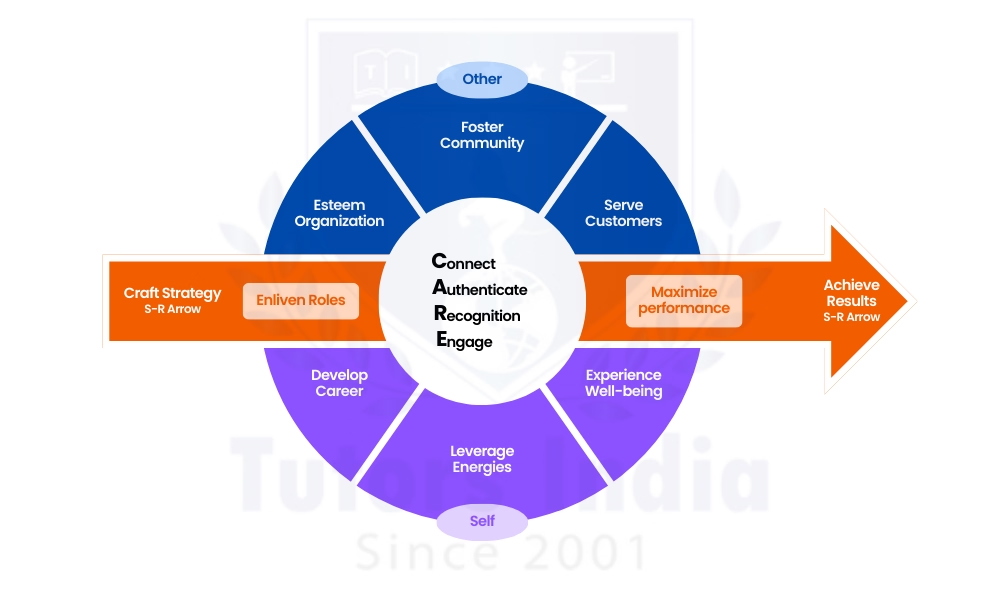
The visual trend shows that quiet quitting is closely linked to job satisfaction, management support, and career development opportunities. Companies with supportive leadership and clear communication experience lower levels of disengagement. This type of analysis is frequently included when students ask about what a dissertation and how workplace behaviour research is structured.
6. How Employers Can Address Quiet Quitting
Organisations in the UK need an understanding of why employees quit quietly so they can respond effectively, using good management strategies to support staff members who are quietly quitting.[5]
- Support work/life balance – respect work hours and boundaries
- Communicate better by regularly providing feedback and recognition
- Help employees develop their careers by providing ways for training options and development opportunities
- Encourage employee voice – have safe places to give feedback
- Be proactive regarding mental health – support through the well-being initiatives and resources available to staff members.
If an organisation addresses employee satisfaction at work, it can change the behaviour of employees from quietly quitting to becoming involved in a positive working environment.
7. Implications for Future Workplace Culture
A trend of declining workplace engagement is emerging amongst Generation Z, as they shift their focus away from work being their primary life goal and towards finding balance, purpose and respect. Employers in the UK that can satisfy these needs will be better positioned to keep employees and maintain productivity.[6]
Recognising quiet quitting as an indication of employee engagement rather than as a threat can provide organisations with the opportunity to:
- Increase employee satisfaction
- Cultivate a positive workplace culture
- Increase employee retention rates in the long term
Conclusion
When considering UK Gen Z employees, quiet quitting can be viewed as a silent response to workplace stress, lack of recognition, and limited advancement opportunities. Many employees see this as a form of self-protection rather than disengagement. These themes are widely explored in a master’s Dissertation on Quiet Quitting in the UK with support from master’s dissertation help, master’s dissertation guidance, and master’s dissertation writing services.
Organisations that recognise these concerns and respond effectively can create balanced workplaces that enhance employee engagement and sustain long-term productivity. As organisational values evolve, understanding employee perspectives will remain essential for continued success and for students researching modern workplace trends through British dissertation help and thesis help UK.
Is Quiet Quitting a Form of Silent Resistance? A Study of Gen Z Employees in the UK: Master’s Dissertation on Quiet Quitting in the UK Average Monthly Searches? [Talk to a Dissertation Expert | Book a Free 15-Minute Consultation]
References
- Bremen, J. M. (2022, September 20). Quiet quitting: The real story (don’t blame gen Z). https://www.forbes.com/sites/johnbremen/2022/09/20/quiet-quitting-the-real-story-dont-blame-gen-z/
- Abbasi K. (2025). To quit quietly or not to quit quietly, that is the existential question. Journal of the Royal Society of Medicine, 118(3), 71. https://doi.org/10.1177/01410768251337079
- Patel, P. C., Guedes, M. J., Bachrach, D. G., & Cho, Y. (2025). A multidimensional quiet quitting scale: Development and test of a measure of quiet quitting. PloS one, 20(4), e0317624. https://doi.org/10.1371/journal.pone.0317624
- Galanis, P., Katsiroumpa, A., Vraka, I., Siskou, O., Konstantakopoulou, O., Moisoglou, I., Gallos, P., & Kaitelidou, D. (2023). The quiet quitting scale: Development and initial validation. AIMS public health, 10(4), 828–848. https://doi.org/10.3934/publichealth.2023055
- Xueyun, Z., Al Mamun, A., Masukujjaman, M., Rahman, M. K., Gao, J., & Yang, Q. (2023). Modelling the significance of organizational conditions on quiet quitting intention among Gen Z workforce in an emerging economy. Scientific reports, 13(1), 15438. https://doi.org/10.1038/s41598-023-42591-3
- Zhenjing, G., Chupradit, S., Ku, K. Y., Nassani, A. A., & Haffar, M. (2022). Impact of Employees’ Workplace Environment on Employees’ Performance: A Multi-Mediation Model. Frontiers in public health, 10, 890400. https://doi.org/10.3389/fpubh.2022.890400