
Digital Transformation and Business Process Efficiency: A UK Master’s Manuscript
Digital Transformation and Business Process Efficiency: A UK Master’s Manuscript
- Home
- How To Article
- Digital Transformation and Business Process Efficiency: A UK Master’s Manuscript
Table of Content
- Understanding Digital Transformation in the UK Business Context
- Business Process Efficiency: Key Concepts
- Role of Digital Technologies in Enhancing Efficiency
- Research Framework for a UK Master’s Dissertation
- Key Challenges in Digital Transformation
- Impact of Digital Transformation on Business Process Efficiency
- Academic Significance for UK Master’s Students
- Conclusion

Digital Transformation and Business Process Efficiency: A UK Master’s Manuscript
With the rise of digital transformation initiatives throughout the UK, it has become very important for businesses (i.e., organisations) to take advantage of improving their business processes as well as becoming more competitive (i.e., business/market) and innovative. A UK Master’s dissertation on digital transformation and process efficiency enables business, management and information systems students to examine these developments in depth. Students often consult digital transformation research papers, a Master’s manuscript PDF, or a Master’s manuscript example to understand structure and academic expectations. This manuscript-style overview discusses how digital technologies can enhance an organisation’s business processes in the UK, as well as ways that post-graduate researchers can evaluate those enhancements through scholarly and empirical research.[1]
1. Understanding Digital Transformation in the UK Business Context
Digital transformation is when organisations use digital technology in their business to enhance their operations, including the way they operate (efficiency), how they make decisions (decision-making), and how they interact with customers (customer experience). Organisations across all sectors of business in the UK (Finance, Healthcare, Retail, Education) are quickly using various forms of technology (cloud computing, artificial intelligence, and automation) as digital solutions to enhance their overall performance.[2]
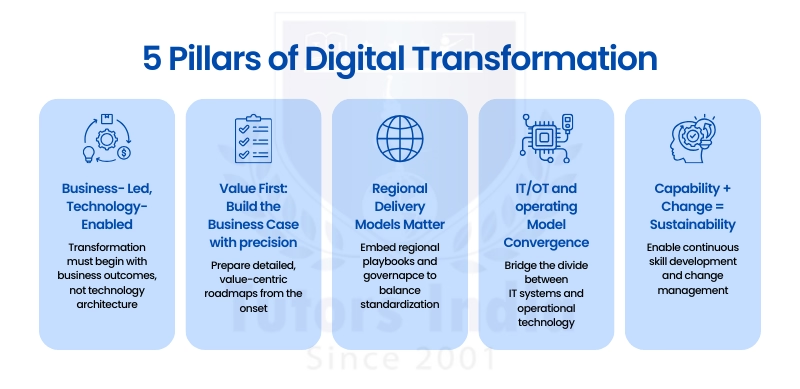
- Make internal operations more efficient
- Enter data-based decision-making more easily
- Connect with customers more effectively
- Decrease their operating costs
For postgraduate research, digital transformation gives students an opportunity to evaluate how the adoption of technology affects organisational productivity and performance, often supported by guidance from a Master’s manuscript service UK or best manuscript writing services for structural clarity.
2. Business Process Efficiency: Key Concepts
Business process efficiency provides an organisation with the ability to generate inputs with the least number of wasted resources in terms of time, money, and other assets. Processes that are efficient lead to higher levels of productivity, quality, and customer satisfaction. [3]
- Process Automation – Elimination of manual labour using digital technologies.
- Data Integration – The ability to have data available in a way that allows for decision-making in real-time due to the use of integrated systems.
- Operational Speed – The ability of an organisation to provide quicker service delivery/response time.
- Cost Optimisation – The reduction in operational and administrative costs.
- Quality Improvement – The decrease in error rates and increased consistency of output.
In the UK, many master’s theses and Master’s manuscript assessment examples evaluate how digital transformation projects improve these indicators of efficiency in organisations, aligning with standards expected in best manuscript assessment UK practices.
3. Role of Digital Technologies in Enhancing Efficiency

Many digital technologies have been studied for their impact on the efficiency of business processes. These include: [4]
1. Cloud computing
- Provides opportunities for remote collaboration (e.g., sharing files);
- Reduces capital expenditures for physical infrastructure; and,
- Increases accessibility to data
2. Artificial Intelligence (AI)
- Provides a basis for predictive analysis using machine learning.
- Automates repetitive tasks that have little value to the organisation; and,
- Improved accuracy in decision-making
3. Enterprise Resource Planning (ERP)
- Integrates the various functions of an organisation into one system.
- Provides better allocation of resources; and
- Improves reporting and monitoring capabilities
4. Robotic Process Automation (RPA)
- Automates the more routine business administrative processes.
- Reduces human error; and,
- Increases business operational throughput.
4. Research Framework for a UK Master’s Dissertation
Students who are researching digital transformation and how businesses can become more efficient can take a structured approach to their research. The outline might look something like this:
Research Objectives |
|
Research Methods [5] |
|
5. Key Challenges in Digital Transformation
Digital transformation offers many advantages; however, there are also several obstacles faced by organisations based in the UK when moving their businesses into a digital environment. Among those challenges are the following considerations for an organisation wanting to undertake this type of project:
- Resistance to change.
- High implementation costs.
- Data protection and confidentiality.
- Skill gaps with employees.
- Integration issues with existing systems.
6. Impact of Digital Transformation on Business Process Efficiency
Digital Technology | Efficiency Impact | Example Outcome |
Cloud computing | Improved collaboration | Faster project completion |
AI and analytics | Better decision-making | Accurate forecasting |
ERP systems | Integrated operations | Reduced duplication |
Automation tools | Time savings | Lower operational costs |
7. Academic Significance for UK Master’s Students
Digital transformation for UK organisations is characterised by challenges such as resistance to change, cost of implementation, data security concerns, lack of infrastructure, and limited staff skills. These challenges must be overcome for businesses to achieve sustainable process improvements. Producing a high-quality dissertation aligned with recognised academic standards sometimes supported by best manuscript writing services, can help students demonstrate scholarly competence and analytical depth.
Conclusion
The business world in the UK is being revolutionised by digital transformation, offering organisations opportunities to enhance efficiency and competitiveness. For those studying for their master’s degree, researching digital transformation provides valuable insights into how technology influences organisational performance. By examining case studies, digital transformation research papers, and structured academic examples such as a Master’s manuscript PDF or Master’s manuscript example, postgraduate researchers can produce a rigorous and well-structured study that reflects the standards expected in a UK Master’s dissertation on digital transformation and process efficiency.
Digital Transformation and Business Process Efficiency: A UK Master’s Manuscript [Talk to a Dissertation Expert | Book a Free 15-Minute Consultation]
References
- Priyono, A., Moin, A., & Putri, V. N. A. O. (2020). Identifying Digital Transformation Paths in the Business Model of SMEs during the COVID-19 Pandemic. Journal of Open Innovation: Technology, Market, and Complexity, 6(4), 104. https://doi.org/10.3390/joitmc6040104
- Saeed, S., Altamimi, S. A., Alkayyal, N. A., Alshehri, E., & Alabbad, D. A. (2023). Digital Transformation and Cybersecurity Challenges for Businesses Resilience: Issues and Recommendations. Sensors (Basel, Switzerland), 23(15), 6666. https://doi.org/10.3390/s23156666
- Lötscher-Stamm, M., & Lenzin, G. (2024). Definition and understanding of “efficiency” in healthcare provision research: a scoping review. Frontiers in public health, 12, 1439788. https://doi.org/10.3389/fpubh.2024.1439788
- Senbekov, M., Saliev, T., Bukeyeva, Z., Almabayeva, A., Zhanaliyeva, M., Aitenova, N., Toishibekov, Y., & Fakhradiyev, I. (2020). The Recent Progress and Applications of Digital Technologies in Healthcare: A Review. International journal of telemedicine and applications, 2020, 8830200. https://doi.org/10.1155/2020/8830200
- Bayot ML, Moore N, Brannan JM, et al. Human Subjects Research Design. [Updated 2025 Dec 1]. In: StatPearls [Internet]. Treasure Island (FL): StatPearls Publishing; 2025 Jan-. Available from: https://www.ncbi.nlm.nih.gov/books/NBK537270/