
What Quantitative Models Can a master’s Dissertation Research Proposal Apply to Examine the Financial Consequences of AI Compliance Policies in the United Kingdom?
What Quantitative Models Can a master’s Dissertation Research Proposal Apply to Examine the Financial Consequences of AI Compliance Policies in the United Kingdom?
- Home
- How To Article
- What Quantitative Models Can a master’s Dissertation Research Proposal Apply to Examine the Financial Consequences of AI Compliance Policies in the United Kingdom?
Table of Content
- Introduction to AI Compliance and Financial Impact in the UK
- Importance of Quantitative Analysis in AI Compliance Research
- Key Quantitative Models for Dissertation Research
- Comparative Overview of Quantitative Models
- Data Sources for UK-Based Dissertation Research
- Steps to Apply Quantitative Models in a Dissertation Proposal
- Benefits of Using Quantitative Models in Dissertation Research
- Conclusion

What Quantitative Models Can a master’s Dissertation Research Proposal Apply to Examine the Financial Consequences of AI Compliance Policies in the United Kingdom?
Adopting Artificial Intelligence (AI) at unprecedented levels within many sectors of the U.K. has triggered the development of very rigorous compliance/regulation policies with an emphasis on responsible AI use, data protection, and transparency. Along with these types of compliance/regulation policies come considerable financial impacts to organisations due to costs of complying with legislation, costs related to making operational changes related to conformance, as well as costs associated with managing risk.[1]
Master’s dissertation candidates studying finance, business analytics and/or management have opportunities to conduct important and relevant research examining the financial implications associated with compliance policies for AI using quantitative modelling. This manuscript presents several key quantitative modelling applications that could be utilised in dissertation research proposals regarding compliance with AI within the context of the U.K. and supports the development of quantitative models for UK AI compliance within academic research.
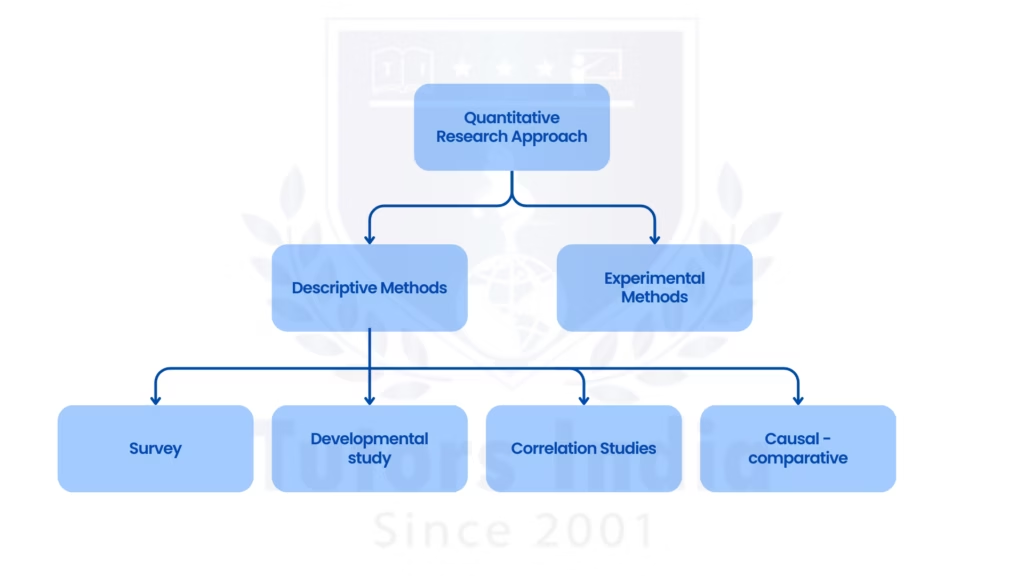
1. Visual Overview: Quantitative Research Models for AI Compliance Studies
Common quantitative frameworks used to measure financial performance, compliance costs, and how a policy impacts the organisation, as well as within the regulatory environment, are represented in these visuals.[2]
2. Importance of Quantitative Analysis in AI Compliance Research
Quantitative analytical models enable students to objectively quantify and evaluate the financial implications of AI compliance policies. The “General Data Protection Regulation” (GDPR) within the UK, along with the AI Regulatory framework and other sector-specific governance policies, are mandating organisations to invest in infrastructure to be compliant. These approaches also highlight the definition of quantitative research as the use of numerical data and statistical methods to analyse relationships and trends.[3]
- Quantify the cost of compliance by various industries
- Evaluate the financial risk of being non-compliant
- Analyse the connection between investment in compliance and performance of the organisation.
- Determine the return on investment (“ROI”) for ethical AI systems.
3. Quantitative Models Suitable for Dissertation Research
3.1. A. Cost–Benefit Analysis (CBA)
The model for evaluating the financial impact of regulatory policy through cost-benefit analysis is one of the most applied tools for measuring compliance risk.[4]
| Examples of how you might apply it in your dissertation | To evaluate these items, you would apply |
|---|---|
|
|
3.2. Regression Analysis Model
The main goal of regression analysis is to determine the relationship between expenditures made to comply with AI regulations and various financial performance indicators.[5]
| Examples of proposed research questions may be |
|
| Common types of variables used in regression analyses are |
|
3.3. Difference-in-Differences (Did) Model
The model assists in measuring improvements or regressions to financial conditions caused by AI compliance policies implemented within organisations.
- Financial condition of firms before and after the implementation of UK AI regulation
- Financial condition of compliant firms compared with that of non-compliant firms
- Allows for temporal measurement of a policy’s effect on organisations
- Strong causal analysis
3.4. Financial Ratio Analysis
Financial ratio analysis assesses the overall performance of an organisation by using quantitative measures. [6]
- Cost-to-Revenue ratio
- Compliance Cost ratio
- Return on Assets (ROA)
- Operating Margin
Students can analyse how AI compliance influences the financial stability and profitability of companies
4. Comparative Overview of Quantitative Models
Model | Purpose | Data Required | Research Value |
Cost–Benefit Analysis | Evaluate compliance costs vs benefits | Financial reports, compliance expenses | Strong policy evaluation |
Regression Analysis | Identify relationships between variables | Numerical financial data | Statistical insights |
Difference-in-Differences | Measure impact over time | Pre/post policy data | Causal analysis |
Financial Ratio Analysis | Assess financial performance | Company financial statements | Performance comparison |
5. Data Sources for UK-Based Dissertation Research
UK Government policy reports, UK Company Financial statements, Office for National Statistics (ONS), Industry Survey and Compliance Reports, and Public Company Disclosure statements can all provide students with quantitative data for their research purposes. Reliable data is required to generate research results that are both valid and credible for a master’s research project proposal or research proposal sample.
6. Steps to Apply Quantitative Models in a Dissertation Proposal
- Outline the objective(s) of the research and formulate hypothesis(es)
- Identify all variables within the scope of your research, financial variables
- Determine the method of analysis (a quantitative model)
- Source reliable secondary or primary study data
- Use a statistical package for analysing your data (e.g., SPSS, R, Excel, Stata)
- Consider the relationship of your findings to the UK Government AI Policy
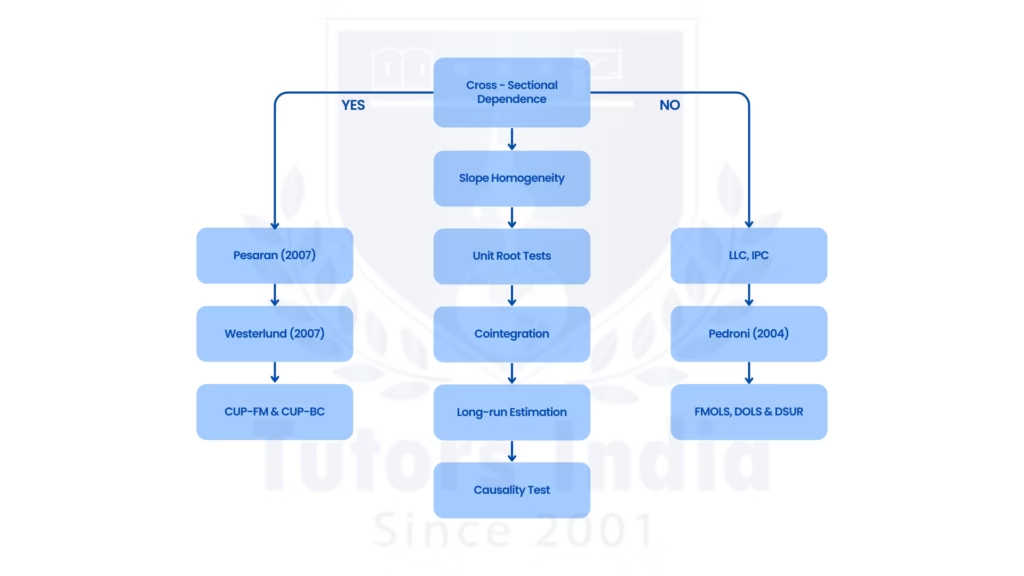
7. Visual Representation: Financial Impact Analysis Framework
These visuals demonstrate how financial data, compliance costs, and performance indicators are integrated into quantitative research frameworks used in quantitative models for UK AI compliance studies.[7]
8. Benefits of Using Quantitative Models in Dissertation Research
The use of quantitative techniques can provide many benefits to researchers in terms of their academic and professional advancement: [8]
- They give measurable and objective data
- Developing analytical statistical skill sets
- By improving a researcher’s academic credibility
- Providing evidence for making policy and business decisions
- Increase an individual’s chance of obtaining a job in finance/analysing jobs
Such approaches are often supported by professional dissertation services and dissertation writing help UK for students seeking structured academic guidance
Conclusion
Quantitative models help analyse the financial impact of AI compliance policies in the UK. Master’s students can use cost–benefit analysis, regression, DID, and financial ratios to evaluate the economic effects of AI governance. Using reliable data and statistical methods, such research supports academic knowledge and ethical AI implementation while addressing real-world economic challenges. These methods also strengthen the development of a strong master’s research project proposal and contribute to effective research proposal sample preparation within UK academic environments.
What Quantitative Models Can a master’s Dissertation Research Proposal Apply to Examine the Financial Consequences of AI Compliance Policies in the United Kingdom? [Talk to a Dissertation Expert | Book a Free 15-Minute Consultation]
References
- Buchanan, B. G., & Wright, D. (2021). The impact of machine learning on UK financial services. Oxford review of economic policy, 37(3), 537–563. https://doi.org/10.1093/oxrep/grab016
- Prince, E. W., Hankinson, T. C., & Görg, C. (2025). A Visual Analytics Framework for Assessing Interactive AI for Clinical Decision Support. Pacific Symposium on Biocomputing. Pacific Symposium on Biocomputing, 30, 40–53. https://doi.org/10.1142/9789819807024_0004
- Kwong, J. C. C., Khondker, A., Lajkosz, K., McDermott, M. B. A., Frigola, X. B., McCradden, M. D., Mamdani, M., Kulkarni, G. S., & Johnson, A. E. W. (2023). APPRAISE-AI Tool for Quantitative Evaluation of AI Studies for Clinical Decision Support. JAMA network open, 6(9), e2335377. https://doi.org/10.1001/jamanetworkopen.2023.35377
- Brent R. J. (2023). Cost-Benefit Analysis versus Cost-Effectiveness Analysis from a Societal Perspective in Healthcare. International journal of environmental research and public health, 20(5), 4637. https://doi.org/10.3390/ijerph20054637
- Flatt, C., & Jacobs, R. L. (2019). Principle Assumptions of Regression Analysis: Testing, Techniques, and Statistical Reporting of Imperfect Data Sets. Advances in Developing Human Resources, 21(4), 484-502. https://doi.org/10.1177/1523422319869915
- Tengilimoğlu, D., Tümer, T., Bennett, R. L., & Younis, M. Z. (2023). Evaluating the Financial Performances of the Publicly Held Healthcare Companies in Crisis Periods in Türkiye. Healthcare (Basel, Switzerland), 11(18), 2588. https://doi.org/10.3390/healthcare11182588
- Scheer, J., Volkert, A., Brich, N., Weinert, L., Santhanam, N., Krone, M., Ganslandt, T., Boeker, M., & Nagel, T. (2022). Visualization Techniques of Time-Oriented Data for the Comparison of Single Patients With Multiple Patients or Cohorts: Scoping Review. Journal of medical Internet research, 24(10), e38041. https://doi.org/10.2196/38041
- Verhoef, M. J., & Casebeer, A. L. (1997). Broadening horizons: Integrating quantitative and qualitative research. The Canadian journal of infectious diseases = Journal canadien des maladies infectieuses, 8(2), 65–66. https://doi.org/10.1155/1997/349145