
How Can a UK Master’s Dissertation Research Proposal Measure the Impact of Child Online Safety Laws on Revenue and Stakeholder Trust in Social Media Firms?
How Can a UK Master’s Dissertation Research Proposal Measure the Impact of Child Online Safety Laws on Revenue and Stakeholder Trust in Social Media Firms?
- Home
- How To Article
- How Can a UK Master’s Dissertation Research Proposal Measure the Impact of Child Online Safety Laws on Revenue and Stakeholder Trust in Social Media Firms?
Table of Content
- Understanding the Research Context
- Research Aim and Objectives for a UK Master’s Dissertation
- Conceptual Framework for Measuring Revenue and Stakeholder Trust Impact
- Research Methodology for Measuring Regulatory Impact
- Data Sources for the Study
- Measuring Revenue Impact of Child Online Safety Laws
- Measuring Stakeholder Trust in Social Media Firms
- Ethical Considerations in the Research Proposal
- Expected Contributions of the Study

How Can a UK Master’s Dissertation Research Proposal Measure the Impact of Child Online Safety Laws on Revenue and Stakeholder Trust in Social Media Firms?
Adopting Child Online Safety Legislation has become a major regulatory focus within the UK digital environment, particularly with the introduction of the Online Safety Act UK and stricter governance of digital platforms. Thus, if you are a student writing a Media, Business, Law or Digital Policy master’s dissertation, evaluating the impact that Child Online Safety Legislation is having on social media companies will provide you with both a timely and impactful research topic. A well-prepared dissertation research proposal will be able to measure both financial (revenue) and non-financial (stakeholder trust) effects related to the UK Child Online Safety Act impact on social media companies.[1]
The article provides guidance on how to effectively conduct your research proposal for a UK master’s dissertation in measuring the impact of Child Online Safety Laws on social media companies using appropriate methodology, reliable data sources, and suitable analytical frameworks, supported where needed by dissertation proposal writing services UK and academic guidance.
1. Understanding the Research Context
hild online safety laws are created to ensure the protection of young people from harmful digital material, data misuse and online exploitation. With the implementation of the Online Safety Act UK, social media companies are required to adopt new compliance mechanisms and policies:[2]
- Implement tighter age verification structures
- Monitor more closely for harmful content
- Provide greater transparency and increase reporting requirements
- Face consequences if they do not comply with these laws
Together, these laws implement additional measures to protect users; however, these laws will also impact the cost of operations, advertising income, and the way in which social media platforms are viewed by the public.
2. Defining the Research Aim and Objectives
An excellent UK Master’s dissertation proposal will define its aim and objectives explicitly to evaluate the UK Child Online Safety Act impact on social media from both financial and reputational perspectives.[3]
A research aim (example):
To assess the impact of child online safety laws in the UK on the revenues generated and the levels of stakeholder trust experienced by social media companies.
Examples of objectives:
- Compare the financial performance of social media companies before and after the child online safety regulation was put in place.
- Measure the level of stakeholder trust (e.g., users, advertisers, and investors).
- Evaluate the response by social media companies to law enforcement relating to child safety.
- Determine the correlation between compliance with child online safety regulations and the reputation and brand image of social media companies.
Having clearly defined objectives enables the study to remain focused and measurable while supporting the development of a high-quality master’s dissertation, supported by thesis help UK or academic supervisors when required.
3. Conceptual Framework for Measuring Impact
A research proposal should include a conceptual framework linking legislation to business outcomes. [4]
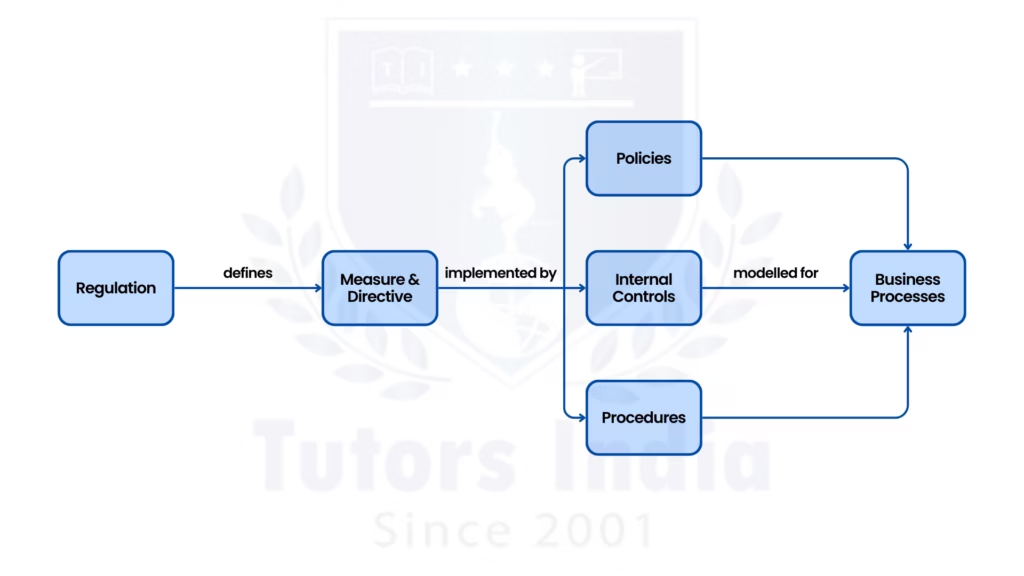
Description: A model can illustrate how child safety laws impact the changes made to operations, which then directly affect revenue streams and the level of trust among all stakeholders.
- Independent variable: Child safety laws as it relates to online use
- Dependent variable: Revenue and trust amongst stakeholders
- Moderating variable: Overall operational compliance cost, organisation’s brand image and overall user engagement levels.
4. Research Methodology
The method chosen for a United Kingdom master’s dissertation proposal must have a clear justification. Mixed-method research is most appropriate and aligns with standard social research technique approaches used in policy and business studies. [5]
| Quantitative Methods |
|
| Qualitative methods |
|
A well-structured assignment demonstrates clarity of thought and academic discipline.
5. Data Sources for the Study
Data Type | Source | Purpose |
Financial data | Company annual reports | Measure revenue impact |
Policy documents | UK government & Ofcom | Understand regulations |
User surveys | Primary research | Assess trust levels |
Media coverage | News databases | Evaluate public perception |
Corporate responses | Company statements | Analyse compliance strategies |
Using multiple data sources strengthens reliability and academic credibility.
6. Measuring Revenue Impact
This research focuses on evaluating how regulatory changes affect financial performance. Key indicators include advertising revenue changes, compliance costs, legal expenses, and user growth or decline. Important measures include quarterly revenue trends, advertising revenue share, compliance costs, and market share changes to assess overall business impact and the UK Child Online Safety Act impact on social media profitability.[6]
7. Measuring Stakeholder Trust
Stakeholder trust includes perceptions from users, advertisers, regulators, and investors.
Methods to Measure Trust
Description: Visual tools such as trust indicators and reputation models help illustrate how regulation influences public perception and corporate credibility.
8. Ethical Considerations in the Research
Students must follow ethical research practices when designing their proposals. Responsibilities include ensuring the confidentiality of survey respondents, obtaining informed consent, using financial data responsibly, and avoiding bias in interpretation. Ethical approval may be required before collecting primary data. [7]
9. Expected Contributions of the Study
High-quality dissertation research contributes to academic and practical knowledge by improving understanding of regulatory impacts on digital enterprises, evaluating the balance between security and profitability, providing valuable insights for policymakers and businesses, and strengthening academic discussions on digital governance.
Conclusion
A research proposal examining Online Child Protection laws within a UK-based master’s dissertation provides a structured way to measure both revenue and stakeholder trust impacts on social media companies. By clearly defining objectives, applying mixed social research technique approaches, and using reliable data sources, students can produce impactful academic research.
This research not only fulfils academic requirements but also contributes to understanding the relationship between digital regulation and corporate performance in the context of the Online Safety Act UK, while supporting future academic development through dissertation proposal writing services UK and professional research guidance where required.
How Can a UK Master’s Dissertation Research Proposal Measure the Impact of Child Online Safety Laws on Revenue and Stakeholder Trust in Social Media Firms? [Talk to a Dissertation Expert | Book a Free 15-Minute Consultation]
References
- Throuvala, M. A., Griffiths, M. D., Rennoldson, M., & Kuss, D. J. (2021). Perceived Challenges and Online Harms from Social Media Use on a Severity Continuum: A Qualitative Psychological Stakeholder Perspective. International journal of environmental research and public health, 18(6), 3227. https://doi.org/10.3390/ijerph18063227
- Thomas P. (2014). Understanding context in healthcare research and development. London journal of primary care, 6(5), 103–105. https://doi.org/10.1080/17571472.2014.11493427
- Monte, A. A., & Libby, A. M. (2018). Introduction to the Specific Aims Page of a Grant Proposal. Academic emergency medicine : official journal of the Society for Academic Emergency Medicine, 25(9), 1042–1047. https://doi.org/10.1111/acem.13419
- Bunn F, Trivedi D, Alderson P, et al. The impact of Cochrane Reviews: a mixed-methods evaluation of outputs from Cochrane Review Groups supported by the National Institute for Health Research. Southampton (UK): NIHR Journals Library; 2015 Apr. (Health Technology Assessment, No. 19.28.) Chapter 2, Conceptual framework and approach. Available from: https://www.ncbi.nlm.nih.gov/books/NBK285317/
- Garg R. (2016). Methodology for research I. Indian journal of anaesthesia, 60(9), 640–645. https://doi.org/10.4103/0019-5049.190619
- Beauvais, B., Dolezel, D., & Ramamonjiarivelo, Z. (2023). An Exploratory Analysis of the Association between Hospital Quality Measures and Financial Performance. Healthcare (Basel, Switzerland), 11(20), 2758. https://doi.org/10.3390/healthcare11202758
- Miller, S. R., Moore, F., & Eden, L. (2024). Ethics and international business research: Considerations and best practices. International Business Review (Oxford, England), 33(1), 102207. https://doi.org/10.1016/j.ibusrev.2023.102207