
How Can Students Overcome Research Methodology Challenges in a master’s Dissertation?
How Can Students Overcome Research Methodology Challenges in a master’s Dissertation?
- Home
- How To Article
- How Can Students Overcome Research Methodology Challenges in a master’s Dissertation?
Table of Content
- Common Research Methodology Challenges Faced by Students
- Developing a Clear Understanding of Research Design
- Strengthening Research Question Formulation
- Improving Knowledge of Data Collection Methods
- Managing Sampling and Data Collection Challenges
- Enhancing Data Analysis Skills
- Addressing Ethical Considerations
- Effective Time Management and Planning
- Conclusion

How Can Students Overcome Research Methodology Challenges in a master’s Dissertation?
Research Methods form a major part of a master’s Dissertation and are among the most difficult and essential sections of the dissertation, often presenting significant research methodology challenges for students. The above challenges can lead to confusion, poor quality of data, delayed submissions, and ultimately an unsuccessful dissertation if not addressed. However, students can successfully overcome thesis writing challenges by planning systematically, receiving appropriate guidance, and using the correct academic resources effectively.[1]
1. Common Research Methodology Challenges Faced by Students
There are many roadblocks that master’s degree students face while conducting research methods in dissertation work, such as: [2]
- Confusion regarding research methodology
- Problems brainstorming research questions/hypotheses
- Knowledge gaps related to qualitative & quantitative methodologies
- Difficulty collecting data and/or finding a proper sample
- Difficulty accessing software for analysing their data (for example: SPSS, R, NVivo)
- Ethical issues, including approval processes
- Lack of effective time management skills
Recognizing these barriers is the first step to addressing them!
2. Developing a Clear Understanding of Research Design
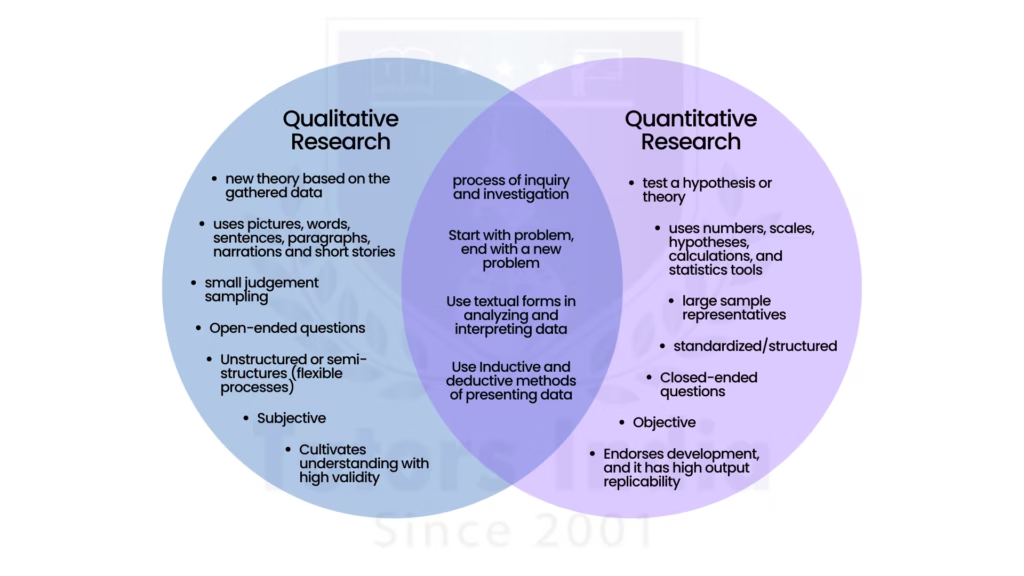
Before conducting research, students should be familiar with three basic classifications of design qualitative, quantitative, and mixed methods. Understanding research design for thesis work and selecting the most appropriate method requires reading textbooks, academic articles, and university guidelines.[3]
- Identifying what kind of research problem will be studied
- Determining what research methods are appropriate for your research questions
- Consulting with supervisors throughout the process to obtain continual feedback.
3. Strengthening Research Question Formulation
Your methodology should be based on strong research questions. A clear research question strengthens master’s dissertation research methods and supports effective study design.
- Complete a comprehensive literature review.
- Find the gaps in the existing research.
- Don’t create a general or vague research question.
4. Improving Knowledge of Data Collection Methods
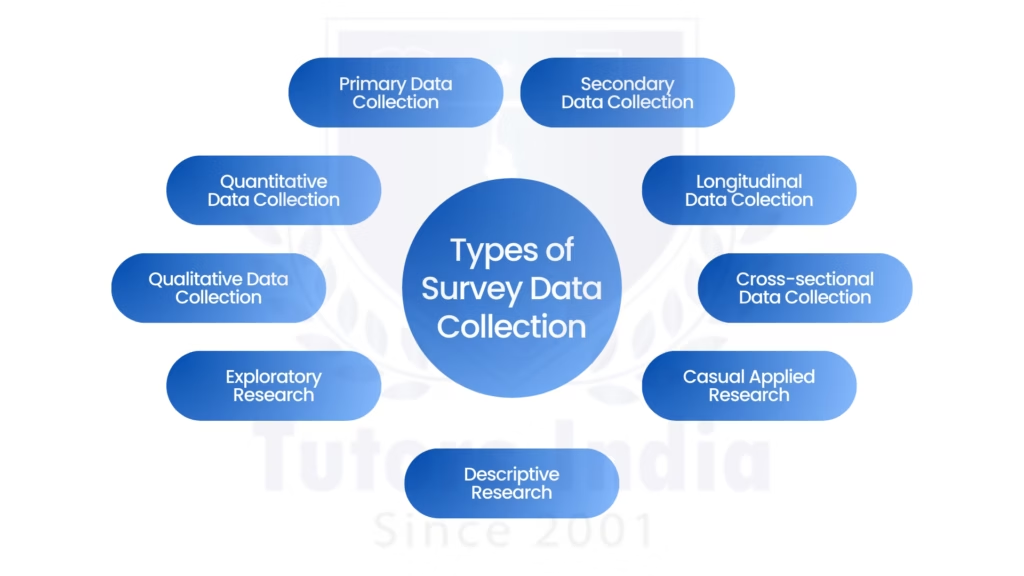
Students often struggle to choose appropriate data collection methods for dissertation research such as surveys, interviews, observations, or experiments. Understanding advantages and limitations is essential. [4]
Common data collection methods include:
- Quantitative: Questionnaires, experiments, structured surveys
- Qualitative: Interviews, focus groups, case studies
- Secondary data: Journals, databases, government reports
5. Managing Sampling and Data Collection Challenges
Choosing appropriate sampling techniques in research can be complex. Students should learn probability and non-probability sampling methods to avoid biased results.
Challenge | Solution |
Small sample size | Use appropriate justification and statistical tools |
Sampling bias | Apply random or stratified sampling |
Low response rate | Use follow-ups and clear communication |
Proper planning and pilot studies can significantly reduce data collection issues.
6. Enhancing Data Analysis Skills
Many students lack confidence in analysing data using data analysis tools SPSS R NVivo. Students can improve skills by: [5]
- Participating in a workshop or an online class (Training)
- Using statistical software applications and qualitative review software to practice their data analysis skills
- Asking an instructor/supervisor or another data analyst for assistance
Using computer software tools will improve the speed of the analysis and provide accurate results during the analysis process.
7. Addressing Ethical Considerations
Most Master’s degree programs require ethical approval. Students must ensure they obtain: [6]
- Participants’ informed consent
- Confidentiality and anonymity of the participants
- Appropriate Data Storage/Handling
Submitting ethics applications early prevents delays and supports postgraduate research methods compliance.
8. Effective Time Management and Planning
Poor scheduling can worsen thesis writing challenges. Effective time management for dissertation projects includes.
Useful approaches to consider are:
- Segmenting the dissertation into multiple smaller projects
- Establishing reasonable and attainable interim objectives
- Using productivity tools to assist with organization and coordination such as planners or electronic calendars.
Seeking Academic Support and Feedback
Regular interaction with supervisors and academic research support services helps improve research quality. Feedback allows students to refine methods and overcome research methodology challenges quickly.
Conclusion
There are many challenges associated with master’s dissertation research methods, but they are not impossible to resolve. By understanding research design for thesis, selecting appropriate data collection methods for dissertation, improving analytical skills with data analysis tools SPSS R NVivo, and following research ethics in dissertation standards, students can overcome thesis writing challenges successfully. With strong planning, effective time management for dissertation, and continuous academic research support, students can transform methodological difficulties into opportunities for strong and credible postgraduate research.
How Can Students Overcome Research Methodology Challenges in a master’s Dissertation? [Talk to a Dissertation Expert | Book a Free 15-Minute Consultation]
References
- Valentino, A. L., & Juanico, J. F. (2020). Overcoming Barriers to Applied Research: A Guide for Practitioners. Behavior analysis in practice, 13(4), 894–904. https://doi.org/10.1007/s40617-020-00479-y
- Daniel, B. (2022). Common Challenges Postgraduate Students and Early-Career Academics face when Engaging with the Scholarly Literature. Electronic Journal of Business Research Methods, 20(3), 142–152. https://doi.org/10.34190/ejbrm.20.3.2503
- Ranganathan P. (2019). Understanding Research Study Designs. Indian journal of critical care medicine : peer-reviewed, official publication of Indian Society of Critical Care Medicine, 23(Suppl 4), S305–S307. https://doi.org/10.5005/jp-journals-10071-23314
- Paradis, E., O’Brien, B., Nimmon, L., Bandiera, G., & Martimianakis, M. A. (2016). Design: Selection of Data Collection Methods. Journal of graduate medical education, 8(2), 263–264. https://doi.org/10.4300/JGME-D-16-00098.1
- Garibaldi, B. T., Hollon, M., Knopp, M. I., Winkel, A. F., Burk-Rafel, J., & Caretta-Weyer, H. A. (2025). How Data Analytics Can Be Leveraged to Enhance Graduate Clinical Skills Education. Journal of graduate medical education, 17(2 Suppl), 37–41. https://doi.org/10.4300/JGME-D-24-00776.1
- Guiding principles for ethical research. (n.d.). National Institutes of Health (NIH). Retrieved February 7, 2026, from https://www.nih.gov/health-information/nih-clinical-research-trials-you/guiding-principles-ethical-research