
How Can Students Overcome Data Analysis and Interpretation Challenges in a master’s Dissertation?
How Can Students Overcome Data Analysis and Interpretation Challenges in a master’s Dissertation?
- Home
- How To Article
- How Can Students Overcome Data Analysis and Interpretation Challenges in a master’s Dissertation?
Table of Content
- Common Challenges in Data Analysis and Interpretation
- Developing a Clear Research Framework
- Choosing the Right Data Analysis Method
- Gaining Software Proficiency
- Ensuring Data Quality and Preparation
- Linking Results to Research Questions
- Using Visual Aids for Better Understanding
- Comparing Findings with Existing Literature
- Role of Academic Support and Feedback
- Conclusion

How Can Students Overcome Data Analysis and Interpretation Challenges in a master’s Dissertation?
The analysis of data (through interpretation) represents one of the most difficult phases of a master’s Thesis. Data analysis and interpretation challenges in a master’s dissertation often arise due to the selection of inappropriate analytical techniques, the handling of complex or large datasets, the application of statistical software, and the interpretation of results. These issues can negatively affect the quality, credibility, and academic style of the research thesis.
Many students seek dissertation data analysis guidance or Dissertation Data Analysis Help in UK to address these concerns. However, with the proper level of planning, methodological understanding, and the effective use of available tools and Dissertation Data Analysis Service, these challenges can be overcome. This section describes common issues and provides practical approaches, supported by Data analysis for master’s dissertation example frameworks. [1]
1. Common Challenges in Data Analysis and Interpretation
Many students encounter difficulties during the data analysis stage, particularly those engaging in dissertation data analysis for the first time. Common challenges include:[2]
- Not having clear research goals
- Being unfamiliar with statistical and/or qualitative methods
- Having poor quality data and or missing data
- Difficulty using analytical packages for data analysis
- Interpreting the results incorrectly
- Relating results back to research questions and or literature
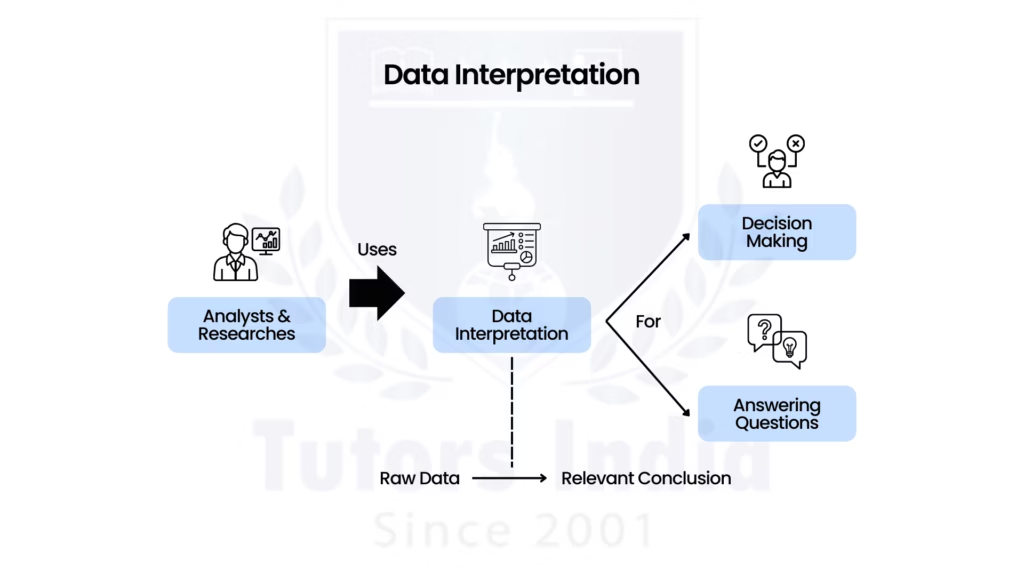
These challenges may arise due to limited prior exposure to research methods or insufficient training in analytical techniques.
2. Developing a Clear Research Framework
Before conducting any form of data analysis for UK master’s dissertation example studies, it is essential to establish a clear research framework: [3]
- Their research questions are both concrete and quantifiable.
- Their definition of variables is precise.
- The formation of their hypothesis is related to their study’s objectives.
A clear framework will aid you in choosing the most appropriate methods to conduct analysis, thereby reducing the amount of needless analysis performed on data sets.
3. Choosing the Right Data Analysis Method
Selecting suitable analytical techniques is essential for valid findings, particularly in dissertation data analysis for UK master’s programmes. [4]
Data Type | Recommended Analysis Methods | Tools |
Quantitative | Descriptive statistics, regression, ANOVA | SPSS, R, Excel |
Qualitative | Thematic analysis, content analysis | NVivo, Atlas.ti |
Mixed-methods | Triangulation, comparative analysis | SPSS + NVivo |
Understanding whether the study is quantitative, qualitative, or mixed-methods is critical for valid results.
4. Gaining Software Proficiency
Numerous students encounter difficulties when utilizing various applications for statistical analysis, such as SPSS, R, Python, or NVivo; however, there are several strategies that will assist in resolving these issues:
- Take advantage of university-based workshops;
- Utilize freely accessible online resources such as online tutorials or MOOC courses;
- Acquire experience working with example datasets;
- Consult user manuals and or guides.
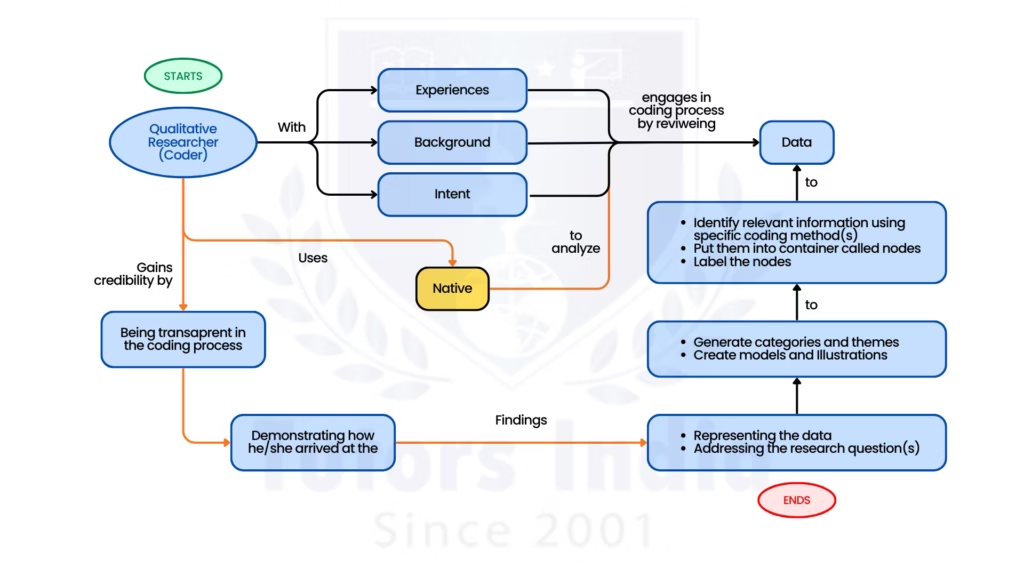
Improved software proficiency increases confidence and reduces errors during analysis.
5. Ensuring Data Quality and Preparation
Accurate Analyses Come from Quality Data. Some of the actions students should take to ensure high-quality data for their analyses include: [5]
- Checking for Missing or Inconsistent Values
- Removing Duplicate Responses
- Conducting Data Cleaning and Validation
- Ensuring Ethical Treatment of Data
These steps are emphasized in Types of analysis for dissertation master’s guidance and professional Dissertation Data Analysis Service standards.
6. Linking Results to Research Questions
Interpreting findings in a meaningful way can be challenging. The criteria for interpreting findings include the following:
- Results should be related directly back to the research questions.
- Avoid over-generalization of the results.
- The statistical significance of results should be assessed along with their practical significance.
Therefore, each result should address the question, “How does this pertain to my research problem?
7. Using Visual Aids for Better Understanding
Graphs, charts and tables are used to clarify data and aid in understanding data.
- Bar charts are used to compare multiple items.
- Line graphs show trends over time.
- Tables are used for detailed numeric data.
Visual aids are commonly used in Data analysis for UK master’s dissertation example reports to improve examiner understanding.
8. Comparing Findings with Existing Literature
When findings are analysed against previous research, the interpretation of the research becomes more solid. The following will assist students in this:
- Comparing and contrasting similarities and differences
- Providing explanations for any findings that were unexpected
- Providing a clear outline or explanation of the importance of the research findings
This approach reflects academic maturity and aligns with expectations demonstrated in Data analysis for master’s dissertation example materials.
9. Role of Academic Support and Feedback
Analytical challenges can be solved with external assistance.
- Have frequent check-ins or meetings with supervisors
- Utilize peer consultation in discussion and study group formation
- Consult a statistician or other subject matter expert on methodology.
Feedback on work and results will allow for any error/variation to be pinpointed sooner and thus improve the quality of analysis. [6]
Conclusion
Although data analysis and interpretation challenges in a master’s dissertation are common, they can be effectively managed through a clear research framework, appropriate analytical methods, improved software proficiency, high data quality, and critical interpretation. Visual aids and literature comparison further enhance clarity. By adopting a systematic approach and, where necessary, using Dissertation Data Analysis Service support, students can produce reliable, rigorous, and meaningful research outcomes aligned with UK academic standards.
How Can Students Overcome Data Analysis and Interpretation Challenges in a master’s Dissertation? [Get Ethical Dissertation Support] or [Schedule a Free Consultation]
References
- Abdullah, C., Parris, J., Lie, R., Guzdar, A., & Tour, E. (2015). Critical Analysis of Primary Literature in a Master’s-Level Class: Effects on Self-Efficacy and Science-Process Skills. CBE life sciences education, 14(3), ar34. https://doi.org/10.1187/cbe.14-10-0180
- Syzon, I. (2025, September 10). Challenges of data analytics: Solving common analytics problems in business. Dot Analytics: Growth-Focused Data Analytics Agency; Dot Analytics. https://dotanalytics.ai/blog/challenges-of-data-analytics-solving-common-analytics-problems-in-business/
- George A. Z. (2024). Research Frameworks: Critical Components for Reporting Qualitative Health Care Research. Journal of patient-centered research and reviews, 11(1), 4–7. https://doi.org/10.17294/2330-0698.2068
- Simpson S. H. (2015). Creating a Data Analysis Plan: What to Consider When Choosing Statistics for a Study. The Canadian journal of hospital pharmacy, 68(4), 311–317. https://doi.org/10.4212/cjhp.v68i4.1471
- National Academies of Sciences, Engineering, and Medicine; Division on Earth and Life Studies; Board on Earth Sciences and Resources; Committee to Review the U.S. Geological Survey’s Laboratories. Assuring Data Quality at U.S. Geological Survey Laboratories. Washington (DC): National Academies Press (US); 2019 Oct 21. 2, Improving Data Quality and Integrity. Available from: https://www.ncbi.nlm.nih.gov/books/NBK552840/
- Chen, C., Bian, F., & Zhu, Y. (2023). The relationship between social support and academic engagement among university students: the chain mediating effects of life satisfaction and academic motivation. BMC public health, 23(1), 2368. https://doi.org/10.1186/s12889-023-17301-3