
What Do UK Supervisors Expect in a master’s Research Proposal?
What Do UK Supervisors Expect in a master’s Research Proposal?
- Home
- How To Article
- What Do UK Supervisors Expect in a master’s Research Proposal?
Table of Content
- Purpose of a UK Master’s Research Proposal
- Clear and Focused Research Topic
- Well-Formulated Research Questions
- Critical Engagement with Existing Literature
- Justified and Appropriate Methodology
- Feasibility and Project Management
- Awareness of Ethical Considerations
- Academic Writing and Presentation Quality
- Originality and Potential Contribution

What Do UK Supervisors Expect in a master’s Research Proposal?
The purpose of a master’s research proposal in the UK is to be much more than just a preliminary idea document; it is a structured, academic document that conveys the student’s readiness for independent, rigorous research. UK supervisors will use the proposal to assess whether the student’s proposed topic is feasible (i.e., is there enough time to complete), academically relevant (i.e., does it fit within established areas of scholarship), and methodologically sound (i.e., does it fit within the parameters of an appropriate methodology). They also will want to assess the student’s critical thinking abilities and ability to engage appropriately with present scholarship, as well as clearly articulate a research pathway that can be accomplished, like expectations shown in a strong research proposal example.
An effective proposal should give the supervisor confidence that the project is realistic, original enough that it will be worth the effort, and grounded in the appropriate theory and methodology. While there are many possible variations between the different universities and disciplines, the vast majority of UK supervisors expect that there be several core components to any research project proposal submitted to them for consideration; namely, clarity of focus, evidence of preliminary reading, a justified methodology, and a general awareness of the practical and ethical implications of engaging in the proposed research study. [1]
1. Clear and Focused Research Topic
The first item a supervisor will look for in your proposal is your topic, and how well-defined it is. If your topic is too vague, or too ambitious, they may think that you will have difficulty completing the study in the time allotted. [2]
They are looking for:
- A concise working title
- A clearly defined research problem
- Defined aims and objectives
- A topic that is consistent with their expertise and your degree subject.
A good proposal demonstrates that the student is aware of the issue or question(s) that their research is addressing and why that research is of significance to the academic community, as would typically be outlined in a clear research proposal template.
2. Well-Formulated Research Questions
UK academic supervisors appreciate that precise, researchable questions are the basis on which an entire research project is built. The research question will normally arise logically from a problem statement and determines the method and methodology used to carry out the project. [3]
Good research questions use criteria such as being: (1) Specific and unambiguous, (2) Feasible within the time and resources available for the project, and (3) Connected to existing debates in the academic literature. Poorly defined research questions almost always lead to unfocused dissertations, so academic supervisors check that it is possible to answer the research question requested using the proposed methods.
3. Evidence of Critical Engagement with Literature
Your research proposals should not necessarily elaborate a full literature review; however, you should provide an indication of the literature you have read in relation to critical academic sources and indicate that you understand the current state of the knowledge pertaining to your research question.
Your supervisor will be looking for the following:
- A discussion of major theories and/or concepts that relate to your area of study
- A discussion of existing literature; gaps in research or limitations of existing
- A preliminary discussion of how your quality of research fits into these gaps
This demonstrates that you are not repeating previous work but contributing new or refined insights, which is often highlighted in good research proposal examples.
4. Justified and Appropriate Methodology
The methodological expectation for supervisors includes how they would like to understand the methodology as well as the reasons supporting its appropriateness for answering their research questions. [4]
The most important elements to be included are:
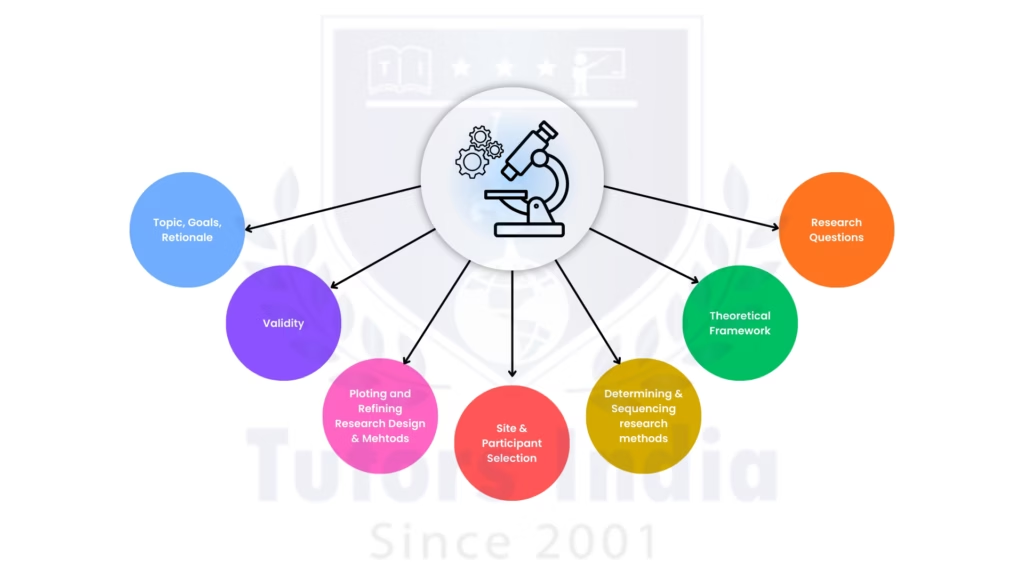
5. Feasibility and Project Management
Due to time restrictions in master’s programmes, supervisors will evaluate each proposed master’s degree project on the feasibility of completion. To evaluate a master’s degree project, supervisors will use realistic expectations for:
- Acquiring data or recruiting participants
- Acquiring necessary resources or tools
- Completing the proposed research.
A practical schedule, often presented as a Gantt chart for research proposal planning, helps demonstrate realistic project management
Example Research Timeline
Stage | Activities |
Initial reading | Literature search and topic refinement |
Proposal refinement | Finalising questions and methods |
Data collection | Conducting interviews/surveys/archival work |
Data analysis | Coding, statistical or thematic analysis |
Writing draft chapters | Methods, findings, discussion |
Revision and submission | Editing, proofreading, formatting |
A vague or unrealistic schedule can signal poor planning and reduce supervisor confidence.
6. Awareness of Ethical Considerations
Research ethics are very important to UK universities. You will be expected by your supervisor to understand possible ethical issues when you are submitting your proposal. 5 The following are some of the most common considerations: [5]
- Participants’ informed consent
- Confidentiality and data protection
- Referring necessary protections from harm or discomfort
Acknowledging the need for formal ethics approval shows preparation and professionalism in any research project proposal.
7. Academic Writing and Presentation Quality
Your written proposal is evidence of your academic communication skills as a student. Supervisors want you to produce clear, formal and well-structured writing.
The main features expected include:
- Logical paragraphing and coherent flow of arguments
- An accurate and consistent referencing style, often Harvard
- Correct grammar and academic tone
Poor writing may lead supervisors to question readiness for dissertation work, even when the master’s research proposal idea is strong.
8. Originality and Potential Contribution
Although master’s level dissertations are not typically regarded as being particularly innovative, supervisors will generally still expect some element of originality to be included within the dissertation.
Examples of originality might include:
- Applying existing theory within a different context
- Utilizing a previously uncollected/analysed dataset or case study
- Providing a new interpretation to established materials.
A new knowledge in this area may be provided by discussing how the research will produce new insights about the topic.
Area | What Supervisors Look For |
Topic and focus | Clear, relevant, manageable research problem |
Research questions | Specific, feasible, method-driven questions |
Literature engagement | Evidence of reading and identified research gap |
Methodology | Well-justified, appropriate, clearly explained methods |
Feasibility | Realistic scope, timeline, and access to data |
Ethics | Awareness of consent, confidentiality, and approvals |
Writing quality | Clear structure, formal style, correct referencing |
Originality | Modest but meaningful academic contribution |
Conclusion
Supervisors in the UK will be looking for a master’s research proposal to act as an effective plan for a feasible dissertation. It should include intellectual clarity, adequate preliminary background research, and an appropriate plan of action which is well justified. A strong proposal indicates that a student can identify a specific problem, formulate a research question that can be answered through research, identify the appropriate research methods to use, and complete the dissertation within the time and ethical constraints of their degree program.
By meeting these supervisor expectations, students will not only improve the likelihood of their proposal being accepted, but they will also create a solid foundation for writing an examiner-ready dissertation.
Confused about ethical approval, consent, or GDPR for your UK dissertation? Tutors India’s academic experts are here to guide you. [Get Ethical Dissertation Support] or [Schedule a Free Consultation]
References
- Crossley, R. M., & Maini, P. K. (2025). Ten simple rules for early-career researchers supervising short-term student projects. PLoS computational biology, 21(11), e1013690. https://doi.org/10.1371/journal.pcbi.1013690
- Kram, J. J. F., Sullivan Vedder, L., Fay, B., & Simpson, D. (2023). A Clear, Succinct Research Question Portends the Rest of the Story. Journal of patient-centered research and reviews, 10(4), 198–200. https://doi.org/10.17294/2330-0698.2066
- Parthasarathy, S., Samantaray, A., & Jain, D. (2023). A well-formulated research question: The foundation stone of good research. Indian journal of anaesthesia, 67(4), 326–327. https://doi.org/10.4103/ija.ija_226_23
- Kiani, A. K., Naureen, Z., Pheby, D., Henehan, G., Brown, R., Sieving, P., Sykora, P., Marks, R., Falsini, B., Capodicasa, N., Miertus, S., Lorusso, L., Dondossola, D., Tartaglia, G. M., Ergoren, M. C., Dundar, M., Michelini, S., Malacarne, D., Bonetti, G., Donato, K., … INTERNATIONAL BIOETHICS STUDY GROUP (2022). Methodology for clinical research. Journal of preventive medicine and hygiene, 63(2 Suppl 3), E267–E278. https://doi.org/10.15167/2421-4248/jpmh2022.63.2S3.2769
- Miteu G. D. (2024). Ethics in scientific research: a lens into its importance, history, and future. Annals of medicine and surgery (2012), 86(5), 2395–2398. https://doi.org/10.1097/MS9.0000000000001959